“If grants rise, share; if they fall, make up the shortfall”... Education superintendents propose a “mutually beneficial compromise”
- Input
- 2026-11-04 09:20:00
- Updated
- 2026-11-04 09:20:00
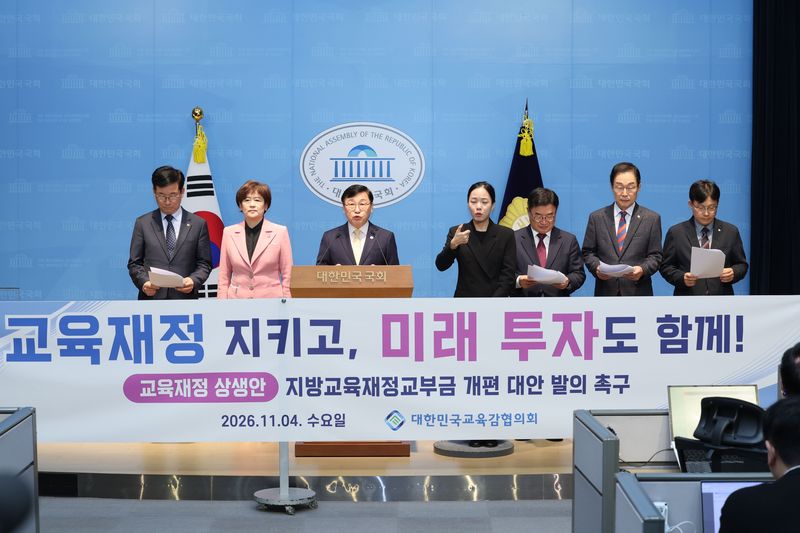
[Financial News] Provincial and metropolitan superintendents of education nationwide have formally proposed to the government and the National Assembly a “win-win fiscal plan” that maintains the framework linking Local Education Subsidy Grants (grants) to domestic tax revenue while sharing some of the increase in tax revenue as funding for the country’s future. In response to the government’s push to end the link between grants and domestic tax revenue in order to secure funding for future national investment, the education community has put forward a compromise to curb tax-revenue fluctuations on its own and take on the challenge head-on.
The Korean Council of Superintendents of Education held a news conference at the National Assembly Communication Center on the 4th and announced an alternative that would maintain the current system, under which 20.79% of domestic tax revenue is automatically allocated to education offices, while sharing sharp increases and decreases in grant revenue with the state.
The plan’s key feature is a “5% fluctuation from the previous year” as its benchmark. If grants rise by more than 5% from the previous year, two-thirds of the increase beyond that threshold would be set aside for a national fund for future needs. Conversely, if grants fall by more than 5%, the state would make up one-third of the decrease beyond that threshold.
Geun-sik Chung, chair of the Korean Council of Superintendents of Education and Seoul superintendent, said, “The idea behind the plan is to share when grants rise significantly and take responsibility together when they fall sharply,” and stressed, “Since teaching children in schools is also an investment in the country’s future, I hope the government and the National Assembly will give the plan active consideration.”
According to the council’s analysis, if the system is adopted, education grants in 2027 would amount to about 89.6 trillion won, meeting the minimum required funding of 88.4 trillion won for provincial and metropolitan education offices. The council also says that about 44.5 trillion won in future-response resources for the country as a whole could be raised over the four years from 2027 through 2030.
The superintendents’ compromise comes against the backdrop of serious fiscal difficulties looming as soon as next year. Even as student numbers decline, essential education needs—including support for basic academic skills, special education and childcare—and school maintenance costs will not fall. As a result, the 16 provincial and metropolitan education offices nationwide project a total funding shortfall of 7.3657 trillion won during preparation of their 2027 main budgets.
The council also criticized the government’s plan to maintain the link between domestic tax revenue and the Local Grant Tax distributed to general local governments while ending that link only for education grants, saying it was inequitable. It called for the law to clearly stipulate that the 11.7 trillion won in grant adjustments projected to result from this year’s tax-revenue increase must not be excluded from the reform process.
The council also voiced concern over efforts to designate and pass the grants reform plan as legislation accompanying the budget bill without sufficient discussion. It said the proposal must first undergo a formal review by the National Assembly’s Board of Education and consultation with people in the education field, since it would change the foundations of education finance.
[email protected] Kim Man-gi Reporter