“Why does Alzheimer’s disease spread throughout the brain?” ... Protein FAM84B holds a clue
- Input
- 2026-11-04 12:00:00
- Updated
- 2026-11-04 12:00:00
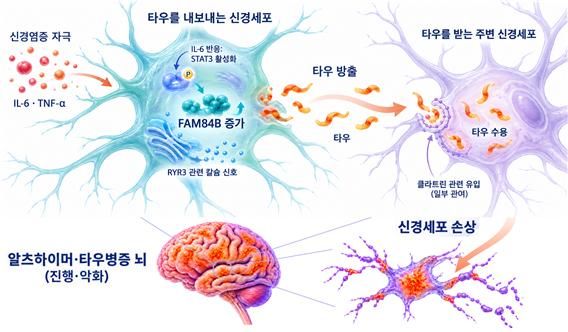
[Financial News] The process of dementia worsening resembles a fire spreading. Abnormal tau proteins that build up in one brain cell move to neighboring cells, expanding the damage. Researchers in South Korea have identified a protein that promotes this “spread.”
The Korea National Institute of Health of the Korea Disease Control and Prevention Agency said it had identified the role of FAM84B, a protein that promotes the movement of tau proteins associated with dementia, including Alzheimer’s disease, into surrounding brain cells. The findings were published online on the 2nd of last month in the international journal Journal of Neuroinflammation, which focuses on neuroinflammation.
Tau is a protein that binds to microtubules, which maintain the structure of nerve cells. If it is abnormally modified and accumulates, it can damage nerve cells in Alzheimer’s disease and other conditions. The spread of tau to surrounding cells is linked to disease progression, but what promotes this movement has not been fully clarified.
FAM84B levels higher in the brains of Alzheimer’s patients
The researchers analyzed postmortem brain tissue from patients and nerve cells made from patients’ stem cells. They found that FAM84B levels were higher than in people without dementia in brain tissue from patients with some tau-related diseases, including Alzheimer’s disease, and in nerve cells derived from patients with Alzheimer’s disease.
The researchers then used cell experiments to examine the effect of FAM84B on tau movement. When they increased the amount of FAM84B, more tau was released from cells, and the number of neighboring cells that received it also increased. This indicates that FAM84B promotes the movement of tau between cells.
This study identified FAM84B’s role in tau movement associated with neuroinflammation and could provide a foundation for understanding dementia progression and researching new treatments. However, further research, including animal studies, is needed to determine how FAM84B affects actual disease progression and whether it can be used in treatment.
Increasing FAM84B boosts tau release and spread
The study’s lead researcher, Cho Cheol-man, a researcher at the Korea National Institute of Health, said, “This is the first study to show that FAM84B plays an important role in the process by which neuroinflammation affects tau transmission,” adding, “Follow-up research is needed to assess how this pathway affects the progression of actual disease and its potential as a therapeutic target.”
Kim Won-ho, director of the Division of Chronic Disease Convergence Research, said, “To overcome dementia, it is important to understand the biological mechanisms involved in the onset and progression of disease,” adding, “We will link human-derived resources with stem cell-based research to uncover the mechanisms of neurodegenerative diseases and build scientific evidence to support follow-up research.”
[email protected] Jung Myung-jin, Medical Correspondent Reporter