‘Innovation City Season 2’ race to attract public institutions heats up ... South Chungcheong Province (Chungnam): “Excluded from the first relocation; compensation must be provided”
- Input
- 2026-11-04 09:01:47
- Updated
- 2026-11-04 09:01:47
On the 3rd, Chungnam held a “Policy Briefing for Local National Assembly Members” at the Kensington Hotel in Yeouido, Seoul, sharing efforts to secure the government budget and major local issues, while calling for active interest and support from the National Assembly.
Last September, the government announced its plans for reforming the functions of public institutions and the second round of relocations to other regions, setting out key principles including minimizing the number of institutions remaining in the Seoul metropolitan area and clustering them mainly in existing innovation cities. With the government set to finalize its relocation plan in the fourth quarter of this year and begin moving lead institutions next year, Chungnam believes this is a golden opportunity to determine the future standing and prospects of Chungnam Innovation City.
Chungnam was disadvantaged in the past when it was excluded from the first relocation of public institutions on the grounds that Sejong City was being built. It was belatedly designated an innovation city in 2020, but not a single public institution has relocated there to date.
Taking these special circumstances into account, Chungnam is continuing to urge the government to adopt a two-track strategy: “tailored relocation,” directly linking Chungnam’s specialized industries with the functions of public institutions while ensuring fairness with existing innovation cities, and “compensatory relocation” to make up for the disadvantage it faced in the first round.
The government has also decided to increase support for employees of institutions being relocated in this second round. In addition to existing relocation allowances and moving expenses, it will introduce a long-distance relocation allowance of up to KRW 200,000 per month for two years, depending on the distance. It also plans to pay an early relocation allowance of up to KRW 500,000 per month for two years, depending on when institutions move. Institutional placements will be decided after comprehensive consideration of the “5 Poles 3 Special Growth Engine,” the functional groups of existing innovation cities, local infrastructure conditions and other factors. Unlike the first relocation, which took at least seven years from the announcement of the plan to the actual moves, the government plans to speed up the process by using leased private-sector buildings, among other measures.
Based on Chungnam’s industrial structure and future growth drivers, the tailored relocation strategy will focus on four functional groups: climate, energy and environment; economy and industry; defense; and culture, sports and tourism.
The highest-priority area is “climate, energy and environment.” Chungnam is home to the country’s largest concentration of coal-fired power plants and a dense cluster of carbon-intensive industries, including steel and petrochemicals, making it the region where a national transition in energy and industrial structures is most urgent. The plan is to attract organizations such as the Korea Environment Corporation (K-eco), the Korea Environmental Industry & Technology Institute, and the Korea Institute of Energy Technology Evaluation and Planning, and develop Chungnam into a hub for demonstrating and disseminating national carbon-neutrality policies.
In the economy and industry sector, the plan is to boost industrial competitiveness by combining policy finance and research and development (R&D) functions with Chungnam’s advanced manufacturing industries, including semiconductors, displays and future mobility. The defense sector will focus on attracting policy, research and demonstration institutions linked to the defense infrastructure in Nonsan and Gyeryong, while the culture, sports and tourism sector will focus on clustering functions that can make use of the historical and sports infrastructure of the Naepo cultural region.
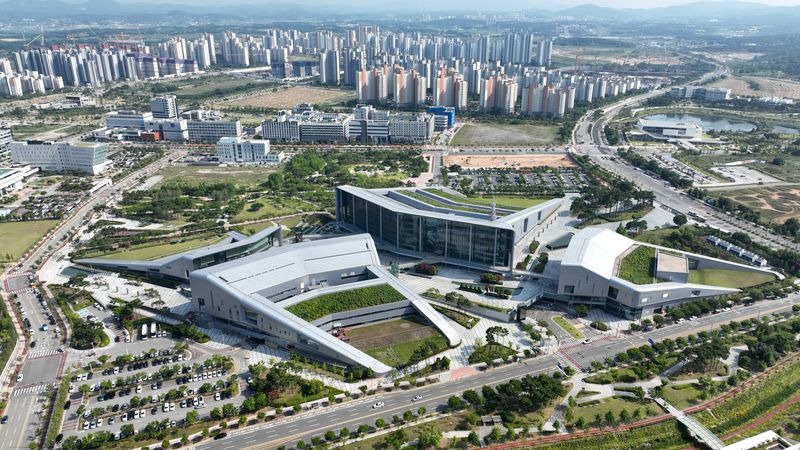
Chungnam is moving quickly to expand infrastructure so institutions can relocate as soon as decisions are made, rather than merely making the case for their relocation. The population of Chungnam Innovation City is expected to surpass 50,000 in November, and the city is growing into a young, self-sufficient community, with people in their 40s or younger accounting for 73% of its population.
The innovation city currently has about 230,000 square meters of land available for public institutions to relocate to and about 61,000 square meters of office space ready for immediate occupancy. The plan is to support lead institutions in relocating early using leased offices and then building their own facilities in stages. Chungnam is also improving living conditions through projects including the Naepo Campus of Chungnam National University (CNU), Naepo Children’s Hospital, Chungnam Museum of Art, Chungnam Sports Center and the Multi-purpose Innovation Center. It is continuing to expand regional transport networks to improve access to the Seoul metropolitan area, including the Seobu Inland Expressway and connections to the Seohae Line and Gyeongbu High-Speed Line.
An official from Chungnam Province said, “Although Chungnam was excluded from the first relocation, it has ample industries and infrastructure that can be linked to the functions of public institutions,” and, “The second relocation should not be a simple allocation of institutions; they should be placed in areas where the functions needed nationally can operate most effectively.” The official added, “To complete the functional groups envisioned for Chungnam Innovation City, it is essential that the Korea Environmental Industry & Technology Institute and the Korea Institute for Defense Analyses, both expected to be among the lead institutions relocated, move to Chungnam.”
[email protected] Kim Won-jun Reporter