“Pay into the National Pension (NPS) for a full 10 years and get 340,000 won a month” ... ‘Disheartening’ that it’s less than the Basic Pension
- Input
- 2026-11-04 19:00:00
- Updated
- 2026-11-04 19:00:00
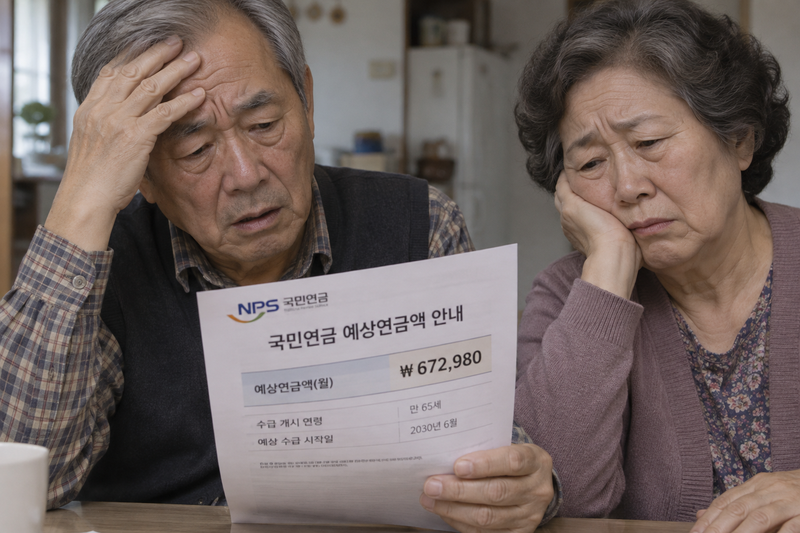
[Financial News]“If I pay in faithfully for 10 years and then die, where does that money go?”The amount an average-income earner who faithfully paid National Pension contributions for 10 years will receive in retirement has turned out to be lower than the Basic Pension, which is funded by taxes.
Benefit inversion between the National Pension and the Basic Pension
The so-called “benefit inversion” occurs when National Pension benefits, for which people have paid contributions themselves, are lower than the Basic Pension, which the state funds with tax revenue and pays out free of charge. This prompted calls for urgent improvements to ensure greater consistency between the two systems.
According to a research report titled “A Multi-Tiered Old-Age Income Security System by National Pension Coverage Period: Focusing on Public Pension Schemes,” published on the 4th by Kim Hyeong-su, an associate research fellow at the National Pension Research Institute, applying a 43% income replacement rate would give an average-income earner who meets the 10-year (120-month) enrollment requirement a National Pension of 343,302 won per month. This is 10.75% of this year’s average monthly income of all subscribers (the A-value), which stands at 3,193,511 won.
By contrast, the Basic Pension’s standard monthly amount, currently 349,700 won in 2026, is about 10.95% of the National Pension A-value for 2026, which is 3,193,511 won. In other words, the pension received after faithfully paying contributions for 10 years is actually lower than the standard amount of the Basic Pension, which is paid with tax revenue.
The report noted that this inversion, in which pension benefits for upper-tier groups fall below the guaranteed benefits for lower-tier groups, could undermine trust in the public pension system as a whole and weaken public acceptance of policy.
It stressed that, to increase acceptance of and confidence in the system, consideration should be given to raising the National Pension’s minimum enrollment period or adjusting the Basic Pension amount to reflect current realities.
An estimate of the long-term cumulative distribution of National Pension enrollment periods using a binomial model, a statistical probability method, found that just 0.6% had been enrolled for less than 10 years by the end of age 59, when mandatory enrollment ends. This means 99.4% of subscribers pay contributions for at least 10 years and have already secured eligibility for the old-age pension. Therefore, even if the current 10-year requirement remains unchanged, as the system matures, the share of people excluded from pension benefits because of insufficient enrollment is expected to fall substantially, to below 1% in the long term.
The report found little practical benefit in the proposal, raised by some, to shorten the minimum enrollment period to five years.
The cumulative share of people enrolled for less than five years is 0.3%, only 0.3 percentage points (p) lower than the 0.6% share enrolled for less than 10 years. The report explained that even if the requirement were lowered, very few additional people would qualify, while an enrollment period that is too short would result in an extremely low pension amount and weaken its actual effect in providing retirement income security. Conversely, even if the requirement were raised to 15 years, the share falling short would be only 1.6%. Given that subscribers to occupational pensions account for around 5%, the report projected that the impact on expanding gaps in coverage would not be substantial.
Criticism that the Basic Pension’s coverage of the “bottom 70% by income” is too broad
The report also found that the current coverage of the Basic Pension is excessive. It is paid to the 70% of people aged 65 or older with the lowest incomes. The National Pension enrollment period corresponding to the cutoff for this 70% was found to exceed 25 years. In other words, even people who have paid into the National Pension for 25 years or more and have relatively stable income and assets are included among those eligible for the Basic Pension. The report assessed this coverage as excessively broad in light of the program’s original purpose of helping older people facing financial hardship in retirement.
The report added that, to allocate limited resources efficiently and uphold the system’s purpose, the Basic Pension’s coverage should be narrowed over the long term—or, if narrowing it is impractical, the system should be reformed to differentiate actual benefit amounts according to whether a person receives the National Pension.
[email protected] Ahn Ga-eul Reporter