Preventing Unauthorized AI Training, Verifying Content Provenance... Copyright Technology Solutions Discussed
- Input
- 2026-11-04 08:00:00
- Updated
- 2026-11-04 08:00:00
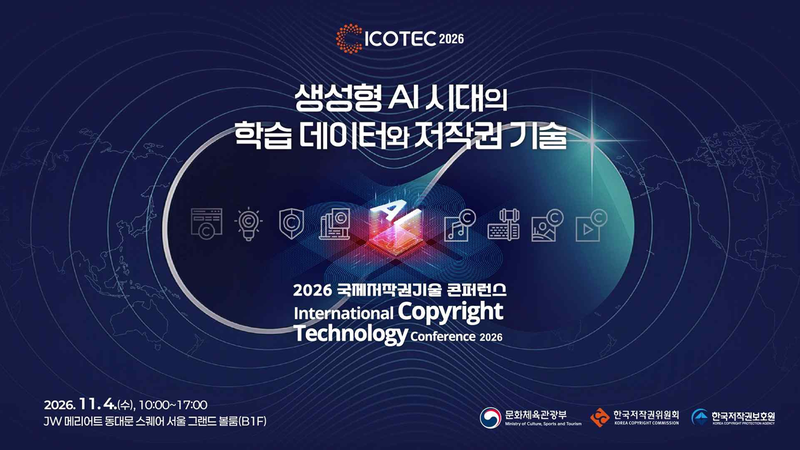
On the 4th, the Ministry of Culture, Sports and Tourism announced that, together with the Korea Copyright Commission (KCC) and the Korea Copyright Protection Agency (KCOPA), it would hold the 2026 International Copyright Technology Conference from 10 a.m. to 5 p.m. that day in the Grand Ballroom at JW Marriott Dongdaemun Square in Seoul. The event will also be livestreamed on the KCC’s YouTube channel.
Launched in 2011, the event is being held for the 16th time this year. Its theme is “Training Data and Copyright Technology in the Generative AI Era.” Hanyang University professor Sang-Wook Yi will deliver a keynote address on creativity and copyright, while Garrett Levin, chief intellectual property law and policy officer at the World Intellectual Property Organization (WIPO), will give a recorded presentation on the foundations of copyright in the AI era and directions for international technology cooperation.
The first session, “Transparency in Generative AI,” will feature Korea University (KU) professor Kim Seong-ung and Korea Electronics Technology Institute (KETI) principal researcher Kim Young-min, who will respectively introduce watermarking and copyright technology for datasets used by multimodal generative AI models. Adobe senior director Andy Parsons will give a recorded presentation on the C2PA standard for verifying content provenance and history, and on industry applications of “Content Credentials,” which is based on the standard.
Content Credentials are provenance information that can include details such as the creator of digital content, when it was created, and the tools and processes used to edit it. They are designed to use digital signatures to verify whether the content or attached information has been changed after signing.
SK Telecom manager Jang Hak-seong will introduce an “AI Bill of Materials (AI-BOM),” which records the data, models and software used in AI development, along with their change histories.
The second session, “Protecting Rights in Training Data and Copyright Technology,” will address the sources and contributions associated with training data, licensing frameworks, and the issue of attribution for training data used by AI music-generation models. Sangmyung University professor Kang Sang-wook will present technology for resolving copyright disputes using machine unlearning and knowledge distillation, while Daegu Gyeongbuk Institute of Science and Technology (DGIST) professor Kim Young-sik will present ways to block unauthorized training using adversarial noise and watermarking.
LG Electronics principal researcher Kim So-im will introduce “Osori,” a public-private collaboration project for sharing open-source license information.
Awards will also be presented to people who have contributed to copyright protection and technological development. Hanyang University professor Jeong Hae-jun and Software Policy & Research Institute (SPRi) principal researcher Kwon Young-hwan will receive the Minister of Culture, Sports and Tourism Award.
[email protected] Jang In-seo Reporter