October consumer prices rise 2.8% as petroleum products and processed food prices climb
- Input
- 2026-11-03 18:29:29
- Updated
- 2026-11-03 18:29:29
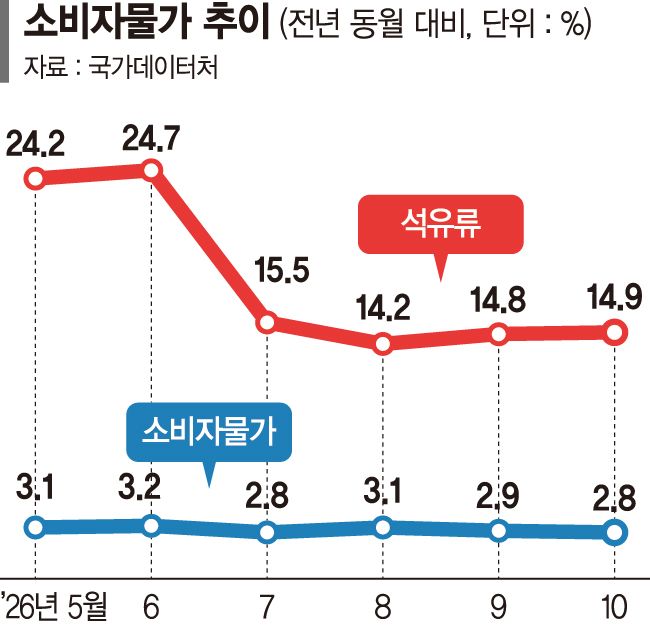
According to the October Consumer Price Trends report released by the Ministry of Data and Statistics on the 3rd, the consumer price index stood at 120.73 (2020=100) last month, up 2.8% from the same month a year earlier.
Consumer price inflation was in the low 2% range early this year, but climbed into the 3% range in May and June as petroleum product prices rose in the wake of the war in the Middle East. It eased to 2.8% in July, but then stood at 3.1% in August, 2.9% in September and 2.8% in October, remaining around 3% for six months.
The main items driving up prices last month were petroleum products and processed foods. Petroleum product prices rose 14.9% from the same month a year earlier. Major fuel types all posted steep increases, including gasoline, up 11.6%; diesel, up 19.7%; and automotive liquefied petroleum gas (LPG), up 14.5%.
The government believes the price cap system introduced to stabilize petroleum product prices has curbed inflation. Government estimates indicate that without the measure, consumer price inflation in October would have reached 3.6%. The government says the price cap lowered the inflation rate by 0.8 percentage points. Processed food prices also rose 2.9% from the same month last year, adding to the increase. This was the highest rate in 11 months, since November last year, when it was 3.3%. Processed foods contributed 0.25 percentage points to overall inflation. The increase is believed to reflect recent hikes in ex-factory prices as well as the end of discounts offered during the Chuseok holiday period. Among personal services, dining-out prices also rose 2.9%, their steepest increase since February this year. They contributed 0.42 percentage points to overall inflation. By contrast, prices for agricultural, livestock and fishery products fell 1.7% year on year, partly easing the overall rise in prices. The decline was largely driven by a 7.5% drop in agricultural products. Livestock and fishery products rose 4.8% and 5.4%, respectively. Among individual items, mackerel (9.3%), largehead hairtail (11.9%) and ginseng (32.5%) rose, while apples (-13.4%), lettuce (-44.3%), cucumbers (-39.5%) and Napa cabbage (-11.8%) fell.
Ahead of the kimchi-making season and winter, the government plans to strengthen supply and demand management and discount support for major agricultural, livestock and fishery products. It will allocate about 64 billion won for its largest-ever kimchi-making season support package and offer discounts of up to 40% on key ingredients through its discount program for agricultural and livestock products. Seafood will be discounted by up to 50% through the kimchi-season special promotion under the 20-billion-won Korea Seafood Grand Sale.
[email protected] Kim Chan-mi, Seo Yeong-jun Reporter