‘Choose between the U.S. and China’: AI war puts Southeast Asia’s balancing diplomacy to the test
- Input
- 2026-11-03 18:18:54
- Updated
- 2026-11-03 18:18:54
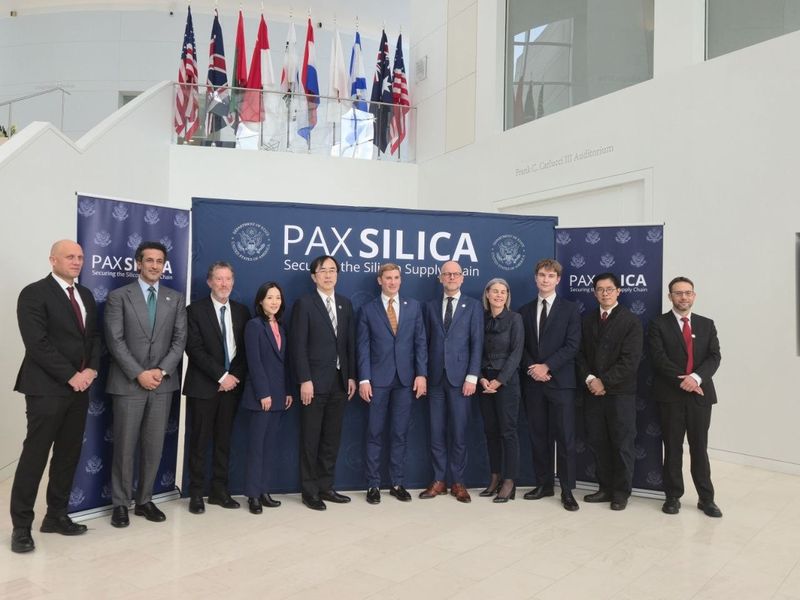
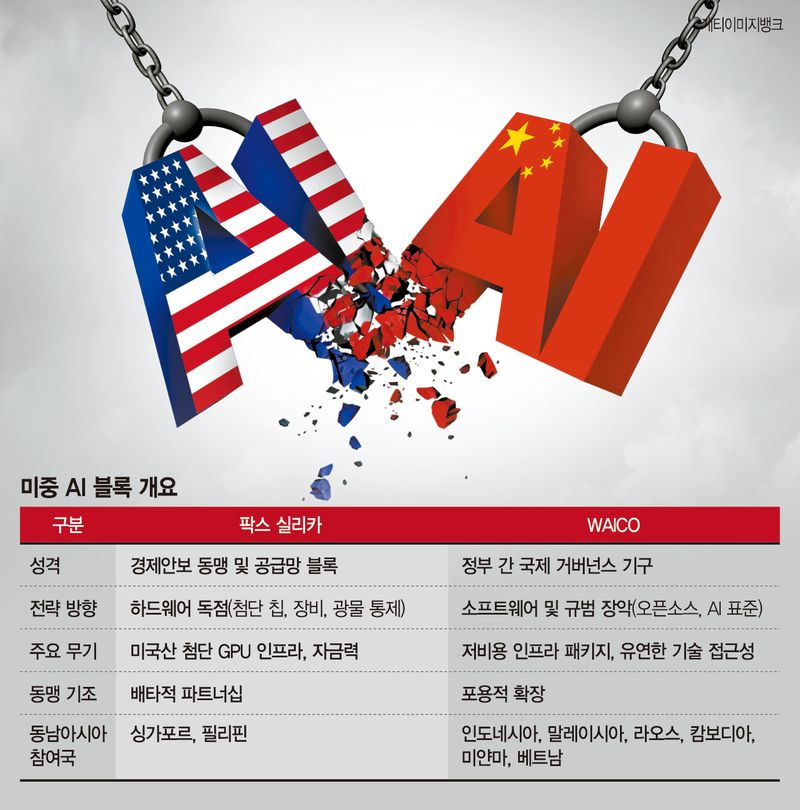
The U.S.-led AI security partnership Pax Silica and the China-backed World Artificial Intelligence Cooperation Organization (WAICO) are clashing in Southeast Asia. As data centers, semiconductor supply chains and open-source AI ecosystems become directly linked to national security, rather than serving merely as commercial tools, it appears Southeast Asian countries’ ‘strategic ambiguity’ is no longer acceptable in the AI arena either.
On the 3rd, foreign media outlets, including Nikkei Asia, said Pax Silica and WAICO were pushing Southeast Asia toward deep division.
AI policy in the Association of Southeast Asian Nations (ASEAN) is already split in two. Singapore and the Philippines have joined the Pax Silica camp, aligning with the U.S. strategy of controlling supply chains centered on high-performance graphics processing units (GPUs). Malaysia, Indonesia and Vietnam, meanwhile, are opting for a pragmatic approach through China-led WAICO, embracing low-cost infrastructure and open-source AI.
The problem is that the U.S. is stepping up pressure on countries participating in its supply chains to prevent them from joining a China-led system at the same time. Singapore, which joined the U.S. Pax Silica alliance, was reportedly weighing an invitation to China’s WAICO when it received an ultimatum-like warning from the U.S. government: “You can’t have it both ways.”
As AI supply chains split and countries are asked to make mutually exclusive choices, global companies operating in Southeast Asia are bound to face a double whammy. With major South Korean companies, including Samsung Electronics, now on the cusp of moving ahead in earnest with plans to build semiconductor production systems in the region, concerns are mounting over what is being called the ‘sandwich risk’ stemming from U.S.-China tech tensions.
■ ‘Pax Silica’ for chip controls vs. ‘WAICO’ for dominance over norms
Pax Silica, led by the U.S. State Department, focuses squarely on forming blocs around ‘physical hardware supply chains’ for semiconductors and critical minerals. Named after silicon, a key raw material for semiconductors, the initiative aims to bring together advanced manufacturing powers such as South Korea, Japan and Taiwan to control exports of semiconductor equipment to China and build exclusive AI infrastructure centered on the U.S. Drawing on its vast financial resources, it has even launched the Pax Silica Fund to bring allies on board, while maintaining an exclusionary policy that bars countries from joining both camps.
China’s WAICO, headquartered in Shanghai and launched in response, aims to establish dominance over software and AI governance norms in the Global South. Its strategy is to flexibly introduce low-cost infrastructure packages and open-source AI models into developing economies’ ecosystems to circumvent U.S. controls on advanced semiconductors. The plan is to gain influence over global governance of AI algorithms and standard-setting, securing a long-term technology lock-in centered on China.
Regional leaders in Southeast Asia are strongly pushing back against the great powers’ binary demands. At the GZERO Summit Asia conference held in Singapore on September 10 last year, Indonesian special envoy Mari Pangestu took aim at the U.S.’s exclusionary supply-chain strategy, saying, “Recently, Pax Silica declared, ‘If you join our system, you cannot join the other camp (China’s WAICO).’” She directly criticized the position, adding, “But we must never be pushed into such an either-or situation.”
Chan Heng Chee, Singapore’s Ambassador-at-Large (an ambassador without a fixed posting), who shared the stage with her, also acknowledged that “most of the real pressure is coming from the U.S.” She lamented that while many emerging economies have wanted a ‘third space’ since the war in Ukraine—one that does not leave them fully beholden to either the U.S. or China—the pressure being applied in the AI field is immense.
■ Will Samsung and SK hynix’s ‘China factory ordeal’ be repeated in Southeast Asia?
This all-out U.S.-China effort to divide countries into opposing camps is even shaking the foundations of ASEAN community integration. The ASEAN Digital Economy Framework Agreement (DEFA), which the bloc’s 10 member states had planned to sign after establishing shared digital norms, is at risk of effectively losing momentum as countries in the region fragment into U.S. and Chinese tech ecosystems. A split between technology camps would hinder the free movement of data within the region and joint investment.
Global big tech companies and semiconductor parts suppliers operating in Southeast Asia also face the risk of astronomical costs as they may be forced to split production lines to avoid losing customers in either camp. An executive at a Japanese company producing semiconductor parts in Southeast Asia told Nikkei Asia, “If AI supply chains are completely split like this and we are required to make mutually exclusive choices, it’s hard to see how we could shoulder the enormous cost of duplicating infrastructure,” describing the company’s predicament.
The U.S.-China divide is also expected to hurt Korean semiconductor companies building supply chains in Southeast Asia. In addition to Samsung Electronics, which is currently building a back-end processing hub in Vietnam’s Thai Nguyen Province, companies operating production bases in Southeast Asia include Hana Micron in Vietnam, SFA Semicon in the Philippines and Haesung DS in Malaysia.
Industry observers say the situation brings to mind the past ‘China factory ordeal.’ The risks posed by U.S. restrictions on bringing advanced semiconductor equipment into the Chinese production facilities of Samsung Electronics and SK hynix, along with export controls, now appear poised to be repeated in Southeast Asia.
There are currently no direct moves toward reciprocal restrictions, but companies operating in the region are watching closely. A semiconductor industry executive said, “It’s troubling that U.S.-China tech tensions are splitting the local ecosystem in Southeast Asia in two,” adding, “To meet the supply-chain demands of both the U.S. and China, we may have to rethink our calculations with even the worst-case scenario in mind: completely duplicating local production facilities and supplier lines.”
[email protected] Reporter