Hanwha Group’s defense future: Reels in warship contracts in the U.S. and launches a submarine at home
- Input
- 2026-11-03 18:13:01
- Updated
- 2026-11-03 18:13:01
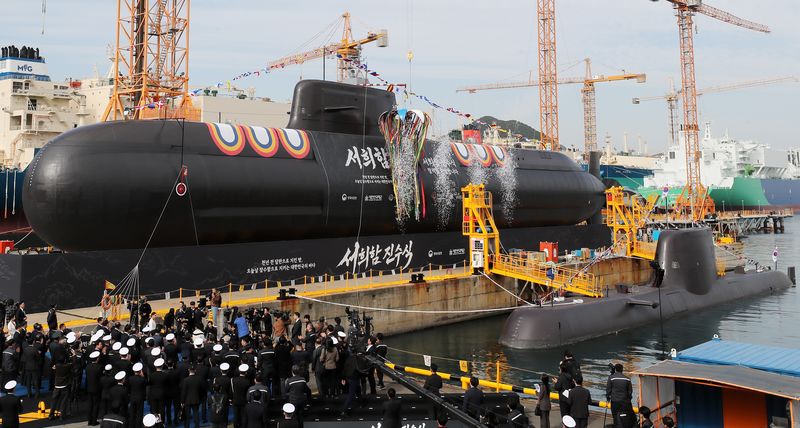
Hanwha Group is ramping up its U.S. Navy warship and submarine businesses as a future growth driver. It is bolstering its warship business by replacing the head of Hanwha Philly Shipyard, which secured its first shipbuilding contract in the United States, while at home it is raising its competitiveness in naval technology by launching the 3,600-ton submarine Seo Hui, built using its own technology. The strategy pursues both a push into the U.S. market and the development of independent technological capabilities.
Industry sources said on the 3rd that Hanwha Philly Shipyard announced on the 2nd local time that it had appointed Kim Hyeok as president, succeeding David Kim. The new president has built up 25 years of experience in shipbuilding and defense, dating back to when Hanwha Ocean was Daewoo Shipbuilding & Marine Engineering and when Hanwha Aerospace was Hanwha Defense. He has worked across shipbuilding projects involving special-purpose vessels, merchant ships, warships and floating liquefied natural gas (FLNG) production facilities, and led the development of unmanned surface vessels at Hanwha Systems Co., Ltd. In short, he is a shipbuilding and defense expert whose experience spans merchant ships, warships and unmanned surface vessels.
The surprise appointment of President Kim, who has extensive experience building warships, is seen as a move to lay the groundwork for ramping up the United States Navy shipbuilding business.
Hanwha Group has also recently secured its first contract in the United States Navy shipbuilding business. On the 29th of last month local time, Hanwha Defense USA, Inc. signed a contract with TOTE Services, the USN’s vessel construction manager (VCM), to build one medium landing ship (LSM). The contract is worth $269 million (about 357.5 billion won). The USN plans to acquire a total of 35 medium landing ships, and the contract also includes an option to build three additional vessels.
Hanwha has also entered the next-generation logistics support ship business. In March, Hanwha Philly Shipyard and Hanwha Defense USA, Inc., together with U.S. ship design firm Vard Marine US, took part in the conceptual design of the USN’s Next Generation Logistics Ship (NGLS). Analysts say that being able to directly assess productivity, construction methods and costs from the conceptual design stage could give the companies an advantage in the full-scale bidding process. According to Congressional Research Service data, procurement costs for a light fleet oiler in the same class reach $453 million per vessel (about 630 billion won).
Alongside its push into the U.S. market, Hanwha is also advancing its submarine-building capabilities at home. On the same day, Hanwha Ocean held a launch ceremony at Okpo Shipyard for Seo Hui (SS-088), the second boat in the Jangbogo-III Batch-II program. The ceremony came five years after the construction contract was signed in 2021.
Seo Hui’s key competitive strength is improved operational performance based on domestic technology. The use of a domestically produced lithium battery system has extended its submerged endurance and the time it can travel at maximum speed compared with previous submarines. The performance of its combat system, which integrates sonar and various types of detection data to support weapons operations, has also been improved. Technologies to reduce noise and vibration have enhanced stealth, a key competitive strength for submarines.
The level of localization has also increased further. Compared with the Dosan Ahn Changho class, Hanwha Ocean has localized 12 additional types of equipment, including the lithium battery system. Seo Hui carries a total of 70 types of domestically localized equipment. Submarines are a prime example of high-value-added warships, with demand for maintenance, repair and overhaul (MRO) and capability upgrades continuing for decades after construction. The higher the share of locally produced equipment, the more a successful overseas contract can expand the revenue base—not only through the initial construction contract but also through long-term parts supply and maintenance work.
[email protected] Kim Yun-ho, Jung Won-il Reporter