Jeju Expands AI-Powered Administration... Forum to Discuss Checks on Gender Bias and Service Gaps
- Input
- 2026-11-03 18:19:35
- Updated
- 2026-11-03 18:19:35
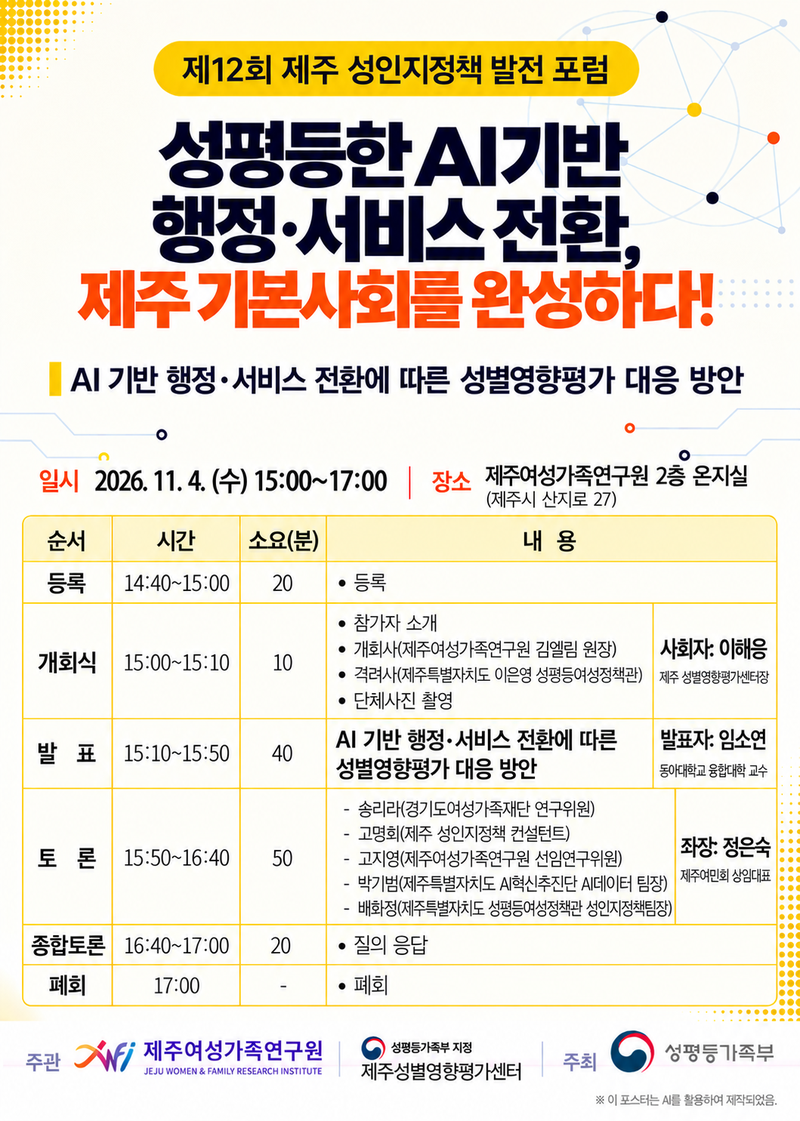
【Financial News | Jeju = Jeong Yong-bok】 A proposal to apply gender impact assessments to the AI-powered administrative services Jeju Province is developing will be discussed. A key focus is checking in advance for gender bias in data and disparities in service use during the transition of administrative services to AI.
According to the Jeju Women's and Family Research Institute on the 3rd, the 12th Jeju Gender-Sensitive Policy Development Forum, hosted by the Ministry of Gender Equality and Family and organized by the institute and the Jeju Gender Impact Assessment Center, will be held at 3 p.m. on the 4th in Onji Room on the second floor of the Jeju Women's and Family Research Institute on Sanji-ro, Jeju City.
Held under the theme “Completing Jeju's Basic Society through a Gender-Equal Transition to AI-Based Administration and Services!”, the forum was organized to incorporate a gender equality perspective into Jeju Province's AI administrative innovation policies.
Jeju Province is pursuing the transition of administrative services to AI—including AI administrative assistants, assistants for residents and data-driven policymaking—as key policy tasks of its ninth popularly elected administration. The need has been raised to ensure that the drive to improve administrative efficiency and convenience does not create differences by gender in access to information or use of services.
Gender impact assessment is a system through which the government and local governments analyze the effects on women and men when formulating or implementing laws, plans and projects, and incorporate the findings into policy improvements. In AI administration, potential areas for review include bias in training data and algorithms, service accessibility, and differences in who benefits from policies.
Policy improvements through gender impact assessments are also being pursued nationwide. According to the Ministry of Gender Equality and Family, central and local governments assessed 25,721 laws, projects and other items last year. They pursued improvements for 7,291 of these and implemented 4,401.
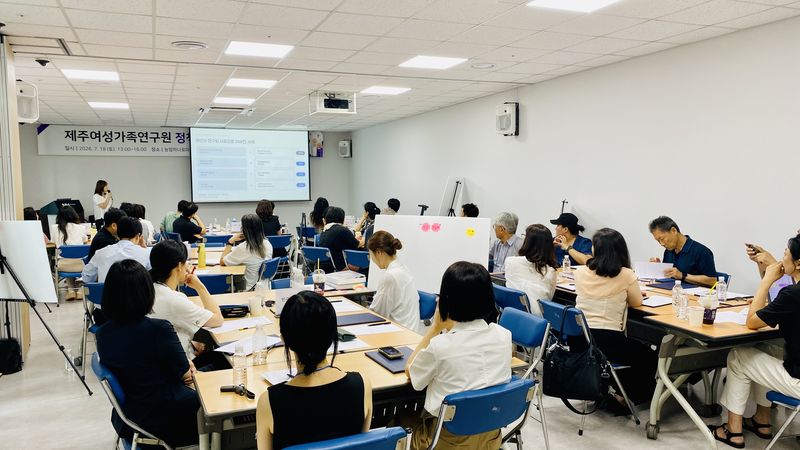
A study analyzing policy needs felt by residents in Jeju from a gender equality perspective has also been published. Policy Brief No. 106, released by the Jeju Women's and Family Research Institute on October 30 and titled “Policy Tasks Proposed by the Jeju Women's and Family Research Institute Residents' Participation Group in 2026 and Implications from a Gender Equality Perspective,” outlines differences in policy needs linked to living conditions in Jeju City and Seogwipo City.
The institute held separate roundtables in Jeju City and Seogwipo City in July. The participation group comprised 61 people: 40 from Jeju City and 21 from Seogwipo City. They discussed policy tasks in five areas: gender equality and safety; the economy and jobs; care and childbirth; population and community; and housing and welfare.
In Jeju City, responding to digital crimes and integrating fragmented administrative services were identified as key tasks. Examples include an AI chatbot-based, 24-hour counseling and reporting system for victims of deepfakes and illegal filming, links to victim support organizations, and a service explaining the progress of reports.
Participants also proposed AI-based welfare check-ins and emotional support services to prevent social isolation among people living alone. They also called for education linked to welfare facilities to help older people use digital technology without difficulty.
In Seogwipo City, the burden of getting around and access to care services in town and township areas stood out more prominently. Key proposals included subsidies for commuting costs and links to commuting options, securing staff for emergency care, and providing integrated medical and welfare services.
The institute found that, alongside expanding new programs, the delivery system for existing, fragmented services should be improved so residents can easily find and use them. It also said policy design should account for differences in access to services depending on region, household type and caregiving burden.
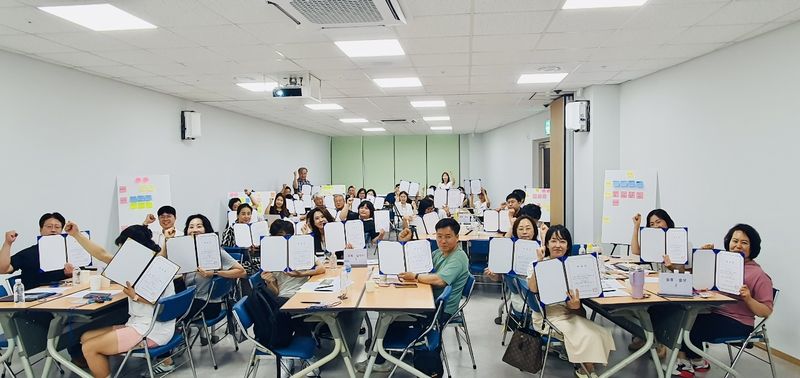
This policy brief is a separate research report compiling proposals from the residents' roundtables held in July. At the forum on the 4th, participants are expected to discuss how gender impact assessments can be applied during the transition to AI of these administrative services closely tied to daily life.
The keynote presentation will be delivered by Professor Lim So-yeon of Dong-A University’s College of Interdisciplinary Studies. Under the title “Responses to Gender Impact Assessments Amid the Transition to AI-Based Administration and Services,” she will outline assessment tasks for different types of AI use and strategies for pursuing policy.
Jeong Eun-suk, head of the Jeju Women's Association, will moderate the discussion. Participants will include Song Ri-ra, a research fellow at the Gyeonggi-do Women's and Family Foundation; Go Myeong-hui, a consultant at the Jeju Gender Impact Assessment Center; Ko Ji-young, a senior research fellow at the Jeju Women's and Family Research Institute; Park Gi-beom, head of the AI Data Team at Jeju Province's AI Innovation Promotion Group; and Bae Hwa-jeong, head of the Gender-Sensitive Policy Team at Jeju Province's Gender Equality and Women's Policy Office.
Kim El-lim, head of the Jeju Women's and Family Research Institute, said, “We will work with relevant agencies and expand policy development so that a gender equality perspective can be reflected in Jeju Province's AI policies.”
The forum will discuss how to connect the AI-powered administrative services Jeju Province is pursuing with gender impact assessments. A key challenge is how to account for not only data bias but also digital skills, caregiving burdens and differences in access across regions at the policy design stage.
[email protected] Jeong Yong-bok Reporter