Democrats could block judicial confirmations if they take both chambers; Trump faces an “early lame duck” [U.S. midterms: “Day of Destiny”]
- Input
- 2026-11-03 18:11:13
- Updated
- 2026-11-03 18:11:13

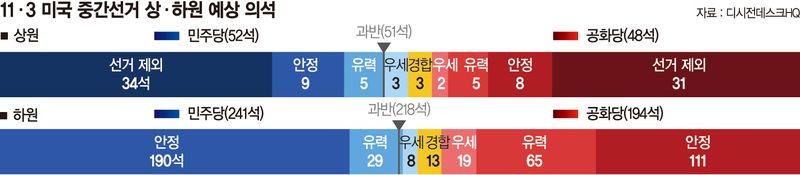
■ 63% chance Democrats sweep both chambers
According to a simulation model by U.S. election forecasting firm Decision Desk HQ, as of the 2nd, there was a 63% chance that Democrats would win majorities in both the Senate and the House. Even if Democrats held only a roughly two-seat advantage in the Senate, they could control its committees and block Trump’s judicial confirmations. In particular, if a Supreme Court vacancy arises, Democrats are likely to delay filling it until after the 2028 presidential election.
If Democrats were to gain a 4-to-6-seat advantage in the Senate, they could pass a raft of bills on tariffs, data centers, health care and the cost of living to prompt Trump to use his veto, then use that in the 2028 presidential election. If both chambers block his legislative authority over domestic affairs, Trump is expected to focus on foreign policy and security, as well as enforcing existing executive orders—areas that require relatively less congressional approval.
If Democrats secure 60 Senate seats, they could end the Republican filibuster, giving them the power to determine whether the budget for Trump’s second-term administration passes. In addition, Democrats would need 290 seats in the House and 67 in the Senate to override a presidential veto. To impeach and convict, they would need 218 votes in the House and 67 in the Senate, respectively.
■ 21% chance Republicans hold the Senate while Democrats take the House
According to Decision Desk HQ, there was an estimated 21% chance that Republicans would keep their Senate majority while Democrats won a majority in the House. If Democrats retake the House by a margin of 5 to 20 seats, they could control its committees and launch full-scale congressional investigations targeting Trump’s second-term administration, using their extensive subpoena powers. However, the investigations are expected to have limited effectiveness, as the U.S. Department of Justice may not cooperate in enforcing subpoenas. In an interview on the 20th of last month, U.S. Treasury Secretary Scott Bessent was asked whether a Democratic-led House could block the policies of Trump’s second-term administration. “I think it would have very little ability to do so,” he replied. He added, “We have very robust tariff authority.”
If Republicans hold the Senate, they would be tasked with defending Trump’s second-term administration against the Democratic-led House’s various hearings and investigative efforts. In addition, appointments in Trump’s second-term administration are expected to proceed without difficulty while Republicans hold an advantage in the Senate, since confirmation of senior officials and Supreme Court justices requires a majority vote there. However, foreign media outlets assessed that if Democrats’ House advantage grew to 21 to 30 seats, it would become easier to win over Republican defectors. They also predicted that calls for Trump’s impeachment would grow louder, particularly among Democratic freshmen.
■ 15% chance Republicans hold both chambers
The chance that Republicans will maintain their current advantage in both chambers is around 15%. In that scenario, Trump and Republicans would hold legislative power and could push through their preferred policies, including making permanent the tax cuts pursued during his first administration, increasing defense and border-control spending, and appointing judges. But Democrats would still have the threat of a temporary government shutdown as a bargaining chip. The Trump administration is currently relying on a continuing resolution because Congress has not passed the federal budget for fiscal year 2027. In a vote last September, the two parties agreed to extend the temporary funding measure through December 11, but what happens after that remains uncertain. If Democrats refuse to pass the Trump administration’s budget over the issue of raising the federal debt limit, the government shutdown that occurred last October could happen again.
Vishal Khanduja, head of fixed income at U.S.-based Morgan Stanley Investment Management, told the Financial Times (FT) on the 1st that a Republican hold on both chambers “could be the biggest negative for bond markets.” He predicted that the market’s reaction could be greater because this scenario “is not priced into the market at all.”
[email protected] Park Jong-won Reporter