Yoon’s side in closing arguments: “Martial law was an appeal warning of national ruin ... ‘self-coup’ is fiction”
- Input
- 2026-11-03 19:35:40
- Updated
- 2026-11-03 19:35:40
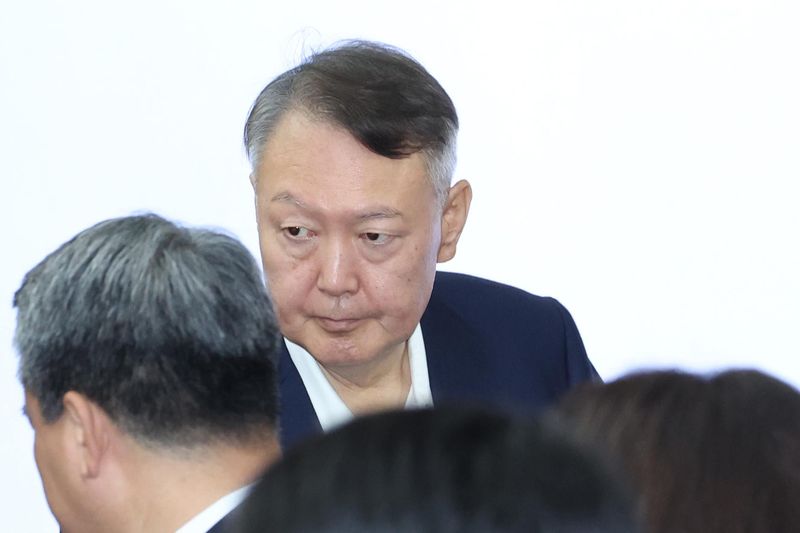
[Financial News] On charges including being the ringleader of an insurrection in connection with the December 3 declaration of martial law, former President Yoon Suk Yeol’s side argued for his acquittal in closing arguments on appeal, saying, “Martial law was a desperate appeal by the head of state to directly alert the public to a crisis threatening the nation’s existence, and the special counsel’s claim of a self-coup is fiction.”
A three-judge panel of Criminal Division 12-1 of the Seoul High Court (Judges Lee Seung-cheol, Jo Jin-gu and Kim Mina) held an appellate hearing for former President Yoon and others on the 3rd and heard final statements from Yoon’s legal team.
That day, Yoon’s legal team pointed out that the charges presented by the special counsel directly contradicted objective evidence, including records of calls made on secure phones and closed-circuit television (CCTV) footage. During the proceedings, Yoon’s side had presented CCTV footage from areas near the National Assembly and inside the National Election Commission during martial law, emphasizing that no violent incidents had occurred.
The legal team stressed, “As a fundamental principle of criminal trials, the burden of proving guilt rests with the prosecution, and an acquittal must be returned unless overwhelming evidence is presented to rebut the defendant’s account,” adding, “Guilt cannot be established solely on circumstantial evidence by relying on the contradictory statements of people involved who tried to shift responsibility during the investigation.”
The team also rebutted the claim of “a long-term conspiracy to impose martial law.” It particularly emphasized that the notebook entries presented as key evidence, attributed to Roh Sang-won, former head of the Defense Intelligence Command, were nothing more than imagined scribbles written after the fact by someone who did not even know Yoon personally.
Regarding meals with military commanders, the team said, “They were ordinary dinners to encourage the military or social gatherings, not coup-planning meetings involving exchanges of security pledges or pledges of loyalty,” adding, “Court testimony reaffirmed that there was no specific discussion of martial law among those present.”
Yoon’s side also strongly criticized the special counsel’s grounds for appeal concerning the “drone operation.” It said, “The drone operation was a non-kinetic self-defense operation planned and carried out at the Ministry of National Defense ministerial level to defend the country’s territory in response to North Korea’s repeated provocations with trash-filled balloons,” and rejected the special counsel’s claim that a security crisis had been fomented to create a pretext for martial law, calling it “nothing more than a fictional scenario with no basis in reality.”
The legal team also maintained its longstanding argument that the essence of the martial law declaration was to inform the public of the paralysis of state functions caused by the major opposition party’s successive impeachments and unilateral budget cuts, as well as the abolition of the National Intelligence Service’s counterintelligence investigative authority. Its point was that the fact the declaration was made publicly through a sudden live address to the nation—even though the military could have been secretly deployed in advance to take control of the National Assembly—was itself evidence that the aim was to sound the alarm.
Regarding activity inside the presidential office, the legal team presented CCTV records and said, “It has been confirmed that before the declaration, former President Yoon looked around the large reception room near his office and instructed that ministers be summoned with a Cabinet meeting in mind.” The team stressed that he had never sought to evade procedural requirements.
[email protected] Lee Chang-hoon Reporter