Lesson teaches students to verify AI-generated information... Grand Prize at national pre-service teacher hackathon
- Input
- 2026-11-03 17:47:27
- Updated
- 2026-11-03 17:47:27
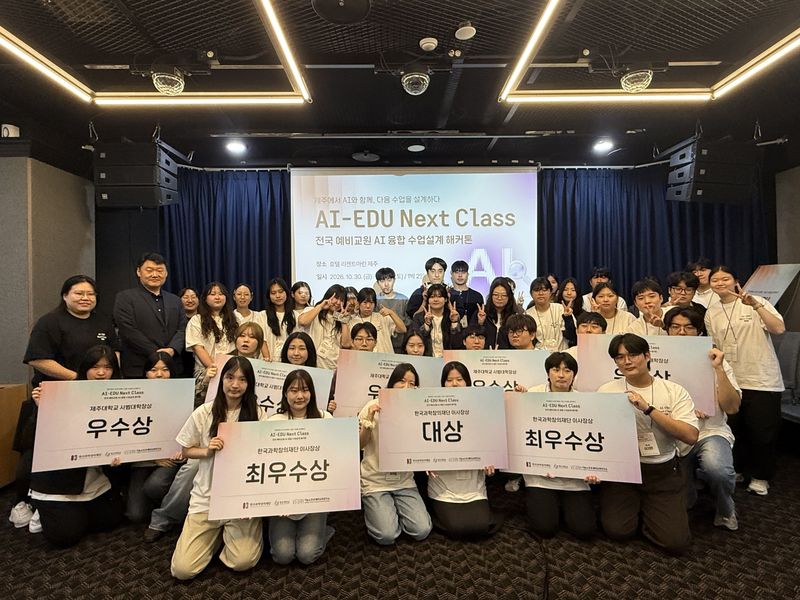
【Financial News Jeju = Reporter Jeong Yong-bok】 A lesson designed to have students independently verify and critically revise information generated by artificial intelligence (AI) won the Grand Prize at a national pre-service teacher hackathon. Forty pre-service teachers from 13 universities nationwide took part in the finals of the competition hosted by Jeju National University.
Jeju National University said on the 3rd that it held the national pre-service teacher AI-integrated lesson design hackathon “AI-EDU Next Class” at the RegentMarine Hotel in Jeju City on Oct. 30–31. The competition was organized as part of the Korea Foundation for the Advancement of Science and Creativity’s “2026 Support Program for Curriculum Development at Teacher Training Institutions.”
The Grand Prize went to the team “Hangyodong,” made up of Kim Seo-hui and Lee Ji-yun, students in Sungkyunkwan University’s Department of Classical Chinese Education. Using the high school Integrated Social Studies curriculum as a basis, they designed a lesson in which students examine the accuracy of AI-generated information and correct inaccuracies themselves.
The team received high marks for having students assess the evidence and validity of information instead of accepting AI responses at face value. The lesson incorporated not only generative AI skills but also critical thinking and information verification skills.
For the preliminary round, 68 students in 34 teams applied. They were enrolled at colleges of education nationwide or in teacher-certification programs at general universities. After a written review of their lesson plans, 40 participants in 20 teams advanced to the finals.
Participants developed lesson plans on topics including addressing overdependence on AI, constraints in digital learning environments, reducing gaps among students in AI use and learning, and developing AI-integrated lessons linked to school subjects. The preliminary round required a one-session lesson plan, while finalists developed it into a lesson of four or more sessions.
The judging panel consisted of five people: two practicing teachers, two university professors, and one industry representative. Entries were evaluated without disclosing the universities to which the teams belonged.
The Top Excellence Awards went to “Prologue,” a team comprising Seong Ye-bin, a student in Seoul National University’s Department of Korean Language Education, and Lee Hae-in, a student in Dongguk University’s Department of Korean Language Education; and “Maesseukeom,” a team comprising Yang Min-ju and Lee Gi-min, students in Jeju National University’s Department of Mathematics Education.
The five Excellence Awards went to “Dongmulwon Gimbap” from Sungkyunkwan University, “AIWA” from Hankuk University of Foreign Studies, “A!-Chem do ET” from Ewha Womans University, “Jisungyi and the Kids” from Jeju National University, and “Hobanu” from Kyungpook National University.
The Grand Prize and Top Excellence Award-winning teams received the Korea Foundation for the Advancement of Science and Creativity Chairman’s Award, while the five Excellence Award-winning teams received the Dean of Jeju National University’s College of Education Award. Total prize money amounted to 3 million won.
The significance of the competition lies in having pre-service teachers directly address, as lesson-design challenges, issues that can arise when applying generative AI in the classroom: overdependence, information reliability, and learning gaps.
[email protected] Jeong Yong-bok Reporter