Punishment for distorting the Jeju April 3 Incident; Port of Jeju to become a nationally managed port... Governor Wi Seong-gon seeks legislative cooperation
- Input
- 2026-11-03 16:19:43
- Updated
- 2026-11-03 16:19:43
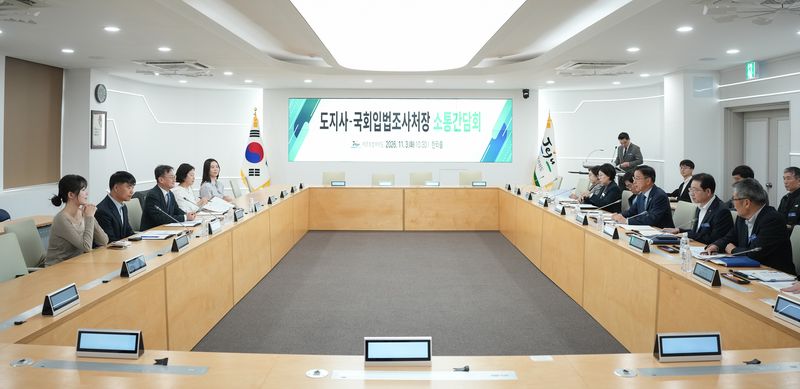
【Financial News, Jeju = Jeong Yong-bok, reporter】 Jeju requested cooperation from the National Assembly on amending laws to establish grounds for punishing historical distortion related to the Jeju April 3 Incident and secure national funding for Jeju New Port. It also proposed transferring to the Jeju governor the authority to approve solar power projects exceeding 3 MW and up to 20 MW.
According to Jeju Special Self-Governing Province on the 3rd, Governor Wi Seong-gon met that morning with Lee Gwan-hu, head of the National Assembly Research Service, at Hallasan Hall in the provincial government building to discuss key legislative issues, including revisions to the April 3 Special Act and the Jeju Special Act.
The National Assembly Research Service is a specialized research agency for legislation and policy under the Speaker of the National Assembly. It supports the legislative work of lawmakers and standing committees through policy analysis and legal review. The meeting was arranged to cooperate on reflecting Jeju’s current issues in the National Assembly’s legislative research.
Revision of the April 3 Special Act was identified as the most urgent task. Jeju asked for the prompt passage of amendments that would establish grounds for punishing historical distortion and secure the legal status of the bereaved families’ association, saying that redress for the rights of victims and bereaved families must not be delayed as they grow older.
The current April 3 Special Act prohibits acts that damage the reputations of victims and bereaved families, among others, by spreading false information, but it contains no separate penalties. This is the context for discussions on amending the law to clarify the scope and standards for punishing acts of historical distortion.
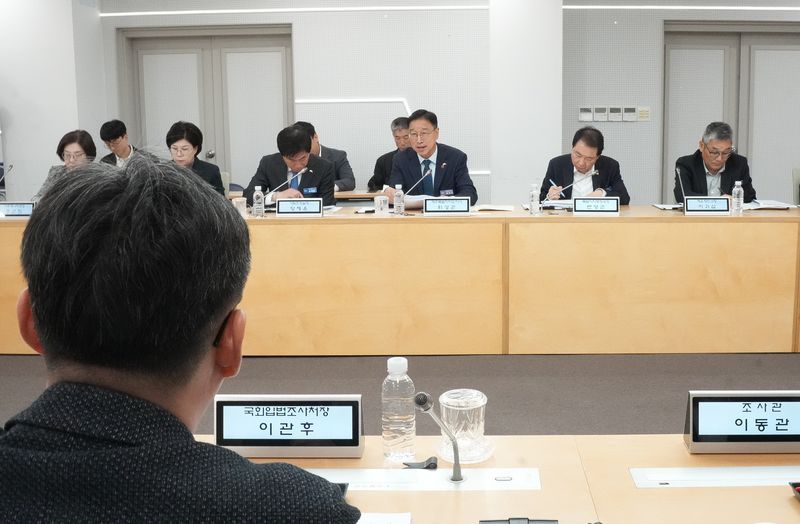
The expansion of permitting authority for renewable energy projects was also included in the proposed revisions to the Jeju Special Act. Jeju noted that the central government currently has authority over solar power projects exceeding 3 MW and asked that permitting authority for projects of up to 20 MW be transferred to the governor. The aim is to narrow the difference with the authority to oversee wind power projects under the Jeju Special Act.
Ways to secure national funding for the development of Jeju New Port were also discussed as a key issue. The Jeju New Port project has a total cost of 3.8278 trillion won, of which 2.5253 trillion won is planned to come from national funds. Jeju said that securing large-scale funding is difficult under the current system of locally managed ports and asked for cooperation on revising the Jeju Special Act to allow the Port of Jeju to be converted into a nationally managed port.
Jeju also proposed improving regulations related to development projects. It said relevant laws need to be revised to address problems arising because Supreme Court precedents restrict the sale to third parties of project sites that have been designated both as recreation areas and as tourism complexes.
Jeju also identified the cost burden on daily life and industry arising from its geographical characteristic as an island as a national legislative issue. It requested the introduction of a “distance-equivalence system,” which would recognize the sea route connecting Jeju and the mainland as a virtual road and provide support for additional transportation costs, as well as the application of the Island Development Promotion Act to Jeju.
Other areas for cooperation included financial incentives for local governments leading the transition to carbon neutrality, adjustments to electric vehicle tax rules, recognition of energy storage systems (ESS) as power generation business operators, and ensuring fair grid-use fees for connections to high-voltage direct current (HVDC) transmission.
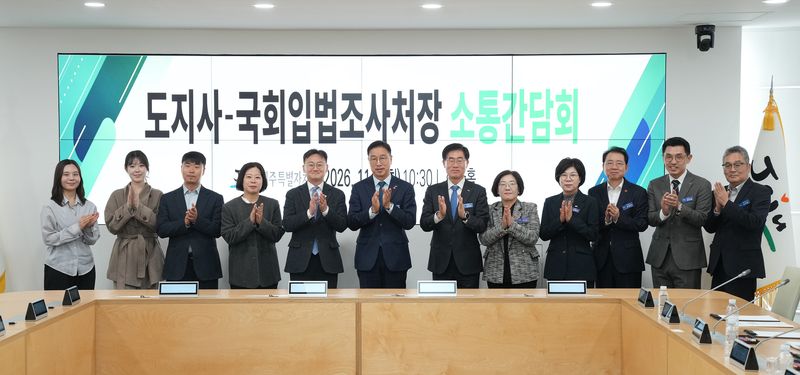
They also agreed to change how legislation is pursued. Jeju explained that it had taken a long time to coordinate with government ministries when it bundled multiple institutional reform measures into government bills. Going forward, it plans to operate an ongoing legislative system that pursues measures requiring coordination with relevant ministries through government bills, while also advancing urgent reforms through bills introduced by lawmakers.
Governor Wi Seong-gon said, “Jeju has experimented with new systems as a special self-governing province, but inequalities stemming from its geographical circumstances have not been sufficiently addressed,” and asked that “the National Assembly Research Service investigate the structural disadvantages faced by island regions and reflect them in legislation.”
Lee Gwan-hu, head of the National Assembly Research Service, said, “Because laws are generally applied uniformly nationwide, some provisions do not fit Jeju’s particular circumstances or do not grant sufficient authority.” He added, “We will examine the difficulties faced on the ground in Jeju and work together to find the necessary legislative and institutional reforms.”
[email protected] Jeong Yong-bok Reporter