Opposition unveils five key livelihood budget priorities; Jang Dong-hyeok: “More funding for half-price tuition at private universities and fire safety support”
- Input
- 2026-11-03 16:25:30
- Updated
- 2026-11-03 16:25:30
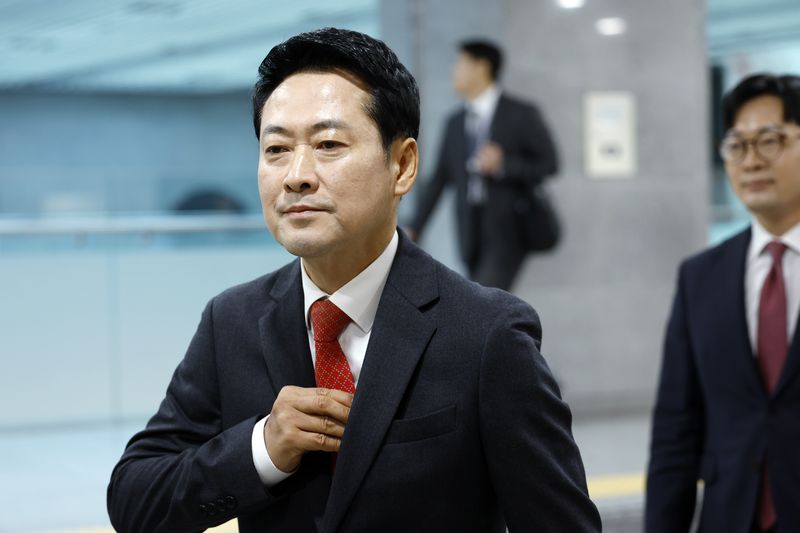
[Financial News] People Power Party leader Jang Dong-hyeok said he would push for cuts totaling 134 trillion won during the review of the government’s 2027 budget proposal. The plan is to cut 104 trillion won from the Future Fund, 27 trillion won from the “100 problematic projects,” and 3 trillion won in interest costs on government bonds. Meanwhile, the party plans to increase the 11.5924 trillion won allocated to its proposed “five key budget priorities.” These include half-price tuition at private universities and funding for fire safety support.
On the 3rd, Jang held a press conference at the People Power Party headquarters in Yeouido, Seoul, and said, “We have put together five key budget priorities to protect people’s livelihoods and the future,” adding that they were “budgets that directly address problems in people’s lives.”
Regarding the government’s 821-trillion-won budget proposal, he said it was “an excessively expansive 821-trillion-won budget bill, waving around a rosy report card based on the semiconductor supercycle,” and described it as “President Lee Jae Myung’s plan to open up at will the national treasury that the people and businesses have filled through blood, sweat and tears.”
On the 162-trillion-won Future Fund, he said, “The word ‘future’ is in its title, but it is hard to find projects that are actually for future generations,” and claimed, “Of the fund’s 162 trillion won, a staggering 104.4 trillion won is surplus money. It is effectively President Lee Jae Myung’s personal kitty, which this government can spend however it wants.”
Jang plans to prevent the government from “squandering taxpayers’ money” during the National Assembly’s budget review. He identified the following as problematic projects and said he was determined to cut them: operating costs for the Basic Society Committee and the Committee of Light (11.5 billion won); cooperative promotion and social solidarity economy projects (113 billion won); the National Research Council for Economics, Humanities and Social Sciences (66.3 billion won); special activity funds for the Blue House and the Serious Crimes Investigation Agency (12.4 billion won); rewards for reporting (254.6 billion won); the Youth Culture and Arts Pass (792.5 billion won); and the content fund (330.5 billion won).
The plan is to cut funding for those projects and increase the “five key budget priorities” proposed by the People Power Party. They are: youth livelihoods (3.4287 trillion won); public safety (2.91 trillion won); people’s livelihoods (2.8306 trillion won); jobs for the people (1.225 trillion won); and everyday insecurity (1.1981 trillion won).
He first called for a new program to halve tuition at private universities. Jang said, “We will lower tuition at private universities and colleges nationwide to the 4-million-won range, the average at national and public universities,” adding, “We will prevent reverse discrimination by excluding international students from eligibility for support.” He also proposed raising monthly rent support for young people without homes of their own and newlyweds to a maximum of 500,000 won, and providing emergency assistance of up to 3 million won for up to six months to young people who have lost their jobs or are owed wages.
For public safety, the plan is to raise firefighters’ hazardous-duty allowance by 500,000 won per month and invest 2.41 trillion won in replacing aging equipment. He proposed allocating 500 billion won to protect crime victims and support their recovery, including treatment, help with living expenses and relocation.
For people’s livelihoods, 1.8416 trillion won was allocated to increase small business owners’ actual income. The plan is to launch a “Real Income Improvement Project” for 25,000 small business owners, linking them with support from business assessments through implementation of improvement programs and providing 4 million to 16 million won per store.
For jobs, the plan is to invest 980 billion won to establish 40 regional companies with capital of 50 billion won, with joint investment from local governments and the private sector. Another 245 billion won will go toward securing platform workers’ incomes and strengthening the social safety net.
To ease everyday insecurity, funding will be increased by 888.1 billion won to build a care system and by 310 billion won to provide food assistance to vulnerable households. The plan is to establish a “24-hour emergency backup care system” and provide young and middle-aged people caring for family members with service vouchers worth 500,000 won per month for one year.
[email protected] Lee Hae-ram Reporter