Ruling party ally Federation of Korean Trade Unions (FKTU): “Trust in the Democratic Party is crumbling”
- Input
- 2026-11-03 15:52:16
- Updated
- 2026-11-03 15:52:16
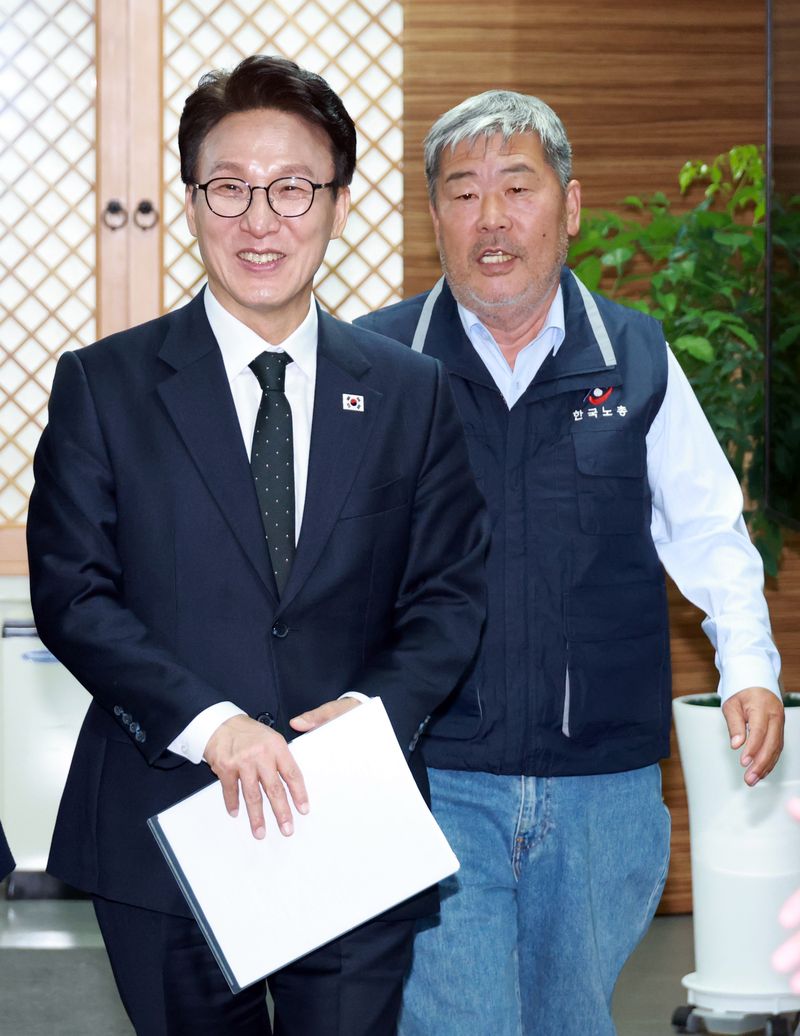
At the 3rd High-Level Policy Consultation held at the Democratic Party’s headquarters in Yeouido, Seoul, on the 3rd, FKTU Chairman Kim Dong-myeong told Democratic Party leader Kim Min-seok, “The FKTU’s support and solidarity are not something that can be taken for granted,” adding, “Trust in the Democratic Party itself is now crumbling.” He warned, “If workers’ demands are ignored, the FKTU cannot simply be expected to maintain the current relationship either.”
The flashpoint in the dispute is a push to exempt super-regional special zones from the 52-hour workweek. The Democratic Party has introduced a series of related bills to advance megaprojects, a government policy priority, and boost regional investment, but has slowed the pace of legislation in the face of opposition from labor groups. Chairman Kim criticized the party, saying, “The Democratic Party introduced a proposal to expand exceptions to working hours and labor rights, and even exclude the application of labor relations laws, under the pretext of corporate investment and economic revitalization.” He took particular issue with the fact that the bill’s co-sponsors included Democratic Party floor leader Han Byung-do and lawmakers from the Labor Respect Practice Group.
The criticism extended beyond individual labor policies to the Democratic Party’s identity and its relationship with the presidential office. “What does it mean to be the Democratic Party? Is it the party’s path to represent only the voices of powerful people and corporations?” Chairman Kim asked. He went on to question the party’s ability to make policy decisions independently, saying, “If it is a party that cannot make any decisions without the Blue House’s judgment, what is its role as the ruling party?”
Delays in legislation to extend the retirement age are also deepening labor groups’ distrust. Chairman Kim criticized the government and ruling party for putting off a decision, saying, “The extension of the retirement age has been at a standstill for the second year.” Kim Min-seok acknowledged, “We promised to legislate within the year, but the situation is that we have yet to bear fruit.” On the issue of the super-regional special zones, he said he would respect the issue-specific social dialogue underway between labor and management and the relevant government ministries.
However, reports say Kim Min-seok made no further remarks on working-hour exemptions even during the closed-door consultation. Democratic Party lawmaker Lee Yong-woo said after the meeting that the party’s policy direction on extending the retirement age was clear, but could not give a definite answer on whether legislation would pass within the year. The Democratic Party plans to restart the Special Committee on Extension of Retirement Age, but has not provided a specific legislative timetable.
The political cost of this dispute is significant, as it comes amid the Rebuilding Korea Party’s growing support, particularly among progressive voters. Competition for support within the broader ruling camp is becoming more visible, and even the FKTU, which has long backed the Democratic Party, has raised questions about the sustainability of its policy alliance with the party. The FKTU’s warning is being interpreted as presenting the ruling party—which has taken labor’s support for granted—with the task of first repairing its relationship with a longtime ally.
A poll commissioned by Asia Economy from Realmeter, conducted among 1,005 adults nationwide on the 29th and 30th of last month and released on the 2nd, found that the Rebuilding Korea Party’s support rating stood at 8.1%, its highest in about two years. Its support among progressive voters also rose from 11.4% in the first week of October to 20.5% in the final week. The poll was conducted using a wireless automated-response method and had a margin of error of ±3.1 percentage points at a 95% confidence level and a response rate of 3.0%. For more details, see the Central Election Poll Deliberation Commission’s website.
[email protected] Jiwon Song Reporter