“The government offices alone must not be moved to Sejong” ... Blunt criticism at public hearing over settlement and administrative-efficiency measures
- Input
- 2026-11-03 15:41:24
- Updated
- 2026-11-03 15:41:24

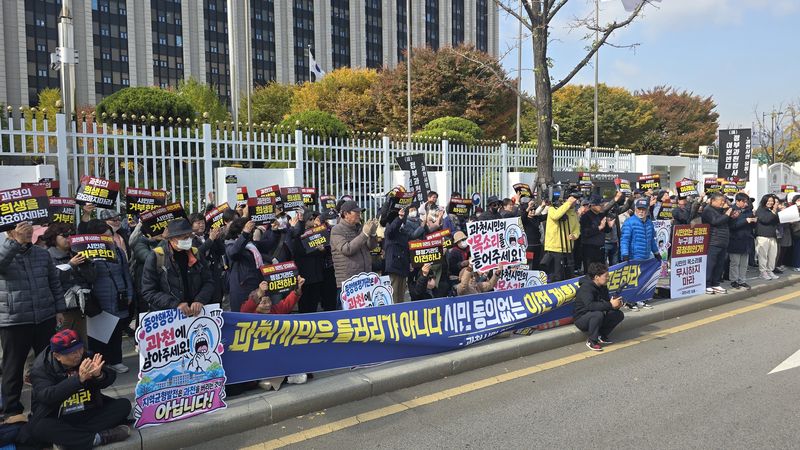
[Financial News] At a public hearing held on the 3rd on the government’s plan for the second-phase relocation of central government agencies to Sejong City, participants called for measures to help civil servants and their families settle in—including housing and education—to be put in place first, and for sufficient time to prepare for the move. Some also said that administrative efficiency would be difficult to improve even if the offices were moved unless existing work practices, such as frequent appearances before the National Assembly of the Republic of Korea and business trips to Seoul, were changed. Others argued that some functions, including finance and services for the public, should remain in the Seoul metropolitan area.
Criticism of the government’s approach to the relocation poured in at the public hearing on the second-phase plan for moving central government agencies, held that day at the Government Complex Seoul. Relocations are set to begin next year, but measures addressing housing for civil servants, their children’s education and the jobs of their dual-income spouses have yet to be fleshed out.
Lee Cheol-su, chair of the National Government Employees’ Union, said, “The number of homes secured for civil servants to actually live in, and when they can move in, remain uncertain ahead of the relocation.” He added, “Rather than setting a deadline and forcing civil servants to move unconditionally, the government should give them time to prepare.” He also pointed out, “Support for moving costs and commuter bus services alone cannot constitute a housing policy.”
The chair of the labor union at the Korea Media and Communications Commission (KMCC), which is due to relocate in the first half of next year, also said, “At most, we have only about six months to prepare. During that time, we have to find a home, move our children to new schools and decide what our dual-income spouses will do.” The chair called on the government to reconsider the timing of the relocation if its measures were inadequate.
Experts called for comprehensive support, from housing supply to education and employment. Im Jun-hyeong, a professor at Korea University (KU), said, “Relocating an agency means moving not only its offices but also its civil servants, so housing is the most important issue,” and proposed reconsidering the special housing allocation program previously implemented. He stressed, however, that resale restrictions should be tightened to prevent the program from being abused for speculation, and that fairness to existing Sejong residents should also be taken into account.
Heo Jun-young, a senior research fellow at the Korea Institute of Public Administration (KIPA), voiced concern that considering only the availability of office space and convenience of location could lead to repeated inefficiencies from agencies being dispersed even within Sejong. “There is no need to concentrate every government function in Sejong,” he said, explaining that field implementation and public service functions should be located with the nature of their work and the public’s access in mind. Seo Yeong-bok, co-chair of the Citizens’ Coalition for Administrative Reform, also argued that functions requiring real-time responses, such as finance and personal data, should use a Seoul office as an effective hub.
The government is also considering leaving some functions in Seoul. An Interior Ministry official said, “The basic direction is for all 44 agencies to relocate to Sejong, but we are considering exceptions for some departments that need to remain in Seoul.” The official added, “Along with measures to support the relocation, we will make as many decisions as possible by the end of this month.” The Financial Services Commission, the Personal Information Protection Commission and the Ministry of Foreign Affairs are among those being considered.
Opposition also continued in areas set to lose government agencies. Gwacheon Mayor Shin Gye-yong protested, “I thought there would be support measures or an alternative for Gwacheon. If this is how it is, why did you call us?” She added, “How can you push this through unilaterally and arbitrarily without even consulting Gwacheon City beforehand?” Gwacheon residents, concerned about the hollowing out of the city center and a decline in local businesses, also called for a consultative body to promote mutual cooperation.
The revised relocation plan that the government presented at the public hearing that day initially included 31 agencies and 5,460 civil-service positions eligible to be relocated under current laws, out of a total of 44 agencies and 9,929 positions targeted for relocation. Twenty-three agencies and 1,831 positions, including the Personal Information Protection Commission and the KMCC, will relocate by next year by leasing private buildings and other premises. Eight agencies and 3,629 positions, including the Korean National Police Agency, the Board of Audit and Inspection and the Corruption Investigation Office for High-ranking Officials (CIO), will relocate by 2031 after securing newly built offices.
The relocation costs are estimated at about 55.7 billion won for moves to leased offices and about 1.6 trillion won to construct new offices. Separate relocation plans will be drawn up after the relevant laws are revised for the remaining 13 agencies and 4,469 positions that require legislative changes, including the Ministry of Foreign Affairs, the Ministry of National Defense and the Ministry of Justice. The government plans to finalize and officially announce the relocation plan after consulting the relevant agencies and obtaining presidential approval.
[email protected] Lee Bomi Reporter