Save small schools, narrow the education gap ... 86 billion won for 43 regions nationwide next year
- Input
- 2026-11-03 15:16:44
- Updated
- 2026-11-03 15:16:44
[Financial News] The government will invest 86 billion won next year to save small schools facing closure as student numbers decline and to narrow education gaps between regions. In 32 depopulation areas, including Geumsan, South Chungcheong Province, it will pursue school consolidation and joint curriculum programs; in 11 areas, including Busan and Daegu, it will strengthen efforts to address education gaps and link education with universities and industry.
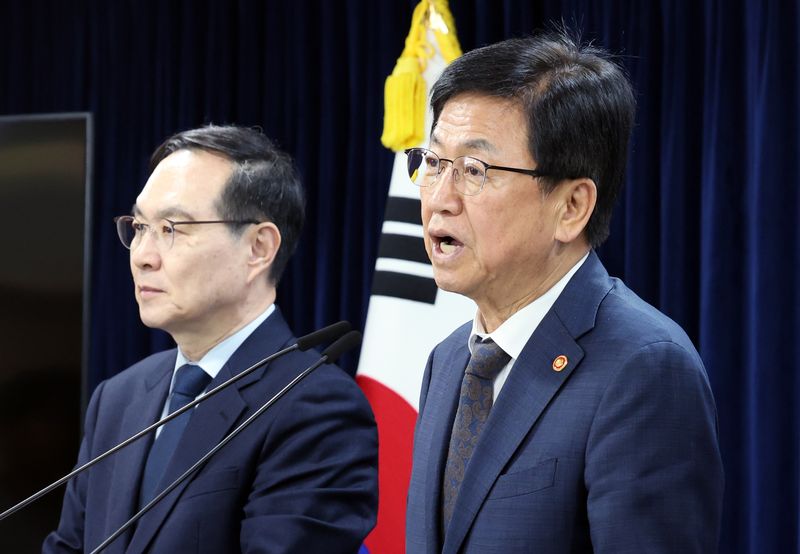
On the 3rd, Minister of Education Choi Kyo-jin announced the results of the designation of the “2027 Education Innovation Leading Regions,” which include these measures, at Government Complex Seoul.
This program is a reworking of the Education Development Special Zones, which have been operating on a pilot basis from 2024 through the end of this year. Under the existing special zones, regions set their own education priorities, but the new program makes small-school innovation a mandatory task in depopulation areas. It also strengthens the role of district education offices, requiring them to develop regional education strategies together with local governments. The aim is to improve educational conditions across entire regions, going beyond support for individual schools.
The government has allocated 86 billion won in special grants for next year’s Education Innovation Leading Regions program. It plans to provide about 1.9 billion won annually to each selected basic local government and about 3.7 billion won to each metropolitan local government. Separate funding may also be provided for school consolidation grants or school-facility integration projects that repurpose closed-school sites as welfare, cultural or sports facilities.
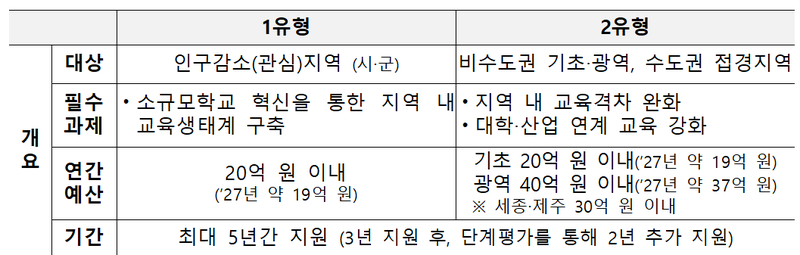
The selected regions are divided into two types. Type 1, which targets depopulation areas and areas of concern, includes 32 regions, such as Yeoncheon, Gyeonggi Province; Gangneung, Gangwon State; Geumsan, South Chungcheong Province; Namhae, South Gyeongsang Province; and Gunwi, Daegu. Of these, 22 submitted plans that include school consolidation.
Geumsan plans to consolidate small elementary schools around a hub school and use closed-school sites for educational facilities. Middle and high schools will also be consolidated and restructured over the medium to long term. In Geumsan, 10.4% of middle school graduates go on to attend schools in other regions. Sancheong, South Gyeongsang Province, is pursuing a “one hub, multiple campuses” model, with combined classes for first- and second-graders at existing campuses and for third- through sixth-graders at hub schools.
The possibility of local opposition to school consolidation was also raised. Minister Choi responded, “When the program was announced last June, concerns were raised, particularly in areas that had been campaigning to save small schools, that this was a policy to encourage school consolidation.” He went on to stress, “This is not about consolidating schools. Rather, it leaves it to the regions to choose for themselves how to save schools in areas that have reached the point of facing the threat of consolidation.” He added that support could be provided for ways to strengthen the area’s educational infrastructure even if it chooses to close a school.
Type 2, which aims to reduce education gaps within regions and promote education linked to universities and industry, includes three metropolitan local governments, including Busan, Daegu and Jeonnam-Gwangju Integrated Special City, and eight basic local governments, including Yangju, Gyeonggi Province; Chuncheon, Gangwon State; Eumseong, North Chungcheong Province; Asan, South Chungcheong Province; and Gumi, North Gyeongsang Province.
Eumseong, North Chungcheong Province, will promote joint classes and student exchanges between schools in the old downtown and the innovation city. It also plans to run joint curricula across four rural areas with small schools and provide differentiated education and parent counseling for students from immigrant backgrounds. Busan will operate a model centered on hub schools and alliances of small schools, with village-based care and after-school programs.
The initial support period is three years. An additional two years of support may be provided following a phased evaluation. However, specific evaluation criteria have not yet been established.
Ryu Jang-su, chair of the Education Innovation Leading Region Committee, said, “We haven’t developed specific indicators, but of course it will be very important to see whether the plans are being carried out exactly as written.” Ryu also proposed conducting the interim evaluation as a form of consulting to improve the program rather than as a means of ending support. He said, however, that this was not a policy agreed upon with the Ministry of Education.
The Ministry of Education plans to expand the number of selected regions next year as well. Minister Choi explained that the ministry had initially planned to select 30 Type 1 regions but increased the number to 32 because the differences in evaluation scores were negligible. He also said the ministry would support regions that were not selected this year so they could apply again next year.
The Ministry of Education will finalize the designation results this month after considering appeals. The selected regions are expected to submit operating plans incorporating expert consultations by December and begin the program next January.
Minister Choi said, “Through the Education Innovation Leading Regions program, we will shift the framework of regional education policy toward an education-ecosystem perspective, so that high-quality education continues from elementary school through high school within each region.” He added, “We will closely link the locally tailored K-12 education innovation models developed through this program with universities’ talent-development policies, building a virtuous cycle in which children born and raised in a region develop their capabilities at local universities and go on to drive the region’s development.”
[email protected] Lee Bomi Reporter