IPO-bound AL Robot: “Expanding production capacity and advancing sensor technology”
- Input
- 2026-11-03 15:17:00
- Updated
- 2026-11-03 15:17:00
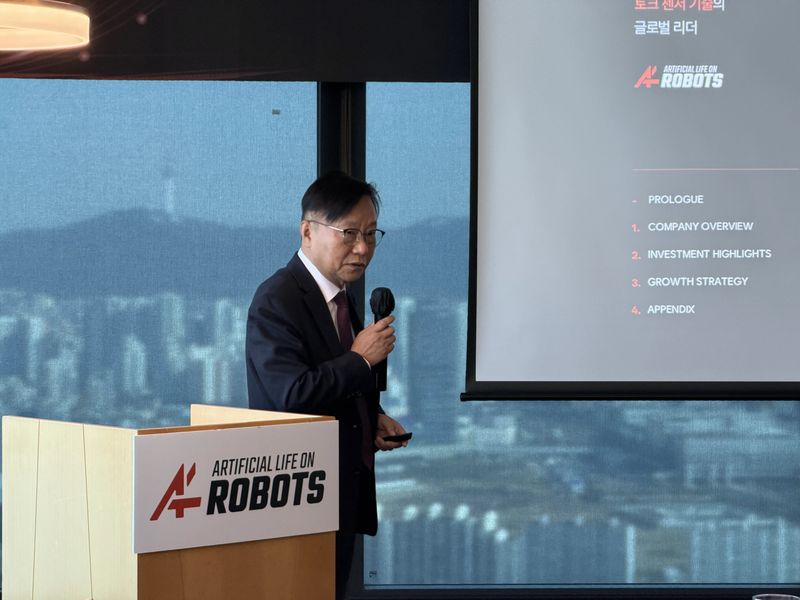
[Financial News] “As robots’ tasks become more sophisticated, the importance of force-and-torque sensors, which accurately measure external forces, is growing.”
Kang Dae-hee, CEO of AL Robot, said at an IPO press briefing held in Yeouido, Seoul, on the 3rd that the company would use its listing on KOSDAQ (Korea Securities Dealers Automated Quotations) as an opportunity to advance its sensor and control technologies and expand into humanoid robots and process automation. The company plans to increase production capacity to meet overseas customers’ demand for mass production and invest in developing technology that enables robots to perform tasks carried out by skilled workers.
Founded in 2017, AL Robot is a key components company that develops and supplies sensors that measure the force and torque applied to robots, as well as control devices that regulate their movement. Its main products are joint-type torque sensors, 6-axis force-and-torque sensors, rotary torque sensors, and integrated control units.
AL Robot’s competitive edge lies in combining sensors that provide robots with their “senses” and control technology that regulates their movements. Beyond accurately measuring force, the company helps robots perform precise tasks by applying the measurements to their actual movements. “Skilled workers have a keen sense of touch,” Kang said. “This kind of sensory capability will also attract attention in future humanoid and autonomous robots.”
The company also cited its ability to achieve both precision and mass-production capability as a strength. It said its proprietary calibration algorithms and process automation had reduced reliance on manual work, boosting productivity and price competitiveness. Kang emphasized the quality and reliability built up through years of supplying customers, saying, “We have had no defects in the field during seven years of mass-production supply.”
AL Robot has supplied key components to major domestic collaborative robot manufacturers for at least seven years, and its components have been selected for successive follow-up models. It also supplies sensors to companies with medical and surgical robots that have received regulatory approval from the U.S. Food and Drug Administration (FDA).
The company is expanding supplies to major Japanese robot manufacturers. It said developing products tailored to customers’ joint structures and communication methods takes 2–3 years, but suppliers are difficult to replace once selected. “Customers provide us with joint drawings, communication protocols, and other materials, and we develop customized products,” Kang said. “Once we’re integrated, it’s difficult to replace us with another company.”
Proceeds from the offering will be used first to expand production capacity. The company expects to raise about 37.4 billion won based on the bottom of the indicative offering price range, of which about 11.5 billion won will go toward buildings, facilities, and equipment. It plans to expand annual sensor production capacity, currently worth about 11.8 billion won, to about 50 billion won in 2027 and about 72.9 billion won in 2028.
The remaining approximately 24 billion won will be used for operating expenses. Research and development will focus on improving sensor performance and “skill transfer”—enabling robots to perform tasks using the skills of experienced workers. The company will also invest in joint research with universities, hiring, validation of new products, and the development of mass-production equipment. Kang stressed, “We need to invest in technology to maintain a world-leading position in sensors and robot components.”
AL Robot also plans to expand its humanoid component business. It plans to broaden its product range by co-developing actuators with a global auto parts company and pursuing the development of tactile sensors. However, Kang said the humanoid business was not included in the company’s revenue projections or valuation, explaining, “Without clear evidence, it is difficult to recognize it as revenue.”
AL Robot will offer 2.4 million shares, all newly issued. The indicative offering price is 15,700–17,600 won per share, with proceeds expected to total 37.7–42.2 billion won. The expected market capitalization is 189.2–212.1 billion won. After bookbuilding among institutional investors through the 3rd, the company plans to list on the KOSDAQ market this month following a retail subscription period from the 6th to the 9th. Daishin Securities is the lead underwriter.
[email protected] Lee Jeong-hwa Reporter