Trump and Iran strike a conciliatory tone and signal willingness to pursue a diplomatic solution ahead of the midterms... Iran war at another crossroads
- Input
- 2026-11-03 15:16:07
- Updated
- 2026-11-03 15:16:07
[Financial News] A day before the United States’ midterm elections, the United States and Iran are striking conciliatory tones toward each other and stepping up efforts to find a diplomatic solution.
On the 2nd (local time), U.S. President Donald Trump said there was “no need to rush” a decision on whether to resume attacks on Iran after the midterm elections. He added that “Iran wants an agreement as soon as possible,” raising hopes that a deal could be reached.
Speculation is growing that Trump, who has pressured Iran by talking about the possibility of resuming large-scale attacks, may be signaling a willingness to negotiate.
In what appeared to be a response, Iran’s president also declared that same day that the Supreme Leader had given the government authority to resolve the crisis through dialogue (with the United States), bolstering the atmosphere for negotiations. Iran’s foreign minister also reiterated the conciliatory gesture, saying that the Strait of Hormuz would be reopened if the conditions were accepted.
As the situation advanced, a delegation from mediator Qatar was making an unannounced visit to Tehran. Sources said Iran, too, had tabled a revised proposal at the Qatar-mediated talks, reigniting negotiations.
After delivering a speech in front of the Reflecting Pool at the Lincoln Memorial in Washington, D.C., Trump answered “No” when reporters asked whether he was considering resuming attacks on Iran after the midterm elections. In an interview with the online news outlet Axios, he also said of whether attacks on Iran would resume, “We will do something one way or another, but there is no need to rush.”
Vance: “The president and I both see the prospects for a deal as quite good”
Trump added, “We are talking with them, and things are going well,” and “They want a deal more than ever.”
Vice President JD Vance also said that several good discussions had taken place with Iran that day. “The president and I both see the prospects for reaching a deal as quite good. We will keep working,” he said. Vance said there was no deadline for a decision on resuming U.S. attacks on Iran.
Iranian President Masoud Pezeshkian also said that day that “our enemies are seeking dialogue, and Iran’s Supreme Leader has authorized the government to pursue it.” At a meeting with provincial governors that day, Pezeshkian said, “The government is working to find a solution through dialogue, and the Supreme Leader of the Revolution has granted the government some authority.” This is seen as indicating that Iran’s leadership has expanded the executive branch’s discretion to negotiate.
Iran is discussing with the United States, through mediators including Qatar and Pakistan, the reopening of the Strait of Hormuz and the resumption of peace talks.
Iran has set out conditions including the lifting of the naval blockade and proposed reopening the Strait of Hormuz within two days if the United States accepts them.
Iranian president: “Supreme Leader gives the executive branch authority to negotiate”
In this regard, Iranian Foreign Minister Abbas Araghchi told the Islamic Republic News Agency (IRNA) in Ashgabat, Turkmenistan, that “consultations through the mediators Qatar and Pakistan are proceeding very intensely.” He emphasized, “We have already presented our conditions and proposals. Now it depends on the United States’ political rationality.”
On the Strait of Hormuz, the central issue, Araghchi said, “Iran’s conditions for reopening the strait are entirely clear and transparent,” adding, “If the conditions are accepted, the Strait of Hormuz will reopen and negotiations will resume.”
Foreign media reported that the Qatari delegation visited Tehran that day and discussed with Iranian officials a draft U.S.-Iran agreement that had been under discussion for the past eight days.
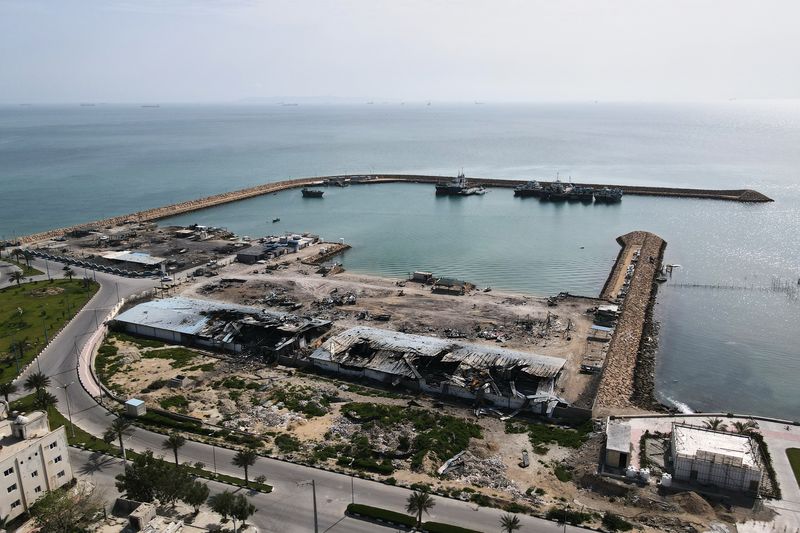
Meanwhile, as momentum for negotiations grew, tanker fires continued to break out in the Strait of Hormuz and the U.S. military continued to carry out defensive strikes. Iran’s state-run IRNA news agency reported that several explosions were heard that day near Qeshm Island, a strategic point for Iran in the Strait of Hormuz. The Wall Street Journal (WSJ), citing U.S. officials, reported that the United States struck Qeshm Island that day in a defensive move intended to prevent Iran from freely attacking commercial vessels in the Strait of Hormuz.
Meanwhile, international oil prices plunged by more than 7% that day on hopes that negotiations between the United States and Iran could make progress. December-delivery U.S. West Texas Intermediate (WTI) futures settled at $96.46 a barrel on the New York Mercantile Exchange (NYMEX), down 7.36% from the previous session.
[email protected] Lee Seok-woo, international affairs correspondent Reporter