Foreign tourists spent 1 trillion won a month in Seoul ... a record high
- Input
- 2026-11-03 15:09:02
- Updated
- 2026-11-03 15:09:02
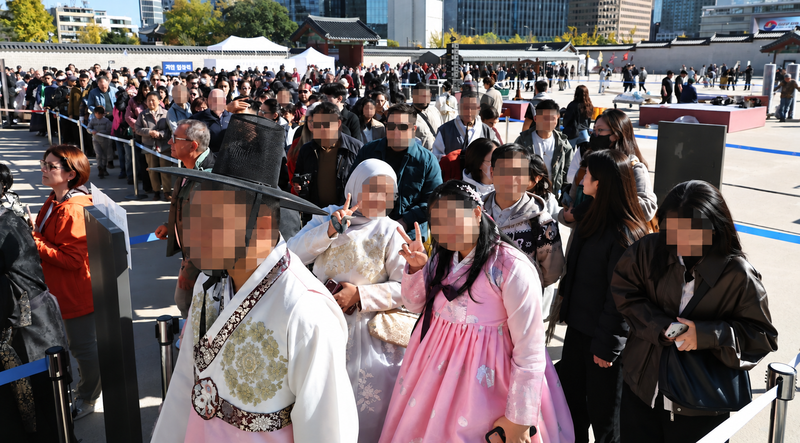
The Seoul Metropolitan Government said on the 3rd that foreign tourists' card spending from January to September this year totaled 8.8435 trillion won, up 57.7% from 5.6071 trillion won in the same period last year. That was 11.4% higher than last year's full-year spending of 7.9375 trillion won, setting a record.
The number of foreign tourists who visited Seoul over the same period reached 13.14 million, up 21.5% from a year earlier. That was also 27.9% higher than in the same period in 2019, before the COVID-19 pandemic, marking a record for the period.
Foreign tourists' card spending reached 1.153 trillion won in April and then topped 1 trillion won a month for six consecutive months through September. Seoul accounted for 70.9% of foreign tourists' offline card spending nationwide. There are also suggestions that full-year spending could top 10 trillion won this year.
By sector, shopping accounted for the largest share of total spending, at 46.0%, followed by medical and wellness services (23.8%), food and beverages (13.3%), and accommodation (10.4%).
One notable change is the geographic spread of foreign tourists' spending. Gangnam District (29.6%), Jung District (27.7%), and Mapo District (7.1%) together accounted for 64.4% of all spending, showing that it remained concentrated in major tourist areas. However, growth in other areas, including Seongdong District and Gangdong District, was also pronounced. Foreign tourists' card spending in Seongdong District rose 102.8% year on year, while it at least doubled in Gangdong District (128.4%), Guro District (103.4%), and Dongdaemun District (103.4%).
Growth in neighborhood commercial districts was also clear. From January to September this year, foreign tourists' card spending in these districts totaled 308.2 billion won, up 80.5% from 170.7 billion won in the same period last year. Among traditional markets, foreign tourists' card spending at Gwangjang Market rose 113.4%; Namdaemun Market (65.6%) and Geumcheongyo Market (60.8%) also recorded high growth rates.
The Seoul Metropolitan Government is expanding tourism offerings that encourage longer stays, including night tourism and food and wellness experiences, to channel this trend into revitalizing the local economy. In six commercial districts, including Kondae and Chang-dong, it is developing the “Seoul Moonlight Night Market,” which combines food with cultural and tourism resources, to create neighborhood commercial districts that attract tourists at night as well.
The number of foreign tourists visiting the Han River is also increasing. From January to September this year, foreign visitors to Hangang Park increased 41.7% year on year, about 4.7 times the growth rate for all visitors (8.9%).
Broadening tourists' itineraries to include neighborhood commercial districts and traditional markets remains a challenge. Under its “3·3·7·7 Seoul Tourism Future Vision,” announced in 2023, the Seoul Metropolitan Government is working toward attracting 30 million inbound tourists, achieving per-person spending of 3 million won, a stay of seven days, and a 70% repeat-visit rate.
Cho Seong-ho, director of the Seoul Metropolitan Government's Tourism and Sports Bureau, said, “The increase in tourists is boosting sales for small businesses and bringing vitality to the local economy.” He added, “We will closely connect diverse tourism offerings with local commercial districts so that tourist spending benefits commercial districts across Seoul and the livelihoods of its residents.”
[email protected] Lee Seol-yeong Reporter