No danger alert issued again despite North Korea launching 'devil's weapon'; military says detection is limited
- Input
- 2026-11-03 14:44:55
- Updated
- 2026-11-03 14:44:55
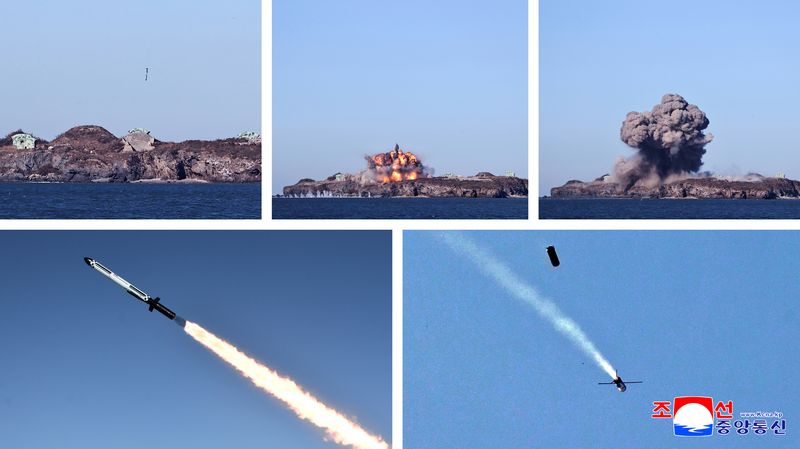
On the 3rd, North Korea released the results of a test conducted the previous day by the Warhead Research Institute under the Missile General Bureau, saying that the cluster warhead mounted on a cruise missile had devastated a target area of 5–6 hectares, roughly the area of seven soccer fields.
However, South Korea's military acknowledged the launch of North Korea's cluster-warhead missile only a day later. The military had also failed to issue a danger alert when North Korea launched a tactical ballistic missile carrying a cluster warhead on the 31st of last month, despite detecting it.
Amid a crisis over restrictions on intelligence about North Korea between South Korea and the United States, concerns were also raised that South Korea's military had limited ability to detect North Korean missiles. The military acknowledged that day that its ability to detect North Korean missiles was limited.
Jang Do-young, the Joint Chiefs of Staff's public affairs director, said at a regular briefing that morning, "Unlike ballistic missiles, cruise missiles are slower and have the characteristic of using the Earth's curvature to fly at low altitudes and maneuver around terrain." He added, "Therefore, if North Korea launches them from a distant area in the north, detection is limited for reasons including the Earth's curvature."
Director Jang, however, reassured the public, saying, "If North Korea launches cruise missiles toward us, our military is fully capable of detecting and responding to them."
The military explained that verifying each individual case of whether it had detected a specific projectile launched by North Korea would expose its surveillance capabilities to the North. Contrary to this explanation, however, the military has routinely made prompt public announcements about ballistic missiles North Korea launches over the East Sea.
Strategic cruise missiles fly at extremely low altitudes, in radar blind spots, and can take detours and make evasive maneuvers along complex routes without a set trajectory, making them difficult for South Korea's military to detect and intercept.
Cluster munitions, which also appear in the film 'Steel Rain,' cause mass casualties by packing multiple submunitions (bomblets) into a single warhead. They are considered weapons that maximize lethality by exploding in the air and scattering submunitions in all directions.
[email protected] Kim Kyung-soo Reporter