‘Lower courts skipped a step’ ... Supreme Court repeatedly puts the brakes on [Case-Law Keywords]
- Input
- 2026-11-04 06:00:00
- Updated
- 2026-11-04 06:00:00
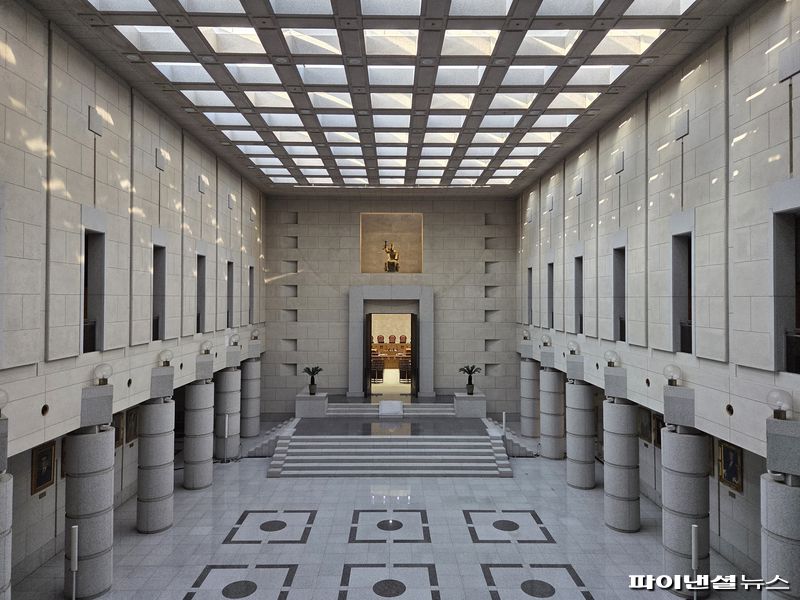
According to Financial News reporting on the 4th, the Supreme Court of Korea overturned three lower-court rulings on the 1st of last month and one on the 8th. In each case, it left undisturbed the facts established by the lower court but challenged the inference that led from those facts to a legal conclusion. It found that separate requirements had to be proven in each instance where the period of possession, the significance of an act, the years elapsed, or a party’s culpability was treated as leading directly to a legal conclusion. This illustrates the fundamental role of an appeals court as a court that reviews questions of law.
The theft case is the clearest example. The defendant was indicted on charges of theft and obstruction of official duties. The charge was that on January 8, 2025, in Busan, after police seized 30 bank and card statements in the defendant’s name while executing a search warrant for the defendant’s spouse, the defendant protested that the statements were not subject to seizure, took the original warrant and other documents, and refused to return them, saying, “If you return the statements, I’ll return the documents.” The second-instance court found an intent to unlawfully appropriate the documents, reasoning that refusing a request for their return and possessing them for a considerable period meant the use could not be considered temporary. On the 1st of last month, the Supreme Court of Korea’s First Division, with Justice Seo Gyeong-hwan sitting as the justice in charge of the case, acknowledged the prolonged possession but said that alone was not enough to establish such intent. It stated, “It must additionally be proven that the defendant intended to use or dispose of them ‘according to their economic use,’ as if they were the defendant’s own property.” The appeal was dismissed with respect to the obstruction-of-official-duties charge.
Another case went in the opposite direction. The director of a hospital in Gwanak District, Seoul, was indicted on fraud charges for having a medical-device sales representative participate in a hip hemiarthroplasty, while making it appear that the director had performed the operation alone, and fraudulently collecting some 95.38 million won in healthcare benefit payments from the National Health Insurance Service (NHIS) on 23 occasions between 2015 and 2019. The second-instance court did not find an intent to defraud, reasoning that the sales representative’s role—holding a tool to open up the surgical site—was an extremely minor act of assistance in medical treatment. On the 1st of last month, the Supreme Court of Korea’s First Division, with Justice Cheon Dae-yeob sitting as the justice in charge of the case, held that a nonmedical person who performs a medical act alongside a medical professional is not legally entitled to receive healthcare benefit payments, and that claims concealing this fact constitute deception. It rejected the inference that the minor significance of the act, by itself, ruled out intent to defraud.
The same pattern appeared in a technology dispute. A manufacturer of transformers for railway vehicles filed a lawsuit seeking, among other things, an injunction against unfair competition, alleging that the company that commissioned the work had used drawings supplied by the manufacturer to produce and deliver a copycat transformer. The second-instance court set the protection period for the technological achievement at 10 years from the first delivery and held that the manufacturer was not liable for deliveries made under contracts after that period. On the 8th of last month, the Supreme Court of Korea’s Third Division, with Justice Eom Sang-pil sitting as the justice in charge of the case, said, “It is difficult to conclude that the protection period can be limited uniformly or that it had already expired by the time of the fourth delivery.” The point was that the mere fact that time had passed was not enough; it was necessary to separately determine whether the technology had entered the public domain and become available for anyone to use. The panel noted that only two months separated the cutoff dates for deliveries for which liability was found and those for which the company was exempted.
The drunk-driving case concerned procedure. The charge was a violation of the Road Traffic Act (drunk driving). Police conducted a breath test on a driver who had fallen asleep on a bench at a police substation without first giving the driver water to rinse their mouth. The second-instance court questioned the test’s reliability, reasoning that the driver had suddenly woken up and blown into the device. On the 1st of last month, the Supreme Court of Korea’s First Division, with Justice Cheon Dae-yeob sitting as the justice in charge of the case, held that the Enforcement Rule of the Road Traffic Act, which requires water to be provided for rinsing the mouth, is a regulation with binding force on the public. It stated that breath-test results obtained without following that procedure “are, in principle, inadmissible and cannot be used as evidence of guilt.”
How such corrections are made has become intertwined with recent debate in the National Assembly of the Republic of Korea. Noh Gyeong-pil, head of the National Court Administration and a Supreme Court justice (class 23 of the Judicial Research and Training Institute), said on the 26th of last month, in response to a question about the appellate ruling involving Seoul Mayor Oh Se-hoon at a comprehensive audit by the National Assembly’s Legislation and Judiciary Committee, “The Supreme Court does not intervene in lower-court trials,” adding, “If there is a legal issue, it can be adequately corrected through the appeals process.” Nevertheless, at that day’s audit, ruling-party lawmaker Lee Seong-yoon said, “Impeaching Chief Justice Cho Hee-dae is the only answer,” while lawmaker Kim Yong-min claimed, “All power in the judiciary is concentrated in one person, the chief justice.”

[email protected] Kim Dong-gyu Reporter