[Exclusive] Seoul alone has 300,000 pyeong of “idle land”... Work begins on establishing a legal basis for housing on sites where construction has yet to begin
- Input
- 2026-11-03 15:41:57
- Updated
- 2026-11-03 15:41:57
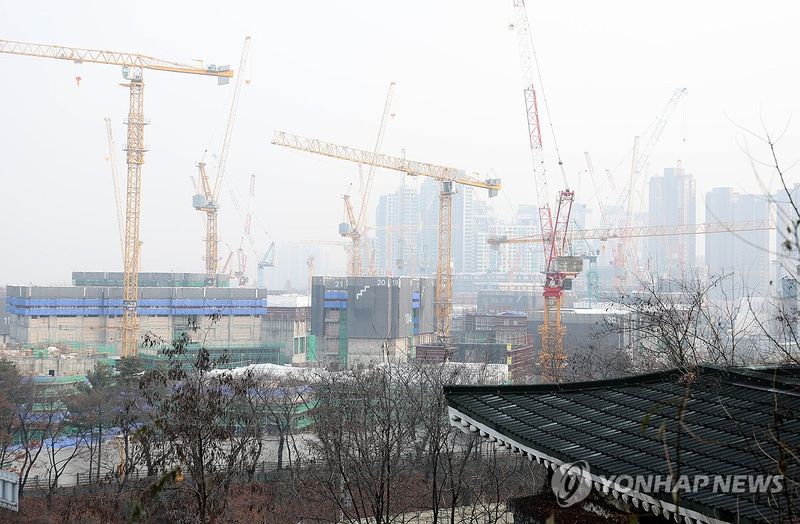
[Financial News] The Ministry of Land, Infrastructure and Transport (MOLIT) has begun work on establishing a legal basis for supplying housing on 300,000 pyeong of sites in Seoul where construction has yet to begin. The ministry believes that around 300,000 pyeong (1 million square meters) of land in Seoul alone is tied up, despite being suitable for housing if its designated use were changed. With the housing supply rate in the Seoul metropolitan area still below 100%, the ministry is seeking a new approach instead of relying on long-running redevelopment projects amid a shortage of land for housing. The move is seen as an effort to accelerate housing supply by upzoning sites where construction has yet to begin for residential use and changing their permitted uses. The biggest challenge is expected to be finding an appropriate level of gains recapture that balances project viability against concerns over preferential treatment.
Based on this newspaper’s reporting on the 3rd, MOLIT commissioned a research project on the “Measures to Make Urban Planning More Flexible to Expand Housing Supply” on the 29th. The project was announced on the 14th, but one round of bidding was unsuccessful.
The key is to establish a legal basis for changes to land-use zones, including upzoning, and for changes to permitted uses under district-unit plans. Under the current National Land Planning and Utilization Act, there is a basis for imposing public contributions only when land-use zones are changed between broad categories, such as converting a residential area to a commercial one. There is no such basis for upzoning or changing permitted uses. MOLIT cited the CJ Group factory site in Gayang-gu, Seoul, as an example. Last July, the ministry decided to rezone a site for a knowledge-industry center in a quasi-industrial area for apartment housing and supply 960 homes there. MOLIT’s assessment is that land on which housing could be built immediately simply by changing its designated use has been left idle for a considerable time.
According to MOLIT, sites in Seoul where construction has yet to begin total about 300,000 pyeong. Regulated areas in Gyeonggi Province cover about 220,000 pyeong (750,000 square meters). These figures represent the area of vacant land in industrial, commercial and business zones within district-unit planning areas, as well as in Type 1 residential areas, identified using imagery data from the Korea Land and Geospatial Informatix Corporation (LX). MOLIT said, “We estimate that the actual amount of unused land is even greater.”
MOLIT assessed that housing supply in the Seoul metropolitan area is insufficient, while new development is difficult. It also pointed out that redevelopment and reconstruction projects take a long time. The ministry said that ultra-high-density office developments in major downtown areas such as Gangnam, Yeouido and Gwanghwamun, which generate demand for housing, have been built without considering residential needs, deepening the imbalance between housing and jobs.
The key issue going forward is the appropriate level of gains recapture. MOLIT asked researchers to propose appropriate levels and methods for recouping gains, drawing on cases of prior negotiations over public contributions. A temporary measure is also under consideration for the period before the system is overhauled: a central-local government consultative body would review the amount of public contributions and deliberate on and recommend changes to land use. When a change in designated or permitted use allows housing to be built, land values rise sharply. Since the gains result from administrative decisions, some would be recouped in the form of public contributions.
The challenge is setting the appropriate amount of gains to be recouped. If it is too high, developers may be unable to make a project viable and could abandon it; if it is too low, the decision could prompt allegations of preferential treatment. The former CJ Group factory site in Gayang-dong was assigned a public contribution rate of 15.1%, with roads, parks, parking lots and other facilities to be provided through land dedication. A MOLIT official said, “As part of the research, we need to review the current arrangements to see what systems exist for recouping gains, at what stage and under what category,” adding, “We have not predetermined the conclusion.”
Industry observers believe that the level of gains that can be recouped will ultimately vary depending on a site’s location and the extent of any increase in its floor-area ratio. An industry official said, “In prime locations with high sale prices, even a small increase in the floor-area ratio can significantly boost sales revenue, making a project viable even with a high public contribution rate. In less central locations, the additional floor area generates less revenue, so the rate developers can afford is much lower.” The official added, “Even if a substantial upzoning is allowed, a project will not be viable if the market cannot absorb the additional housing.”
Some have argued that adjustments should be made through the share of rental housing instead of gains recapture. Shin Bo-yeon, a professor in the Department of Real Estate AI Convergence at Sejong University, said, “Rather than collecting additional gains-recapture payments, it seems better to make adjustments based on the share of rental housing.” Shin added, “Adjustments should be made using a project-viability preservation coefficient and the volume of rental housing. If a separate gains-recapture payment is also imposed, it would be difficult in practice,” the professor predicted.
[email protected] Jeong Gyeong-su Reporter