KRICT to Establish AI Coordination Office, Develop Specialized AI Models
- Input
- 2026-11-04 10:00:00
- Updated
- 2026-11-04 10:00:00
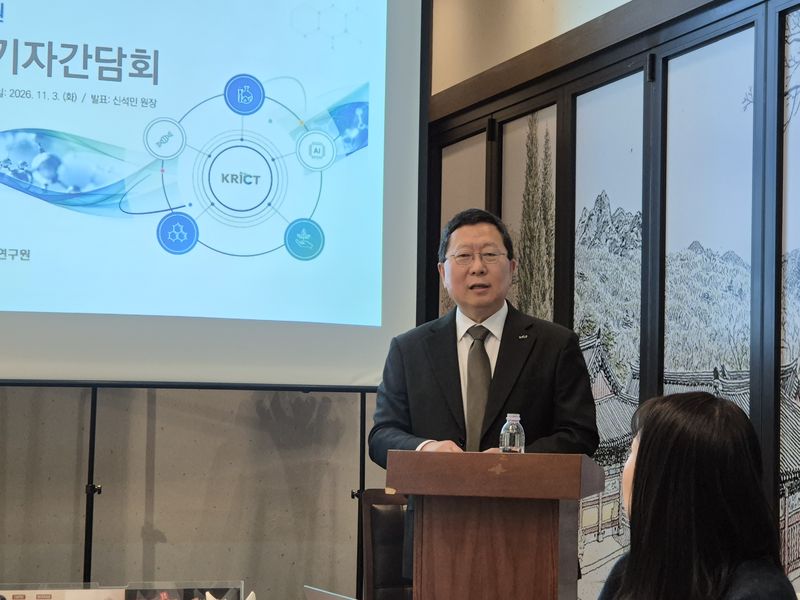
[Financial News] The Korea Research Institute of Chemical Technology (KRICT) will establish an AI organization directly under its president to expand the use of AI across all areas of the institute. It plans to launch the organization in full next year, standardize chemical experiment data, and develop specialized models suitable for AI training.
Seokmin Shin, president of KRICT, held his first press briefing since taking office on the 3rd and announced the plan, saying, “In response to structural changes in the chemical industry and the sweeping AI transformation, we will secure the core chemical technologies the nation needs.”
Shin first said, “A task force (TF) has been formed and is currently working to establish an AI organization,” adding, “We will also build the infrastructure and provide training so that more people can use AI effectively in research and research administration.”
Specifically, KRICT will standardize all experimental data from its projects so that AI can learn from it. The plan is to develop specialized models for each field and put them to use.
Shin said, “The AI organization is scheduled to launch next year. Our plan is to make AI available even in areas where it is not currently being used. The challenge is to bring together people within the institute who are good at AI.”
He also shared his thoughts on talent. Shin said, “It is difficult to recruit people who specialize in AI,” adding, “Working conditions for researchers at government-funded research institutes need to improve. What matters is changing perceptions about the need for better working conditions.”
He added, “It is important to establish a system that enables researchers at government-funded research institutes to conduct research with pride and a sense of self-worth under the post-PBS (Project-Based System) framework.” He also said the low share of personnel costs in the overall budget needs to be addressed.
He also emphasized the need to develop a research portfolio suited to KRICT in the post-PBS framework. Shin said, “Ultimately, we should develop KRICT’s core capabilities through the Basic Research Program, while also building the new capabilities we will need in the future on the basis of those core strengths. Strategic research should tackle important national challenges and connect the solutions to industry. We are also considering a roadmap for strategic research programs.”
For example, KRICT plans to set aside about 3 billion won next year for early-career researchers to conduct new research, then continue the effort for around three years so it can be developed into a strategic research program. The plan is intended to help the institute navigate the transition to the post-PBS framework.
KRICT is conducting five strategic research projects this year: urban integrated energy-module technology, next-generation modality-based therapeutics, efforts to address antibiotic-resistant bacteria, materials and components for automobiles, and an advanced-materials platform for autonomous experimentation. These projects aim to address national challenges. In addition, through its Global Top Strategic Research Group, KRICT is conducting research on next-generation rechargeable batteries and carbon dioxide to address the climate crisis. It has also recruited its first specially appointed researcher from industry.
Shin said, “We will secure the core chemical technologies the nation needs and ensure that research outcomes contribute to industry and people’s lives.” He added, “We will create an environment where researchers can pursue challenges and immerse themselves in their work autonomously, and move forward as a research institute that answers the problems facing the nation and society through chemistry.”
[email protected] Yeon Ji-an Reporter