KOSPI falls more than 3% as foreign and institutional investors sell KRW 2.8 trillion; KOSDAQ plunges 4% [fn Afternoon Market Update]
- Input
- 2026-11-03 14:25:25
- Updated
- 2026-11-03 14:25:25
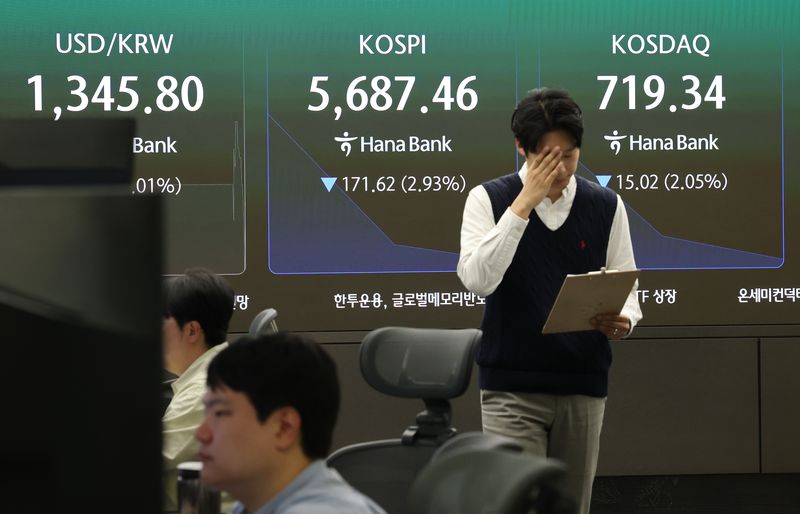
According to the Korea Exchange, as of 2:15 p.m. on the 3rd, the KOSPI was trading at 5,640.10, down 218.98 points (3.74%) from the previous trading day.
On the main board, retail investors were net buyers of KRW 2.6061 trillion. Foreign investors and institutions, meanwhile, were net sellers of KRW 2.0028 trillion and KRW 860.3 billion, respectively.
By sector, pharmaceuticals (0.25%) and paper and wood (0.17%) were among the gainers. Medical and precision equipment (-7.90%), machinery and equipment (-5.23%), electrical and electronic equipment (-4.85%), and chemicals (-4.01%), among others, were lower.
Among the largest stocks by market capitalization, Hanwha Aerospace (2.97%), Samsung Biologics (1.83%) and Hyundai Mobis (0.14%) were among the gainers. Doosan Enerbility (-4.49%), Samsung SDI (-4.28%), Samsung Life Insurance (-3.86%) and SK Square (-3.58%), among others, were lower.
Large-cap semiconductor stocks were also broadly weaker. Samsung Electronics was trading at KRW 222,000, down KRW 7,000 (3.06%) from the previous trading day. SK hynix was at KRW 1,417,000, down KRW 55,000 (3.74%).
The KOSDAQ was trading at 704.63, down 29.73 points (4.05%) from the previous trading day. Retail investors were net buyers of KRW 365.2 billion, while foreign investors and institutions were net sellers of KRW 163.9 billion and KRW 189.3 billion, respectively.
Among the KOSDAQ’s largest stocks by market capitalization, EcoPro (-4.47%), EcoPro BM (-5.21%), Jusung Engineering (-7.44%), EO Technics (-9.20%) and Robotis (-9.78%), among others, were lower.
Even as international oil prices eased, concerns over AI companies’ financing and investment costs appeared to weigh on investor sentiment. News of progress in talks between the United States and Iran sent West Texas Intermediate (WTI) crude down more than 7% overnight, below $100 a barrel. However, reports that Meta and Oracle were each seeking to raise $20 billion reignited concerns about whether they could continue securing the funds needed for AI investment.
Anthropic’s amended securities filing also highlighted the investment burden, revealing large spending commitments alongside rising revenue. Apple’s outlook for gross margins fell short of market expectations despite strong sales of new products, underscoring the burden of memory costs.
Kang Jin-hyuk, a senior researcher at Shinhan Investment & Securities, said, “Despite the easing in oil prices, concerns over constraints on AI capital have led the market to give back the previous day’s gains, particularly in semiconductor stocks.” He added, “Foreign investors have been selling in both the spot and futures markets, while financial investment firms and pension funds—which had recently supported the market—have also seen net selling.”
[email protected] Bae Han-geul Reporter