[Interview] “What the police must protect is someone’s safe return home” ... A police chief who became an author
- Input
- 2026-11-04 06:00:00
- Updated
- 2026-11-04 06:00:00
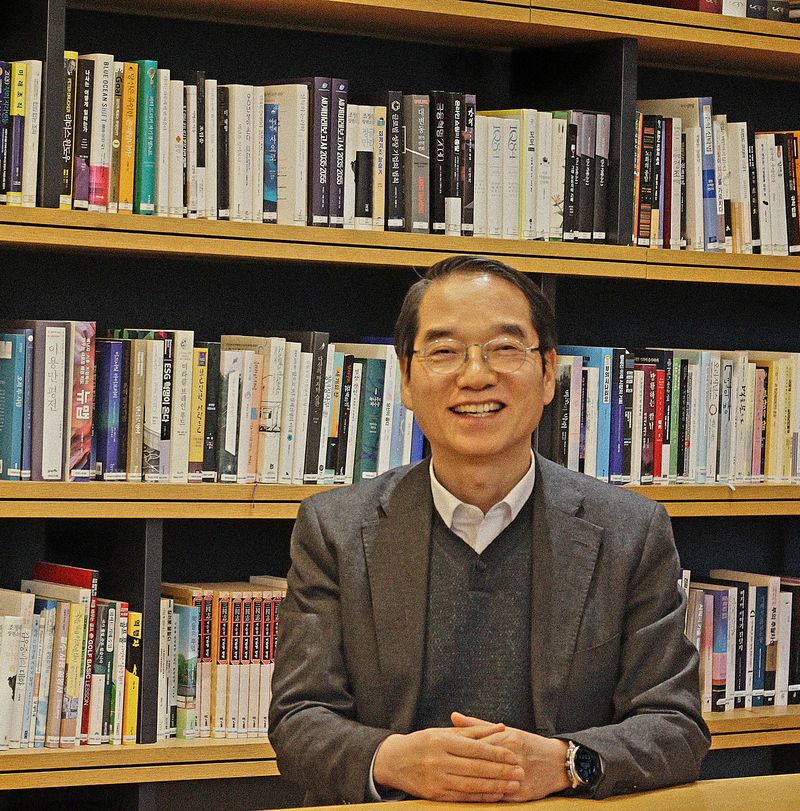
[Financial News] The boy from a mountain village in Bonghwa, North Gyeongsang Province, who walked ten ri (about four kilometers) along a mountain path to school in black rubber shoes, would later lead Yeongdeungpo Police Station, regarded as a key post for public safety in Seoul. Kim Du-yeon, former chief of Seoul’s Yeongdeungpo Police Station, is currently serializing on Naver Series the web novel ‘The Way of the Police: Choices That Protect People,’ based on his life. In an interview with Financial News, Kim said, “As time passed, the people who lifted me up became clearer in my mind than what I had achieved,” adding, “I wanted to share through stories the warmth I received from them.”
Born in Bonghwa in 1965, he graduated from Haeundae High School in Busan and the Korean National Police University (Class 4), then joined the police as a lieutenant. He built most of his career in intelligence, serving as head of the intelligence divisions at Guro and Yangcheon police stations, chief of Hwacheon Police Station in Gangwon State and Geochang Police Station in South Gyeongsang Province, and head of Intelligence Division 3 at the Korean National Police Agency, among other posts. During his tenure as chief of Yeongdeungpo Police Station from October 2011 to April 2013, the station was selected as the nation’s “Best Police Station for Public-Safety Performance in 2012” among 249 police stations and received a presidential group commendation. After serving as head of Security Division 2 at the Korean National Police Agency and in other positions, he honorably retired in 2016 at the rank of senior superintendent. After retiring, he served as CEO of Mapo Aekyung Town, an Aekyung Group affiliate. He is currently a full-time auditor at Yido and a member of the Seoul Metropolitan Autonomous Police Commission, among other roles. Earlier this year, he published the autobiographical essay collection ‘People and Paths.’
What led him to pursue admission to the Korean National Police University, overcoming competition of 25 applicants for each place, was the people he had seen in his mountain village. “Growing up in a poor mountain village, I saw neighbors who struggled but didn’t know where to turn for help,” Kim said. “I wanted to become a police officer people could turn to without hesitation when they were having a hard time or felt afraid.”
The word that has run through his long career in the police and continues to define him is “people.” The memory that has stayed with him longest from his 28 years in the police is the reopening of a crosswalk in front of Yeongdeungpo Station after 32 years. Although the other side of the road was right before their eyes, elderly people, people with disabilities and people pushing strollers were left stranded at the stairs to an underpass. Shopkeepers in the underground shopping arcade worried that their livelihoods would be at risk if people began walking above ground. “At first, I said, ‘Is anything more important than people’s lives?’” he recalled. “It was only when I heard the reply, ‘Don’t we have to make a living, too?’ that I realized you can’t persuade people simply by saying what is right.” The crosswalk was installed after he consulted with relevant agencies and repeatedly listened to the shopkeepers’ concerns. “The words of an elderly person who crossed the crosswalk—‘Now we can finally cross like human beings’—still stay with me,” he said. “I would make the same choice if I could go back.” Just as he created a crossing for people, publishing a book about his experiences is another way of making a path for future readers.
In August 2012, while he was serving as chief, an armed rampage took place in the middle of Yeouido. “I can’t forget the victim’s hand that I held at the scene of the Yeouido knife attack,” he recalled. “The victim was an ordinary citizen heading home after work. Their hand and mine were both trembling.” He added, “I felt acutely that what the police must ultimately protect is someone’s safe return home.”
He chose to write a web novel after publishing an essay collection in order to reach younger readers. “I thought I could get closer to them with a web novel that they could read in small portions on their phones,” he said. He identified “holding back the urge to explain” as the most difficult part. Trying to include everything from such a long period could easily turn the story into a list of career milestones, he explained, so he focused each episode on a central experience and choice and tried to convey emotions through scenes and dialogue. On changing the protagonist’s name to “Daedo,” he said, “I wanted to look at myself from a little distance and reflect on the choices I could have made better.”
He handled his experience in intelligence and security with restraint. He left out specific intelligence details and investigative circumstances related to the National Security Act, focusing instead on the responsibilities and dilemmas of the time against the backdrop of national events and major public-safety issues. “The less visible the work, the more important it was to verify the facts accurately and exercise restraint in making judgments,” he said.
He also drew on his experience handling safety at a company. “The goal is the same: to ensure people get home without being hurt,” he said, while noting a challenge of corporate safety: “When no accident happens, the money and effort spent on prevention are hard to see.”
Speaking to junior colleagues in the field, he said, “On the ground, you have to make decisions in a split second, but society’s expectations of those decisions keep rising.” He added, “We also need to look at whether there are enough personnel, training, equipment and support to meet those expectations.” He went on to emphasize, “Wrongdoing must certainly be corrected, but we also need to examine gaps in organizations and systems alongside individual responsibility,” and, “It is also necessary to trust and support junior officers so they can work responsibly.”
Asked why he chose to serialize the novel for free, he replied, “If it gives someone the courage to keep going or the comfort to get through the day, I think that is more than enough to make writing it worthwhile.” Plans to publish the work or adapt it for the screen after it is completed have not yet been decided. “For now, I want to carefully finish the story I promised my readers,” he said.

[email protected] Lee Hwan-ju Reporter