Why Your Face Turns Red—It’s Not Because You’re “Sensitive” [Woo Su-han’s Excellent Skin Note]
- Input
- 2026-11-03 14:38:01
- Updated
- 2026-11-03 14:38:01
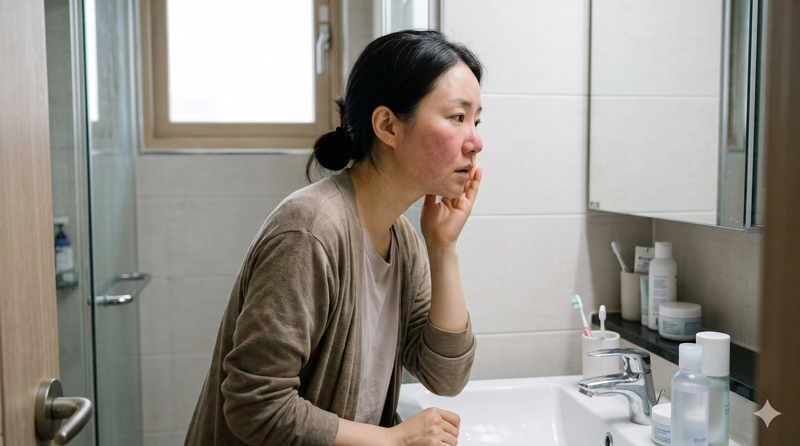
[Financial News] If your face often turns red for no obvious reason and the redness does not fade easily, or if your skin feels hot or stings and acne-like red bumps keep recurring, the symptoms may not simply be due to “sensitive skin.” One key condition to consider in such cases is rosacea.
Why Does the Face Turn Red?
The skin on the face contains numerous tiny blood vessels. When body temperature rises or a person experiences emotional stimulation, the blood vessels in the skin dilate, increasing blood flow and making the face look red. So a red face after going somewhere hot or exercising is a normal response that can happen to anyone. The face may also turn temporarily red after drinking alcohol or eating spicy food, or when a person feels tense or emotionally worked up. With normal facial flushing, once the cause goes away, the blood vessels constrict again and the skin returns to its original color.
Rosacea, however, is not a condition that can be explained simply by blood vessels dilating easily. It is a chronic inflammatory skin disease that can cause a range of symptoms, mainly in the central area of the face, including recurring or persistent erythema and flushing, visible small blood vessels, papules and pustules, and a burning sensation. Multiple factors are thought to be involved, including heightened responses in the skin’s blood vessels and nerves—known as “neurovascular dysregulation”—abnormal inflammatory responses in the immune system, and changes to the skin barrier.
With rosacea, the face may flush and feel hot easily in response to various triggers, including heat, ultraviolet radiation, and spicy food. Redness may also remain at other times, or small blood vessels on the skin’s surface may become visible. The symptoms are not the same for every patient, and which ones are most prominent varies from person to person.
It’s easy to think your “skin has simply become sensitive”
Recurring flushing is common with rosacea, but some patients may feel that it was the first symptom they noticed. They may feel fine ordinarily, but find that their face turns unusually red after drinking alcohol or eating hot food, or flushes more easily than other people’s when they enter a warm place. In these cases, too, many people think their skin has simply become sensitive.
But if flushing persists for a long time, redness around the cheeks and nose remains even when you are not experiencing a flare, or fine blood vessels on the skin’s surface begin to stand out, rosacea may be worth considering. Many people also report a burning or stinging sensation and a feeling of dryness. They may feel that their skin has become much more sensitive than before: even cosmetics they used without a problem may sting, and their face may become intensely red after washing. If these changes occur alongside recurring facial flushing, it is best not to assume that it is simply sensitive skin.
Alcohol, spicy food, heat... Why do they make your face redder?
One characteristic of rosacea is that certain triggers can easily worsen the symptoms. Common triggers include ultraviolet radiation, high temperatures, hot baths or saunas, strenuous exercise, alcohol, hot or spicy food, sudden temperature changes, and stress. These triggers can affect the skin’s blood vessels and nerve responses, worsening flushing and the burning sensation.
Ultraviolet radiation is one of the important factors that can worsen rosacea. Repeated exposure to UV rays can affect the skin’s inflammatory response and blood vessels, so regular sun protection is important.
However, the same foods or environmental conditions do not cause problems for everyone. One person may become intensely flushed after drinking alcohol, while another may experience worse symptoms after a sauna or exercise. Rather than automatically restricting a wide range of foods and activities because you have rosacea, a practical way to manage it is to identify and reduce the triggers that repeatedly worsen your own symptoms.

/Director of the Mapo Gongdeok branch of THE HEAL MAPO Dermatology Clinic
[email protected] Kim Hyeon-seon Reporter