AI Glasses Prompt People to Replace Even Perfectly Good Eyewear as ‘Horn-Rimmed Glasses Phobia’ Spreads Ahead of the CSAT
- Input
- 2026-11-03 14:58:47
- Updated
- 2026-11-03 14:58:47
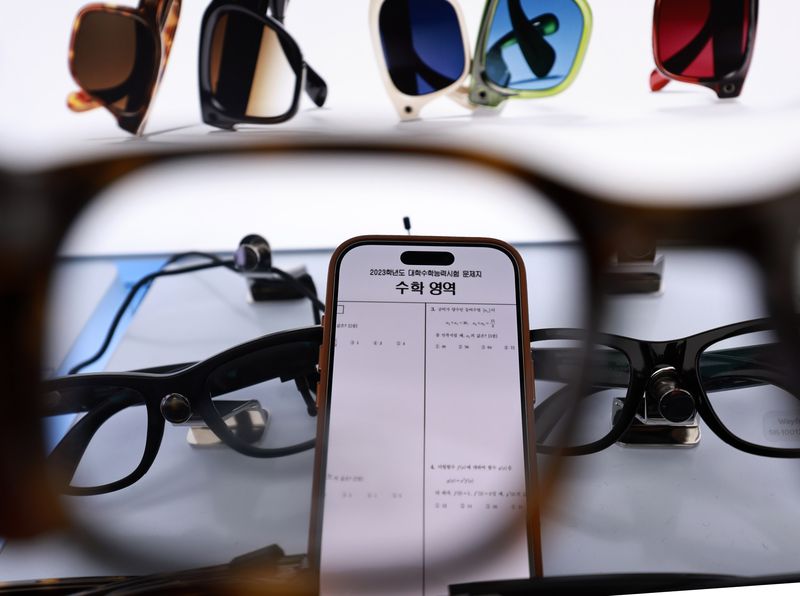
On the 3rd, sources in the education sector said some test-takers and parents have recently been considering switching from their usual horn-rimmed glasses to a different style or wearing contact lenses. They are concerned that ordinary glasses could also come under suspicion as smart glasses—which can be difficult to distinguish from regular glasses by appearance—are used to cheat on exams.
Some smart glasses look little different from ordinary glasses, making it difficult to tell by sight whether someone is wearing them. Cameras and microphones built into the frames can capture video and audio of the surroundings, and, when connected to AI, the glasses can search for information; some models can also display relevant content on the lenses. As a result, how to detect cheating involving smart glasses has emerged as a new challenge at test sites. This year, test-takers wearing smart glasses were also caught during essay exams at the University of Seoul and Yonsei University.
Parents of prospective test-takers, as well as parents of high school seniors preparing for the CSAT, are also making preparations. Moon, 56, whose child is in the second year of high school, plans to replace the child’s frames with transparent horn-rimmed ones during winter break. Moon has not liked thin frames because of their fit and style, but is looking for an alternative given the possibility that the child’s current horn-rimmed glasses could be mistaken for smart glasses. “Since I replace the lenses every school break anyway, I’m thinking of changing the frames at the same time this time,” Moon said, adding, “I think it’s better to get used to new glasses in advance than to change them suddenly just before the CSAT.”
CSAT proctors have raised concerns that it is difficult to determine on site whether someone is wearing smart glasses. Education authorities plan to strengthen oversight, including by assigning dedicated personnel to prevent cheating, but concerns have also been voiced that the distinctive difficulty of identifying smart glasses by sight could limit on-site responses. The Korean Teachers and Education Workers Union (KTU) surveyed 2,716 middle and high school teachers nationwide from the 21st to the 27th of last month. The results showed that 82.3% of respondents saw limits in the existing proctoring procedures distributed by the Ministry of Education for identifying smart-glasses use during the CSAT and mock exams.
Experts agree that specific inspection guidelines and a clear scope of responsibility are needed to reduce the burden on both students and proctors. They say uniform procedures should be established to prevent proctors from applying different standards when determining whether glasses are smart glasses, and to avoid disputes over inspection results. Hyun Kyung-hee, a KTU spokesperson, stressed, “The Ministry of Education should also issue specific guidelines on who makes the final determination about whether someone is wearing smart glasses, and who is responsible if complaints or disputes arise during the inspection process.”
Providing advance guidance and establishing a technical identification system to protect test-takers’ right to sit their exams are also seen as important tasks. The aim is not to focus solely on preventing cheating, but to ensure that students taking exams properly are not unnecessarily suspected or disrupted during inspections. Park Nam-gi, an emeritus professor at Gwangju National University of Education, said, “Rather than placing the inspection responsibility solely on proctors, the obligations of students to comply with legitimate inspection requests and the authority of proctors should also be clearly specified.” He added, “In the long term, it is also worth considering the introduction of specialized equipment that can technically identify smart glasses.”
[email protected] Seo Ji-yun Reporter