“Concerns over discrimination against U.S. companies” ... U.S. industry groups push back against South Korea’s platform regulations
- Input
- 2026-11-03 17:38:59
- Updated
- 2026-11-03 17:38:59
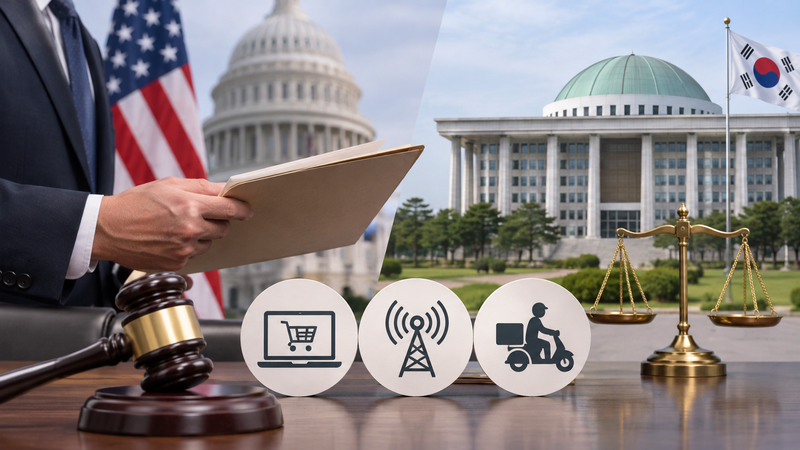
[Financial News] U.S. economic and digital industry groups have raised concerns that bills related to platforms, telecommunications and delivery being pursued in South Korea’s National Assembly would burden U.S. companies. They also urged the Office of the U.S. Trade Representative (USTR) to respond.
According to industry sources on the 3rd, the U.S. Chamber of Commerce, the Association for Competitive Technology (ACT), the Coalition of Services Industries (CSI), the Computer & Communications Industry Association (CCIA) and the Software & Information Industry Association (SIIA) sent a joint letter on the 2nd to U.S. Trade Representative Jamieson Greer. They argued that the Platform Transaction Fairness Bill, an amendment to the Telecommunications Business Act and a bill regulating delivery platform prices, all being pursued in South Korea, could constrain U.S. digital companies’ activities in the South Korean market.
The groups argued that the Platform Transaction Fairness Bill targets U.S. companies operating in a digital market worth $100 billion or more, while excluding traditional suppliers, including Korean and Chinese companies, from its scope. They said it could ban a broad range of commercial practices, introduce financial custody obligations and price regulations, and substantially expand the Korea Fair Trade Commission’s enforcement powers and discretion to intervene in platform operations.
They described the amendment to the Telecommunications Business Act as introducing into South Korean telecommunications law the interoperability rules in the European Union’s (EU) Digital Markets Act (DMA). Under the measure, designated mobile operating system providers would have to allow third parties access to device hardware and software functions; the groups claimed it effectively targets two U.S. companies.
They also raised concerns about the bill regulating delivery platforms. According to the letter, the bills include measures such as capping the combined total of brokerage, advertising and delivery fees at 15% of the order amount. The groups also argued that some bills require the disclosure of commercially sensitive information and include sanctions ranging from administrative penalties of up to 10% of revenue to criminal penalties.
The groups jointly stressed that “the three bills mentioned above run counter, at a minimum, to the spirit of the agreement, regardless of whether they violate the wording of the commitments Korea made in the U.S.-Korea Joint Fact Sheet.” They also warned that the bills could pass by the end of the year, as South Korean authorities are seeking to advance them as quickly as possible, and urged the USTR to consult with the South Korean government and convey its opposition to the bills.
[email protected] Kim Hyun-ji Reporter