Is the birthplace of coffee mix losing its footing? Cafes just across the street at home, war fallout abroad compounds its woes on all fronts
- Input
- 2026-11-04 10:59:36
- Updated
- 2026-11-04 10:59:36
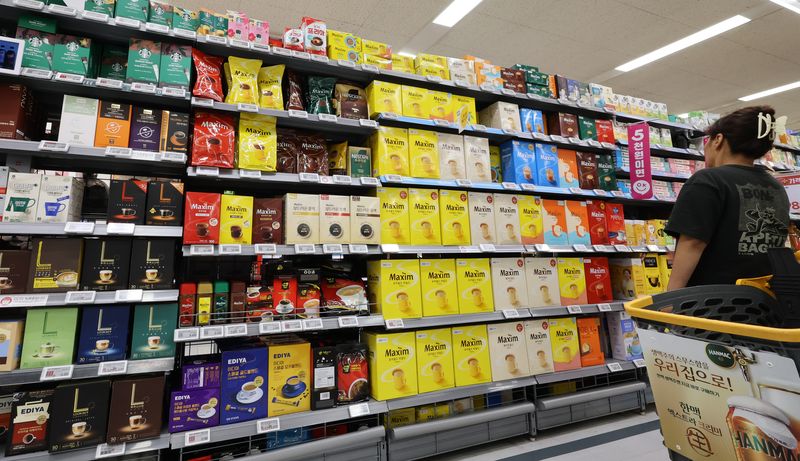
[Financial News] Coffee mix, first developed in South Korea, is facing troubles on all fronts as coffee shops spread across the country and global wars take their toll. With consumers turning to coffee shops and the domestic market shrinking, war has also blocked access to the Middle East, its largest export destination, cutting exports nearly in half.
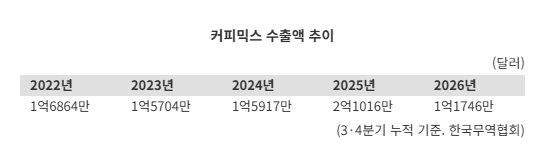
According to the Korea International Trade Association on the 4th, exports of instant coffee, including coffee mix, totaled $117.46 million through the third quarter of this year, down $92.7 million (44.1%) from $210.16 million in the same period a year earlier. On a cumulative basis through the third quarter, instant coffee exports were $168.64 million in 2022, $157.04 million in 2023 and $159.17 million in 2024, before surging to $210.16 million last year and entering an upward trend. This year, however, they have been on a steep downward trajectory.
The biggest factors are the Middle East war and the prolonged Russo-Ukrainian War. Key export markets for Korean-made coffee mix include the Middle East, including Israel, and Russia. Domestic manufacturers have made their products popular in those markets by using world-class freeze-drying technology to preserve the distinctive taste and aroma of coffee beans. A key selling point was that the coffee could be easily mixed and consumed without deteriorating even in extreme climates, from scorching desert heat to bitter cold. In particular, the creamer in coffee mix is made from plant-based ingredients such as palm oil and coconut oil, making halal certification easier and giving it a competitive edge in the Middle East over European-style coffee made with animal milk.
But as the Middle East war intensified, maritime routes to the region, including Israel, its largest market, were blocked. Because the products are made in South Korea and then exported, rather than produced locally overseas, the industry bore the full brunt of geopolitical trade risks. In fact, Israel accounted for $40.41 million, or 19.2%, of total exports of $210.16 million from January to September last year, but exports there this year have been virtually nonexistent.
In addition, as sanctions against Russia over the Russo-Ukrainian War continued, exports to Russia, another key market, were also brought to a halt. The structural limitation that Dongsuh Foods Co., Ltd., the leader in South Korea’s coffee-mix market with brands such as Maxim and KANU, cannot export overseas is also cited as an obstacle to expanding overall exports.
The product is losing ground in the domestic market as coffee shops, including low-cost chains, have multiplied rapidly. According to the Ministry of Agriculture, Food and Rural Affairs, the number of coffee shops nationwide rose sharply from about 83,000 in 2020, during the COVID-19 pandemic, to 106,452 in 2024, surpassing 100,000. By contrast, the domestic instant coffee market has been shrinking, from 1.3243 trillion won in 2023 to 1.3038 trillion won in 2024 and 1.2299 trillion won last year.
Industry insiders believe that resolving international trade risks and stabilizing raw material and input prices will be key to an export recovery. A food industry official said, “The Middle East war has blocked export routes, and international palm oil and coffee bean prices have also soared, weakening the distinctive price competitiveness of coffee mix—its value for money. As the domestic market has entered a structurally shrinking phase, we can expect exports to rebound only if the external trade environment improves, including through an end to the war.”
[email protected] Park Kyung-ho Reporter