“My account is the only thing melting away”... A surge to cheer, but a day later it’s back where it started
- Input
- 2026-11-04 06:00:00
- Updated
- 2026-11-04 06:00:00

[Financial News] “One day it soars and the next it plunges, so I have no idea how to respond—and there’s nowhere to hide.”
As the roller-coaster ride in South Korea’s stock market continues, individual investors are growing increasingly weary.
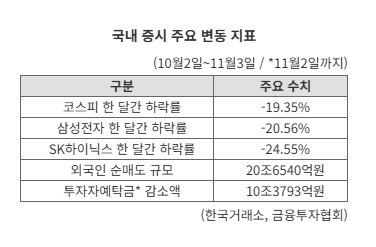
According to the Korea Exchange (KRX) on the 4th, KOSPI fell 19.35% in a month, from 7,003.74 on the 2nd of last month to 5,648.79 today. It plunged 7.57% in a single day on the 15th of last month, but surged 6.63% on the 28th.
The hard-to-predict swings continued: the index fell 1.24% on the 29th and 3.48% on the 30th, then rebounded 2.24% on the 2nd of this month. Today, it fell 3.59% from the previous trading day, slipping to the 5,600 mark.
Samsung Electronics and SK hynix suffered steeper losses than the index. Samsung Electronics fell 20.56%, from 276,000 won on the 2nd of last month to 219,250 won today. Over the same period, SK hynix dropped 24.55%, from 1,841,000 won to 1,389,000 won.
Today, Samsung Electronics and SK hynix also fell 4.26% and 5.64%, respectively, from the previous trading day. With sharp daily swings continuing—SK hynix surged 10.89% on the 28th of last month before dropping 7.08% on the 30th—the burden on individual investors to respond is growing.
External factors shaking South Korea’s stock market are also becoming increasingly complex. International oil prices fell in the 7% range today, dropping below $100 a barrel amid expectations of progress in negotiations between the United States and Iran, among other factors. Yet KOSPI fell 3.59%. Concerns over the cost of AI investment by U.S. Big Tech companies and their ability to raise funds had a greater impact on domestic semiconductor stocks than the positive news of stabilizing oil prices.
The Federal Reserve System (Fed)’s interest-rate path and Treasury yields, as well as the possibility of changes to industrial and trade policies after the midterm elections, are also adding to uncertainty. Since the semiconductor and AI industries are affected by U.S. export restrictions and subsidy policies, it has become difficult to explain stock movements based solely on the earnings of domestic companies. Analysts say a pattern is taking hold in which U.S. Big Tech investment plans and earnings outlooks are quickly transmitted to major domestic semiconductor stocks.
Foreign investors’ retreat is also pronounced in the supply-demand picture. From the 2nd of last month through today, foreign investors were net sellers of about 20.654 trillion won on the main board.
By contrast, individual investors and institutions absorbed the shares on offer, buying a net 5.1073 trillion won and 5.114 trillion won, respectively. On this day alone, individual investors bought a net 1.6635 trillion won, while foreign investors sold a net 1.5142 trillion won. Individual investors are once again taking on the foreigners’ selling onslaught.
As investor fatigue grows, funds waiting on the sidelines have dwindled. Investor deposits fell by about 10.3793 trillion won, from 100.8422 trillion won on the 2nd of last month to 90.4629 trillion won on the 2nd of this month. Individual investors are buying stocks during the sharp downturn, but the funds waiting in the market have instead shrunk.
An industry official at a securities firm said, “It will be difficult for investor sentiment to recover on the strength of a short-term rebound alone. Individual investors’ fatigue will ease only when we see global uncertainties abate this month and market volatility settle.”
[email protected] Kang Jung-mo Reporter