“There was no intent to subvert the constitutional order, nor was there a riot” ... Kim Yong-hyun’s side seeks acquittal in closing arguments
- Input
- 2026-11-03 13:20:03
- Updated
- 2026-11-03 13:20:03
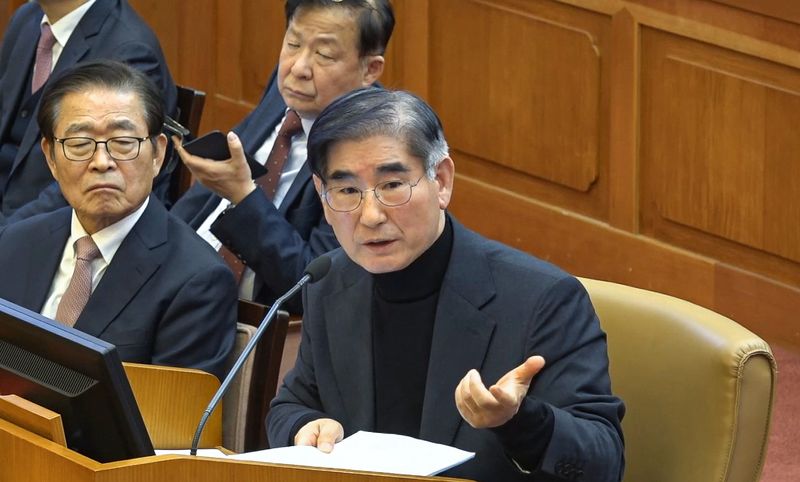
[Financial News] Kim Yong-hyun, the former Minister of National Defense, was put on trial on charges including carrying out key duties in an insurrection related to the Dec. 3 declaration of emergency martial law. At the closing stage of his appeal, his side strongly called for an acquittal and dismissal of the indictment, arguing that “there was no intent to subvert the constitutional order, nor was there a riot necessary to establish the crime of insurrection.”
On the 3rd, Criminal Division 12-1 of the Seoul High Court (High Court Judges Lee Seung-cheol, Jo Jin-gu and Kim Mina) held the 26th hearing in the appeal of former President Yoon Suk Yeol, former Minister Kim, Korean National Police Agency Commissioner General Jo Ji-ho, former Seoul Metropolitan Police Agency Commissioner Kim Bong-sik and others on insurrection charges, and began hearing the defendants’ closing arguments.
That morning, the legal team for former Minister Kim pointed to serious procedural violations in the investigation and prosecution, and urged the court to dismiss the indictment.
Kim’s side stressed that “although Section 4(2) of the former Prosecutors’ Office Act prohibits a prosecutor from directly indicting a crime that the prosecutor initiated an investigation into, the same prosecutor handled the initiation of the investigation, the indictment, the maintenance of the prosecution and the sentencing recommendation,” adding that “in light of Supreme Court of Korea precedents, the indictment itself is invalid.”
On the merits, the defense also criticized the lower court’s 30-year prison sentence, saying it relied on circumstantial inferences without direct evidence. Kim’s side argued that “the constitutional review of martial law and whether the crime of insurrection has been established are entirely different questions,” and that “even under the standards set out by the lower court, this was merely a one-off, short-term measure, making it difficult to find an intent to subvert the constitutional order by paralyzing the National Assembly’s functions for a substantial period.”
In particular, the defense pointed out that “no shots were fired, no one was arrested or detained, and there were no casualties when martial law was declared; the deployment of troops was also a blocking operation to maintain order around the perimeter, not an exercise of force to suspend the National Assembly’s functions,” adding that “the requirement of a riot was not met either.”
The defense also continued its rebuttal of the “drone leaflet operation” and the “Samcheong-dong safe house meeting,” which the special counsel team had cited as grounds for appeal. The legal team said the “drone leaflet operation was psychological warfare, properly planned and approved at the JCS level to respond non-physically to North Korea’s repeated provocations involving trash balloons.” It added that “if the aim had been to heighten military tensions to create the conditions for martial law, they would not have maintained a policy of NCND (neither confirming nor denying) or ended the operation early, just before emergency martial law was declared.”
Earlier, the special counsel team sought the death penalty for former President Yoon and life imprisonment for former Minister Kim. The court is scheduled to continue hearing Kim’s side’s closing arguments on each item of evidence in the afternoon.
[email protected] Lee Chang-hoon Reporter