North Korea unveils vertical-dive and cluster-munition tests of ‘Hwasal’ cruise missiles... Military: “Technology from 20 years ago; we can neutralize them immediately if provoked”
- Input
- 2026-11-03 13:38:28
- Updated
- 2026-11-03 13:38:28
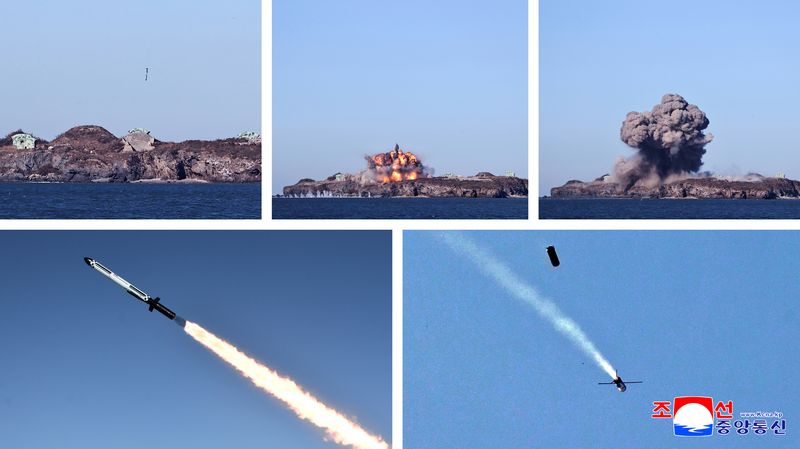
North Korea tested the effectiveness of a cluster warhead (dispersal warhead) loaded with numerous submunitions on a strategic cruise missile, and carried out a test of a “terminal maneuver” in which the missile dives vertically toward its target while bypassing air defense systems.
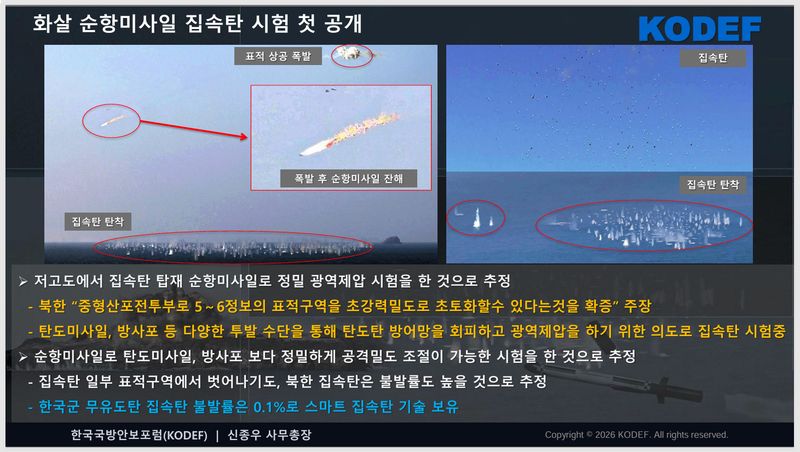
On the 3rd, North Korea’s state-run Korean Central News Agency reported that the Warhead Research Institute of the Missile General Bureau had conducted a power assessment test of a strategic cruise missile dispersal warhead and a test of its vertical-strike flight characteristics on the 2nd, under the guidance of Gen. Kim Jong-sik, first vice department director of the Central Committee of the Workers’ Party of Korea. The agency claimed that the test “confirmed that a medium-sized dispersal warhead can lay waste, at an extremely high density, to a target area of 5–6 jeongbo (about 15,000–18,000 pyeong, an area equivalent to 7–8.3 soccer fields).”
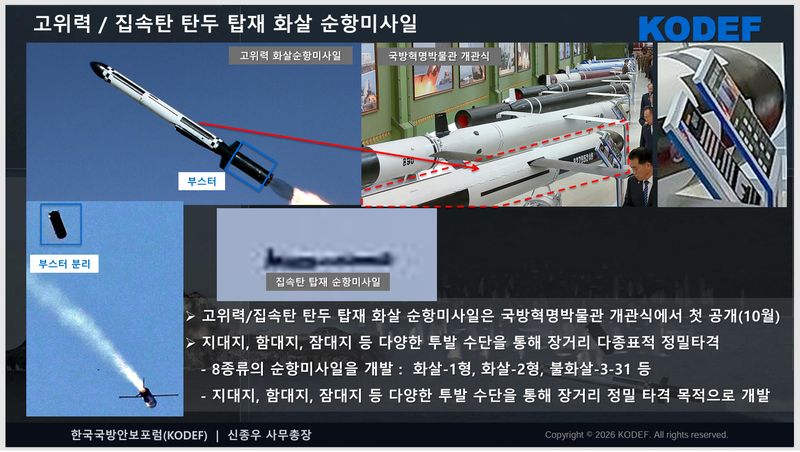
The test North Korea conducted this time is believed to have involved a Hwasal-series cruise missile fitted with high-yield and cluster-munition warheads, first unveiled at the opening ceremony of the Defense Revolution Museum last October. North Korea is currently developing a total of eight types of cruise missiles, including the Hwasal-1, Hwasal-2 and Pulhwasal-3-31, and diversifying their launch platforms, including ground-to-ground, ship-to-ground and submarine-to-ground.
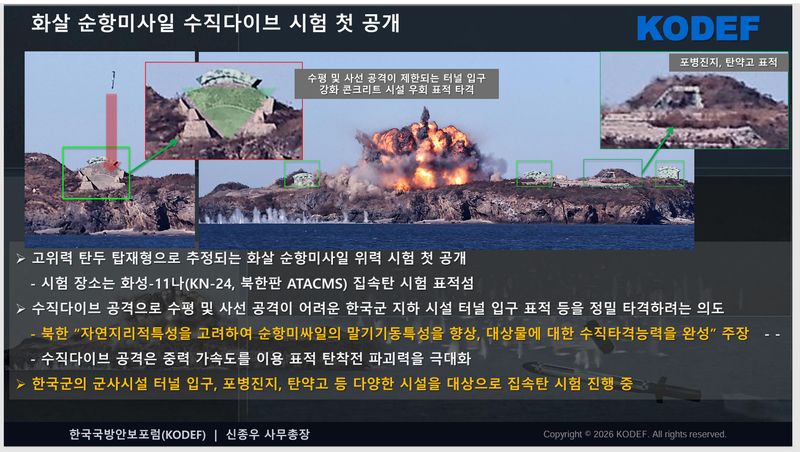
According to an analysis by the Korea Defense & Security Forum (KODEF), North Korea’s adoption of a “vertical-dive” attack profile for cruise missiles is intended to precisely strike tunnel entrances, artillery positions, ammunition depots and other key ROK Armed Forces facilities that are difficult to hit with horizontal or oblique attacks. The calculation is to use gravitational acceleration during the terminal maneuver to maximize destructive power just before impact. It is also seen as a diversification strategy to evade the South Korea-U.S. ballistic missile defense networks by precisely adjusting attack density at low altitude, compared with ballistic missiles or multiple rocket launchers.
The ROK Armed Forces, however, say they can adequately control North Korea’s efforts to advance these weapons systems at the tactical level. Jang Do-young, public affairs director of the Republic of Korea Joint Chiefs of Staff (ROK JCS), said, “South Korean and U.S. intelligence authorities are closely analyzing the specifications of the missiles North Korea launched on the 2nd.” He stressed, “Our military developed and acquired precision-strike capabilities that surpass this technology 20 years ago, and maintains a constant state of operational readiness.”
The ROK JCS explained that initial detection may be somewhat constrained if North Korea exploits the characteristics of cruise missiles—which use the curvature of the Earth to fly at low altitude and take a circuitous route—to launch a surprise attack from a distant location in the north. It added, however, that a complete response system would operate in the event of an attack on South Korea. Jang reaffirmed the country’s firm military readiness, saying, “If North Korea launches cruise missiles toward us, our military has the capability to detect and intercept them with its current capabilities.”
Experts also pointed to the technical limitations behind North Korea’s claim that it could “lay waste” to an area. In an analysis, KODEF head of the secretariat Shin Jong-woo noted, “North Korea attempted a wide-area suppression test using low-flying cruise missiles carrying cluster munitions. But our analysis of publicly released photos and other material found that some submunitions fell outside the target area, indicating poor accuracy; given the technical limitations, the dud rate is expected to be very high.”
The ROK Armed Forces maintain rigorous military standards that keep the dud rate of even unguided cluster munitions at around 0.1%, and have fielded world-class “smart cluster munition” technology as an ongoing operational capability, enabling munitions to accurately identify targets and self-destruct or strike them precisely.
[email protected] Lee Jong-yoon Reporter