One parcel for 1,000 won: Incheon's '1,000-Won Delivery,' used by 10,000 small businesses, to overhaul its operations
- Input
- 2026-11-03 12:56:44
- Updated
- 2026-11-03 12:56:44
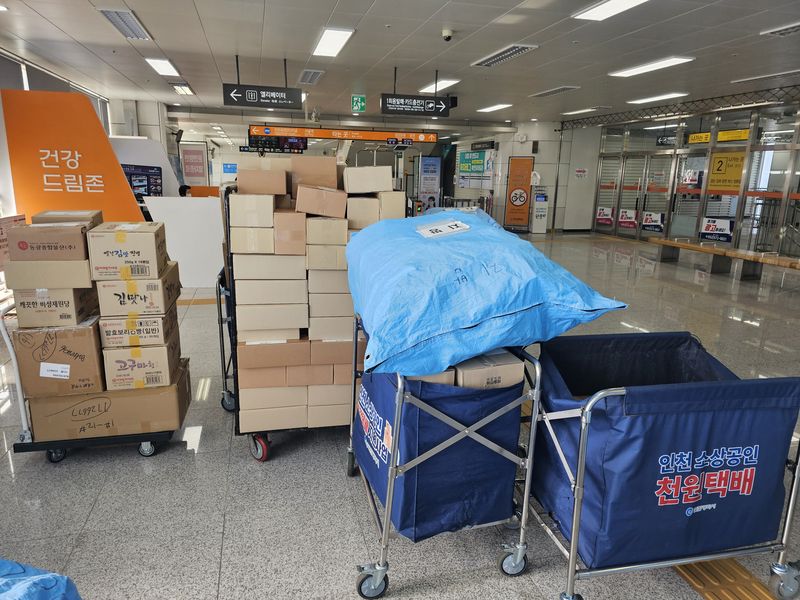
【Financial News, Incheon = Han Gab-soo, reporter】 One parcel for 1,000 won. Incheon City's “1,000-Won Delivery” is becoming a new logistics alternative for small businesses, which often receive small orders and face a heavier delivery-cost burden than large retailers. With use surging and cumulative deliveries exceeding 3.4 million just two years after the program began, Incheon City has moved to overhaul its operating system.
Incheon City said on the 3rd that it plans to improve service reliability and convenience by integrating the collection and delivery systems of the Incheon Small Business Joint Logistics Center (1,000-Won Delivery), which it has operated to reduce small businesses' logistics costs, and introducing unmanned collection facilities, mobile collection services and other measures.
1,000-Won Delivery is a daily logistics support program that uses Incheon Subway stations as logistics hubs, pooling packages from small businesses that have difficulty contracting with delivery companies individually to lower delivery costs.
Since the program began in October 2024, demand has grown, and it now operates at all 60 stations on Incheon Subway Lines 1 and 2. Small businesses can leave their items at collection centers inside the stations, where they are sorted and transported before being transferred to delivery companies' networks.
Standard delivery costs 1,000 won per parcel for items weighing 5 kg or less and with combined dimensions of 100 cm or less. Same-day delivery within the Seoul metropolitan area costs 2,000 won. A pickup service is also available for small businesses that have difficulty visiting subway stations.
Usage has also risen rapidly. As of the end of September 2026, cumulative deliveries had exceeded 3.4 million, and the number of registered businesses had reached 10,000. In particular, deliveries from January to September this year totaled 2.07 million, already surpassing last year's annual total of 1.23 million.
The program is also creating local jobs. It has hired 120 people, including older adults and women returning to work after career breaks, to sort and transport items at collection centers inside subway stations. It is being run as a community-focused initiative that both reduces small businesses' logistics costs and creates jobs for vulnerable groups.
As usage grows, so too does the need to improve operational efficiency and service quality. Incheon City has decided that, starting with the next phase of the program, it will combine the previously separate collection and operations system with the delivery system. The plan is to use logistics companies' existing infrastructure, including delivery vehicles, IT networks and customer service centers, to reduce duplicated costs and strengthen oversight and accountability throughout the delivery process.
The city will also supplement the collection system centered on subway stations. It plans to introduce unmanned collection facilities and mobile vehicle collection services in areas with limited subway access, such as industrial complexes, traditional markets and knowledge industry centers. It will also expand card and easy-payment options to simplify the process.
Incheon City plans to develop 1,000-Won Delivery from a simple delivery-fee support program into a daily logistics platform that supports small businesses' online sales and helps them expand their sales channels.
Park Gwang-geun, head of the city's Marine and Aviation Bureau, said, “We will continue to improve service quality and convenience to support small businesses' entry into online markets and expansion of their sales channels.”
[email protected] Han Gab-soo Reporter