Wall Street chiefs upbeat on corporate earnings and AI demand ... eye Asian investment opportunities
- Input
- 2026-11-03 16:15:05
- Updated
- 2026-11-03 16:15:05
Wall Street chiefs weigh risks amid optimism
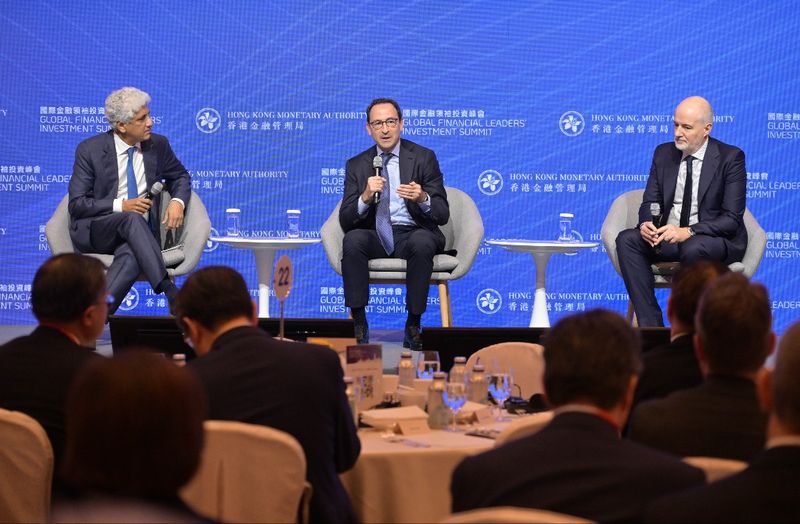
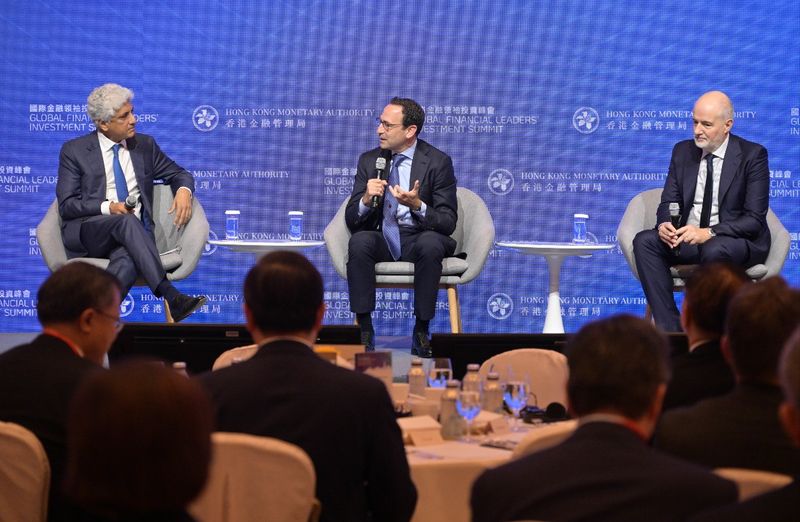
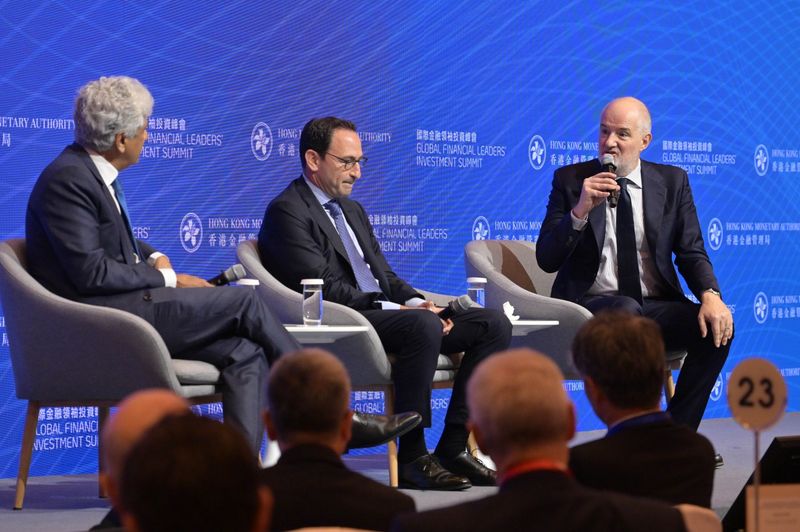
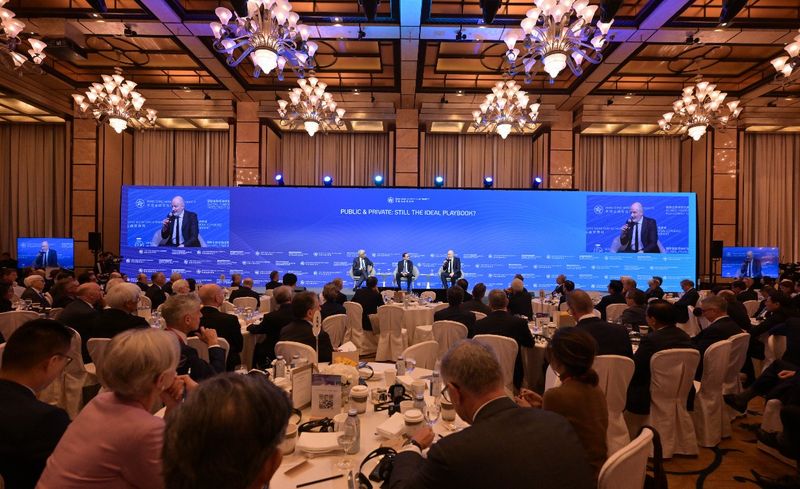
A discussion between Morgan Stanley Chairman and CEO Ted Pick and Goldman Sachs Chairman and CEO David Solomon drew attention at the summit. The two, who warned last year of the possibility of a market downturn, addressed both the factors underpinning growth expectations and the risks involved in investing during this year's discussion.
Pick said, “The earnings of large companies continue to be very strong. These companies are also highly active in bond and equity issuance and in the mergers and acquisitions (M&A) market.” He assessed, “Taken together, these factors suggest that the glass is much more than half full.”
He also expressed optimism that AI investment would support economic growth. Pick forecast that AI investment could raise the United States' real growth rate by 0.5 percentage points over the long term. However, he said the pace of technological progress and infrastructure build-out could diverge, and that the success or failure of individual projects could depend on their financing structures.
He explained, “Technology could get ahead of infrastructure, or the reverse could happen. Some projects will have such weak financing structures that they will not stand the test of time.” He added, “The question is not whether AI is having a real impact, but which businesses will succeed and which will fail.”
Solomon also distinguished between the strength of AI demand and long-term investment returns. He said, “There is no question that demand for computing power will far exceed supply for at least the next few years,” but added, “Nobody knows what the market will look like in three, five, seven or 10 years, or who the winners and losers will be.”
He pointed to AI applications as an area where value would be created in the future. Solomon said, “A lot of value will come from applications. But identifying and understanding them specifically is very difficult.” He predicted, “The opportunities are enormous, but the process will not be a straight line.”
Pick also cited energy shocks and political polarization as risks to the global economy. He said, “On the negative side, there are energy shocks stemming from ongoing conflicts. Political polarization is also happening around the world, and that is a reality.” He assessed, “Taking the positives and negatives together, you could say the likelihood of extreme outcomes has increased.”
Focus on investment opportunities in Asia, including South Korea
Executives at global financial companies also focused on investment opportunities in Asian markets, including South Korea.
KKR Co-CEO Scott Nuttall said the firm was looking for a range of investment opportunities in Asia, citing South Korea, China, Southeast Asia, Australia and India. He said, “There are many opportunities in Asia. Most global investors have relatively little invested in the region,” noting that “they do not understand these markets well enough and do not visit them often.”
HSBC Group CEO Georges Elhedery described the expansion of trade and investment between Asia and the Middle East, as well as capital flows within the region. He stressed, “There is abundant capital in this region. It has traditionally been invested in attractive markets such as the United States, but is now increasingly looking for opportunities within Asia.”
However, in the AI sector, where investment demand is high, the process of building actual infrastructure was cited as a potential variable.
Brookfield CEO Bruce Flatt identified power supply as the biggest constraint on data center expansion. He said, “The scale of the energy needed is putting strain on power systems around the world. Spare capacity has been almost exhausted.” He added, “If you cannot secure power, you cannot build data centers. Power is by far the biggest bottleneck.”
[email protected] Ye Byung-jung Reporter