Gwangju Special City and the Democratic Party of Korea’s Gwangju Special City Chapter mount an all-out push to secure at least 500 billion won in additional central government funding next year
- Input
- 2026-11-03 10:50:58
- Updated
- 2026-11-03 10:50:58
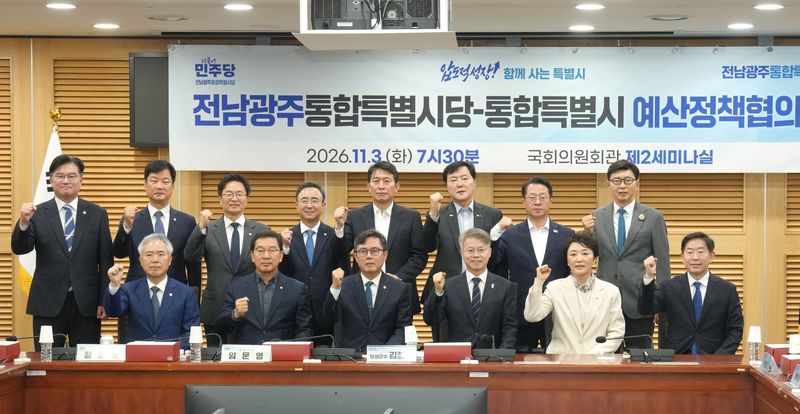
【Financial News, Jeonnam-Gwangju — Hwang Tae-jong, Staff Writer】Jeonnam-Gwangju Integrated Special City (Gwangju Special City) and the Democratic Party of Korea’s Jeonnam-Gwangju Integrated Special City Chapter (Gwangju Special City Chapter) will mount an all-out effort to secure an additional 500 billion won in central government funding ahead of the National Assembly’s review of next year’s budget.
Gwangju Special City Mayor Min Hyung-bae stressed, “I will put together the first integrated budget properly to support Jeonnam-Gwangju’s overwhelming growth and the Republic of Korea’s new growth engine,” adding, “I will devote all our capabilities to this until the National Assembly’s review is complete.”
According to Gwangju Special City and the Democratic Party of Korea’s Gwangju Special City Chapter, a budget policy meeting was held on the 3rd in Seminar Room 2 of the National Assembly Members’ Office Building, attended by Gwangju Special City Mayor Min Hyung-bae, Ahn Do-geol, chair of the Democratic Party’s Gwangju Special City Chapter, local lawmakers and officials from the council of heads of basic local governments.
The meeting was arranged to review key projects requiring additional central government funding and discuss ways to cooperate, as the government audit had concluded and the Special Committee on Budget and Accounts of the National Assembly was set to begin its comprehensive policy questioning session on the 4th.
The amount included for Gwangju Special City in next year’s central government budget proposal is 13.9009 trillion won, up 820.5 billion won (6.3%) from the 13.0804 trillion won in central government funding secured by the former Jeonnam and Gwangju areas the previous year.
However, additional funding increases are needed for projects that were not included, or were only partly included, in the government’s proposal in order to secure future growth engines for the region and address pending issues.
The city plans to strengthen cooperation with local lawmakers and central government ministries, aiming to secure at least 500 billion won in additional central government funding during the National Assembly’s review.
Mayor Min Hyung-bae said, “Thanks to the special attention and cooperation of local lawmakers, we succeeded in getting around 13.9 trillion won included in the first government budget proposal since the integration,” and asked, “Please join forces through the end to protect the funding included in the government’s proposal and secure additional funding in the National Assembly for key projects that were not included.”
The projects given priority at the meeting included: 18 billion won in design costs for eight projects included in the 6th National Road and Regional Road Construction Plan; 8.1 billion won to support certification costs for eco-friendly agricultural products; 900 million won to establish a K-GIM export complex; 600 million won to hold the Light City signature media art festival; an additional 113 billion won for construction of Gwangju Metro Line 2; an additional 1 billion won to install an incoming water transmission pipeline for the Honam Semiconductor Cluster; 500 million won to support community recovery in areas affected by the 12.29 passenger plane disaster; and 1.3 billion won to support the Jeonnam-Gwangju diocesan event of the 2027 Seoul World Youth Day.
The meeting also discussed, through the National Assembly’s standing committees, ways to secure central government funding for 30 projects proposed by cities, counties and districts, with a total value of 56.8 billion won. Key projects included establishing the Gwangju Institute of Science and Technology (GIST) Hwasun Advanced Bio Campus; supporting the revitalization of Arctic sea routes; building the Yeosu International Cruise Complex Center; establishing an infrastructure base to support the commercialization of key equipment for power facilities in advanced industries; and developing a Green Convergence Cluster. These projects address pending issues closely tied to residents’ lives and the promotion of future industries.
In addition to the projects discussed that day, Gwangju Special City plans to prepare written questions on about 170 central government funding requests for projects that were not included in the government’s proposal or need increased funding, and send them to local lawmakers for use during reviews by the relevant standing committees and the Special Committee on Budget and Accounts.
Mayor Min Hyung-bae said, “Adjusting welfare spending after the integration will require a budget of about 1.4 trillion to 1.5 trillion won,” and urged lawmakers to “look after essential central government-funded projects that can help shore up these vulnerable local finances.”
[email protected] Hwang Tae-jong Reporter