5 Billion Won for Fake News Response Classes Next Year—10 Times This Year’s Budget
- Input
- 2026-11-03 12:00:00
- Updated
- 2026-11-03 12:00:00
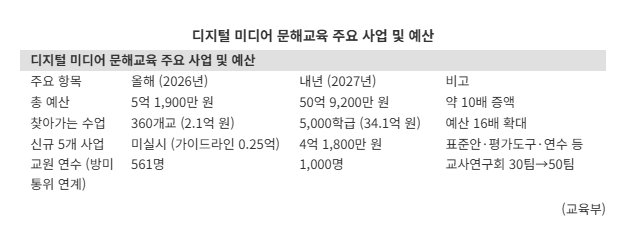
[Financial News] The Ministry of Education has set next year’s budget for school-based digital media literacy education to address fake news and false or manipulated information at 5.092 billion won. That is nearly 10 times this year’s 519 million won. The ministry plans to significantly expand classes taught by specialist instructors who visit schools and launch five initiatives that were not included in this year’s budget.
The Ministry of Education announced its Basic Plan for School Digital Media Literacy Education on the 3rd. The plan reflects the ministry’s assessment that false and manipulated information is increasing as artificial intelligence (AI) and social media become more widespread.
In a survey of 9,428 elementary, middle and high school students conducted by the Ministry of Education in June, 54.0% of elementary school students, 55.6% of middle school students and 61.1% of high school students said they had encountered false or manipulated information. Experience with media literacy education declined at higher school levels, while the greatest demand was for ways to check whether news or videos were genuine.
To that end, the budget for classes delivered at schools will increase 16-fold, from 213 million won this year to 3.414 billion won next year. A program currently operating in 360 schools will expand to 5,000 classrooms next year. Its share of the total budget will also rise from 41% to 67%.
The five initiatives launching next year, with a combined budget of 418 million won, are: developing standard lesson plans for each school level (78 million won); holding a competition for subject-linked programs (90 million won); developing lesson kits (70 million won); developing assessment tools for teachers (80 million won); and developing a teacher training system (100 million won). This year, 25 million won was allocated to developing guidelines.
The budgets for competitions and events to share results will rise from 27 million won to 70 million won; improvements to “Mirine,” the online platform for teaching materials, from 49 million won to 100 million won; and student surveys from 62 million won to 80 million won. The Ministry of Education said these are estimated budgets that include matching investments from municipal and provincial governments, and that they may change during implementation.
Starting next year, the Ministry of Education will develop around 20 types of “lesson kits” each year. The kits bundle concept-explanation videos, lesson slides, student worksheets and assessment questions into materials organized by class period, ready for teachers to use.
Teacher training will also be expanded. Training for teachers in partnership with Viewer Media Centers will grow from 561 participants this year to 1,000 next year, while the number of teacher research groups will increase from 30 to 50. The target for teacher training in partnership with the Ministry of Culture, Sports and Tourism is 6,000 participants a year. The ministry is also pursuing plans to include related content in teacher education courses for prospective teachers. Media education visits to schools in underserved areas, run by the Broadcasting, Media and Communications Commission, will expand from 36 schools this year to 250 next year.
Education Minister Choi Kyo-jin said, “We will actively support the operation of systematic and comprehensive digital media literacy education centered on school classes so that students can grow into healthy digital citizens.”
[email protected] Kim Man-gi Reporter