“Three colon adenomas, removed” on a health screening report... When should the next test be? [Health Check]
- Input
- 2026-11-03 09:43:24
- Updated
- 2026-11-03 09:43:24
A research team of professors Kim Jeong, Bae Jeong-ho and Seo Ji-yeon from the Department of Gastroenterology at Seoul National University Hospital’s Gangnam Center published findings in the latest issue of the international gastroenterology journal Gastroenterology showing that even small adenomas under 1 cm found during colonoscopies carry different risks of future advanced colorectal lesions depending on their number and size.
Colon polyps are growths that form on the inner lining of the colon. Some adenomas can develop into colon cancer over time, so they need to be removed and monitored. The timing of the next colonoscopy after adenoma removal is usually determined by considering the number and size of the adenomas and the biopsy results. However, follow-up schedules for small adenomas under 1 cm have mainly been based on their number, and the extent to which risk differs by size among adenomas of the same number has not been sufficiently established.
Risk is 5.21 times as high with 5–10 small adenomas
The research team analyzed 16,870 adults aged 50–75 who had undergone at least two colonoscopies at Seoul National University Hospital’s Gangnam Center between 2004 and 2023. The adenomas were under 1 cm and had no advanced features on biopsy, making them “non-advanced adenomas”; cases with 11 or more adenomas were excluded. The median follow-up period was 5.3 years.
The team divided participants into groups based on the number of adenomas found during their first examination: no adenomas, 1–2, 3–4, and 5–10. During follow-up examinations, the researchers checked whether adenomas 1 cm or larger, adenomas with advanced features on biopsy, or colon cancer were newly detected, and assessed these outcomes together as “advanced colorectal lesions.”
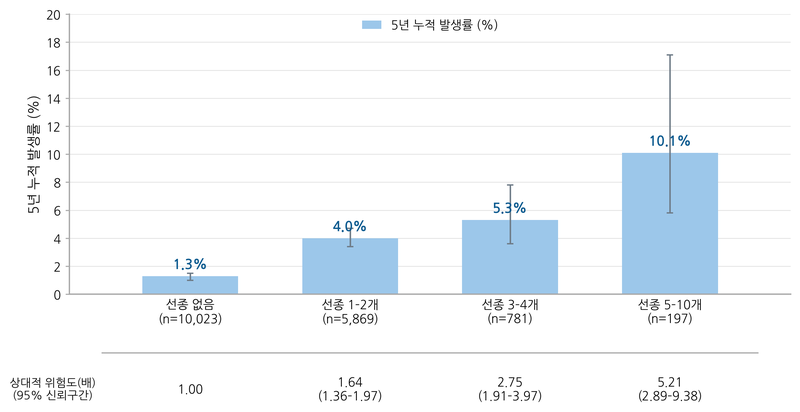
The results showed that the more adenomas found in the initial examination, the higher the subsequent risk of advanced colorectal lesions. The five-year cumulative incidence was 1.3% in the group with no adenomas, 4.0% in the group with 1–2, 5.3% in the group with 3–4, and 10.1% in the group with 5–10. After adjustment for age, sex and underlying conditions, the risk was 1.64 times as high in the 1–2 group, 2.75 times as high in the 3–4 group, and 5.21 times as high in the 5–10 group compared with the group with no adenomas.
Risk rises if an adenoma larger than 6 mm is present, even with the same number
Among people with 1–4 adenomas, risk differed by size even when the number was the same. The incidence of advanced colorectal lesions was higher when at least one adenoma measured 6–9 mm than when all adenomas were 5 mm or smaller. By contrast, among people with 5–10 adenomas, risk was high regardless of size.
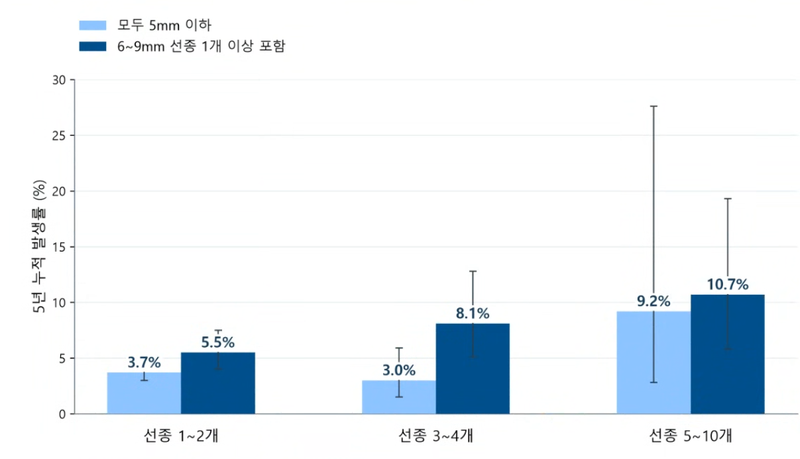
Professor Seo Ji-yeon said, “The more adenomas under 1 cm there were, the higher the risk of advanced colorectal lesions; in particular, when there were 1–4, the risk also differed by size. The number and size of adenomas should both be considered when scheduling follow-up colonoscopies.”
Professor Bae Jeong-ho said, “As the quality of colonoscopy improves and examinations using artificial intelligence (AI) are introduced, more small adenomas are being detected. We hope this study will help provide a more accurate understanding of the risks associated with adenoma number and size, and establish reasonable follow-up guidelines tailored to individual risk.”
This study is significant because it assessed the risk of advanced colorectal lesions in greater detail by analyzing differences in risk based not only on the number of small adenomas but also on their size. Professors Seo Ji-yeon and Bae Jeong-ho were co-corresponding authors, while Professor Kim Jeong and researcher Kim Hui-yeon were co-first authors.
[email protected] Jung Myung-jin, Medical Correspondent Reporter