Ruling and opposition parties unite in call to include EVs in Korea’s version of the IRA: ‘We must save domestically made EVs’
- Input
- 2026-11-03 10:45:32
- Updated
- 2026-11-03 10:45:32
[Financial News] Ruling and opposition lawmakers united in calling for electric vehicles to be included among the beneficiaries of the government’s proposed ‘Korean version of the Inflation Reduction Act (IRA).’ With lawmakers from both sides demanding tax support for domestic EV production at last month’s parliamentary audit, this month’s National Assembly review of the tax amendment bill has emerged as a turning point. As Chinese-made EVs’ share of the domestic market has surpassed 40%, policy measures to protect the production base for domestically made vehicles are emerging as a key issue.
■ Ruling and opposition parties introduce 24 bills ... November review to be pivotal
According to the auto industry on the 3rd, lawmakers from both sides repeatedly called for electric vehicles to be included among those eligible for the domestic production tax credit during the parliamentary audit, which concluded on the 30th of last month. In particular, lawmakers held intensive questioning over the government’s plan to exclude EVs from support during the comprehensive audit of the Ministry of Economy and Finance by the National Assembly’s Finance and Economy Planning Committee, held on the 22nd of last month.People Power Party lawmaker Ahn Sang-hoon pointed out, ‘Major developed countries are pulling out all the stops—tariffs, tax credits and subsidies—to protect their domestic EV industries,’ adding, ‘There seems to be virtually no country that has protected its market without an active response.’ Fellow party lawmaker Bae Joon-young also stressed the need for policy support for the EV industry, saying, ‘When the semiconductor industry was struggling in the past, the government acted as a catalyst.’
Similar calls came from the Democratic Party of Korea. Lawmaker Yoon Hoo-deok called for expanding eligibility for the tax credit, saying, ‘Chinese-made EVs are rapidly taking over domestic and international markets, putting the domestic EV industry in a crisis.’ Lawmaker Moon Jin-seok criticized the government’s proposal, saying, ‘It seems to be pushing domestic automakers to the brink as they compete with Chinese automakers, which have strong price competitiveness.’
At the National Assembly Committee on Climate, Energy, Environment and Labor, People Power Party lawmaker Na Kyung-won also said, ‘The United States and Europe are defending their domestic industries with tariffs and other measures, while we are effectively using no such tools,’ and called for measures to boost the competitiveness of domestically made EVs.
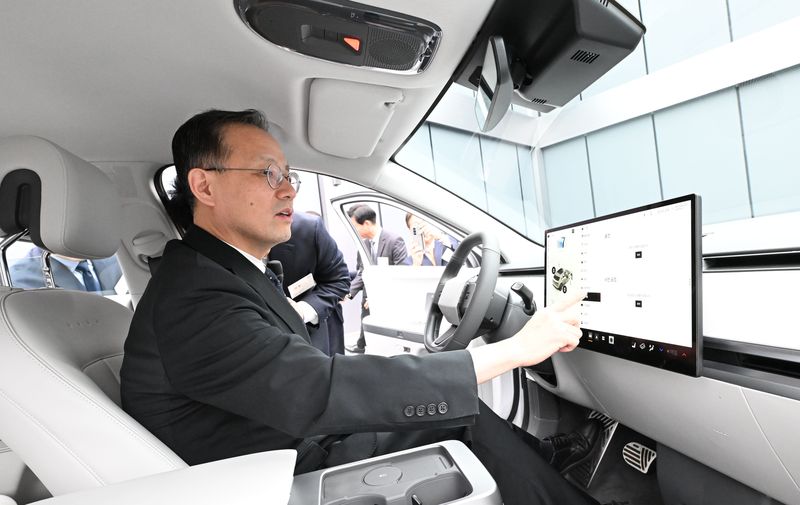
In response, Deputy Prime Minister and Minister of Economy and Finance Lee Hyung-il said at the Hyundai Motor-Kia technical research institute he visited on the 2nd, ‘The next battleground for a rebound in potential growth is EVs,’ adding, ‘The government will also actively participate in the National Assembly’s discussions and continue to engage in in-depth deliberations.’
The tax reform plan announced by the government last August included six sectors—solar power, wind power, secondary batteries, semiconductors, key materials, and artificial intelligence (AI) and robotics components—but excluded electric vehicles.
By contrast, a total of 24 bills to include future-oriented vehicles such as EVs among the eligible support targets were introduced in the 22nd National Assembly. Of these, 11 were introduced by members of the Finance and Economy Planning Committee, and 8 were sponsored by members of the Tax Subcommittee. Whether to include EVs is expected to be discussed in earnest at the Tax Subcommittee’s review this month.
■ Chinese-made EVs surge ... domestically made cars lose their majority share
Behind the growing calls to expand tax support is the rapid encroachment of Chinese-made EVs into the market. According to statistics from the Korea Automobile & Mobility Association (KAMA) and the Korea Automobile Importers & Distributors Association (KAIDA), 112,417 Chinese-made passenger EVs were newly registered in South Korea from January through September this year, 2.2 times the 51,535 registered in the same period a year earlier.Chinese-made passenger EVs captured 43.5% of the market, up 8.4 percentage points from the same period a year earlier. By contrast, the market share of domestically made passenger EVs fell 6.2 percentage points to 48.7%, dropping below half. This has raised concerns that intensifying competition in the EV market could also affect the foundations of domestic production and employment.
An auto industry official emphasized, ‘Chinese-made EVs have secured price competitiveness across their supply chains, including materials, parts and batteries,’ adding, ‘Given that South Korea’s export-oriented industrial structure makes it difficult to take trade measures like those of major economies, policy support—including the domestic production tax credit—needs to be provided in a timely manner.’
[email protected] Dong-ho Kim Reporter