Ulsan confirms Korea’s only “dinosaur tail-drag fossil” ... a rare fossil of which only around 50 are known worldwide
- Input
- 2026-11-03 14:02:20
- Updated
- 2026-11-03 14:02:20
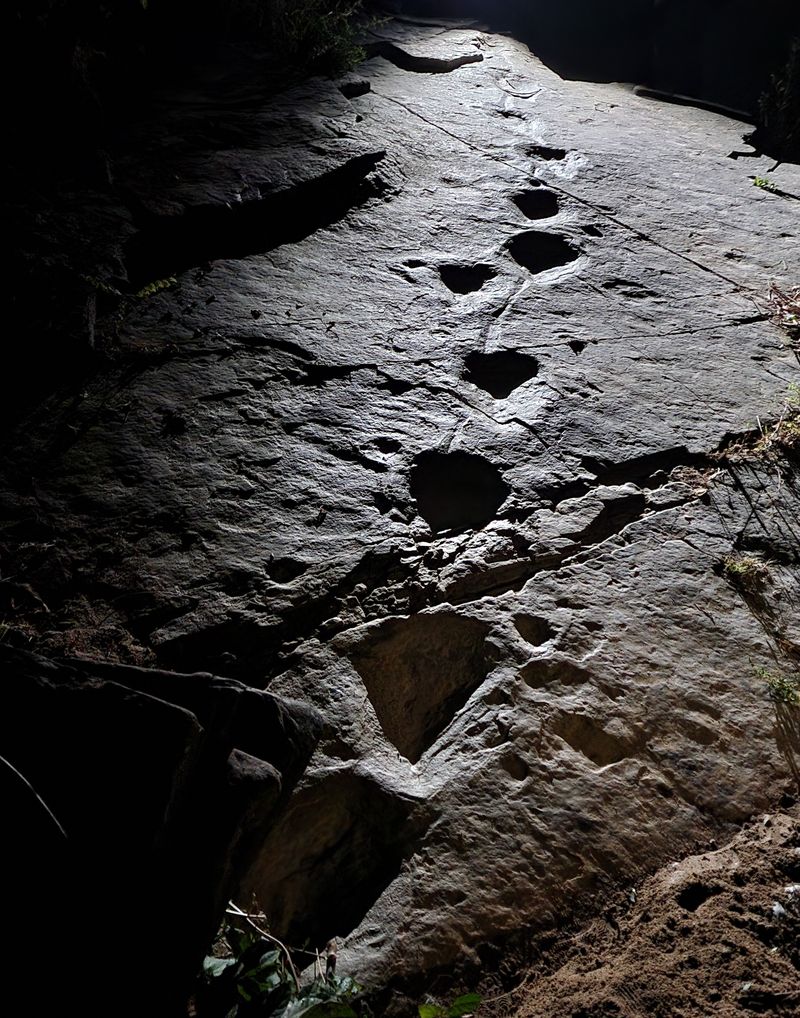
【Financial News, Ulsan = reporter Choi Soo-sang】 A fossil bearing tail-drag marks left by a dinosaur from the Cretaceous Period of the Mesozoic Era, an extremely rare find worldwide, has been confirmed in Ulsan. It is the second such discovery in Korea, but is now recorded as the country’s only surviving fossil of its kind.
The tail-drag marks are expected to accelerate recognition of the site’s academic value and its designation as a Natural Monument, a nationally designated natural heritage site, after researchers fully identified a behavioral trace left by a moving dinosaur—a type of trace rarely found until now.
Ulsan City and Korea National University of Cultural Heritage held a final briefing on the academic study to establish the value of the Ipam-ri fossil site in Ulju County at the site on the 3rd. They announced that they had precisely identified Korea’s only fossil of dinosaur tail-drag impressions (TDI) in and around Ipam-ri, Beomseo-eup, Ulju County. The study was conducted over six months beginning in May, with participation from Gong Dal-yong, principal researcher at the university’s Industry-Academia Cooperation Foundation and a PhD in paleontology, and sedimentology researchers from Gyeongsang National University, among others.
The Ipam-ri fossil site in Beomseo-eup, Ulju County, Ulsan, which was the focus of the study, covers about 41,800 square meters across three areas, A, B and C. It corresponds to the Ulsan Formation in the upper part of the Hayang Group of the Gyeongsang Supergroup, dating to the Early Cretaceous, about 100 million years ago. The detailed survey clearly established the stratigraphic context in which a variety of dinosaur footprints and trace fossils, including those of ornithopods and sauropods, occur repeatedly across at least seven horizons.
A key finding of the study is an approximately 8.2-meter-long sauropod trackway and tail-drag marks identified in Area C. Fossils of tail marks left by dinosaurs as they moved, including the one at Ipam-ri, are extremely rare worldwide: only around 50 have been found across nine countries, including France, the United States, China and Korea, with the total reaching as many as 55 depending on the counting method.
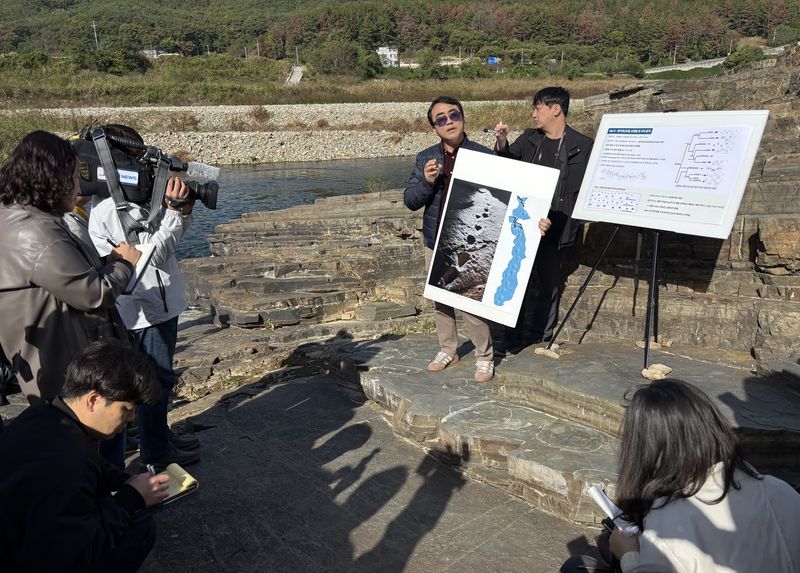
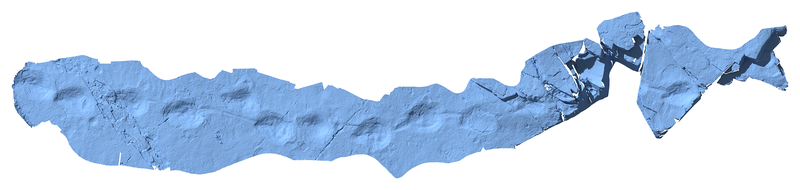
This is only the second time a fossil of this type has been officially confirmed in Korea. The first was reported in Yeongdong, North Chungcheong Province, in 2011, but that fossil site was lost after a slope collapse, leaving the Ipam-ri fossil in Ulsan as the only preserved dinosaur tail-drag trace in Korea. The tail fossil from Yeongdong was a trace of a carnivorous dinosaur, whereas the Ulsan fossil is believed to have been made by a herbivorous dinosaur.
For the Ipam-ri site, the researchers proposed as a behavioral hypothesis that the dinosaur may have moved through water that submerged part of its body, with buoyancy and the soft substrate affecting its movement. Their explanation is that as the giant dinosaur walked through shallow water, buoyancy lifted its upper body and made it lighter, so it balanced by supporting its weight on its hind feet alone while dragging its tail along the bottom.
The site’s fossils were also rated highly for their scientific completeness. Around the fossil site, ripple marks, raindrop impressions and paleosol layers occur alongside irregular polygonal cracks and gas structures formed by microbial mats. Researchers concluded that the microbial mats increased the cohesion of the sediment surface, allowing the globally rare tail marks and footprints to be precisely preserved in their original positions.
A city official said, “The Ipam-ri fossil site, whose value has now been established, is a unique geological heritage where globally rare information about the behavior of Cretaceous dinosaurs and their depositional environment has been preserved in situ at high density. We will swiftly establish a legal and institutional framework for its protection by securing its designation as a Natural Monument.”
[email protected] Choi Soo-sang Reporter