Small-school consolidation and narrowing the education gap... 86 billion won to be invested in 43 regions
- Input
- 2026-11-03 14:00:00
- Updated
- 2026-11-03 14:00:00
̈
[Financial News] Geumsan County in South Chungcheong Province plans to consolidate elementary schools with declining enrollments around hub schools, while Eumseong County in North Chungcheong Province plans joint classes between schools in the old downtown and the Innovation City.
The Ministry of Education has designated 43 locations nationwide as Education Innovation Leading Regions to support innovation at small schools and narrow regional education gaps. They include Geumsan and Eumseong, as well as Busan, Daegu and Jeonnam-Gwangju Integrated Special City.
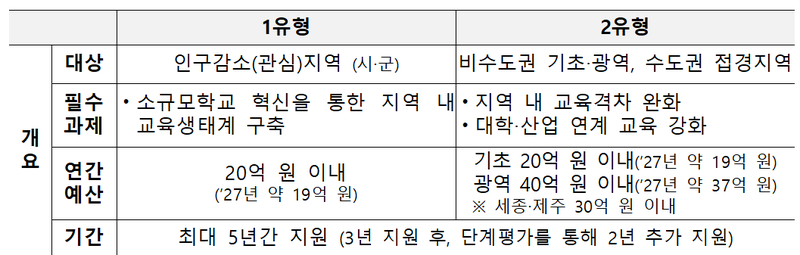
Starting next year, basic local governments will receive about 1.9 billion won annually, and metropolitan local governments about 3.7 billion won. District offices of education and local governments will consult on local education issues and carry out projects.
On the 3rd, Education Minister Choi Kyo-jin announced at Government Complex Seoul the 43 local governments selected as “2027 Education Innovation Leading Regions.” Type 1, which supports innovation at small schools in population-decline or at-risk areas, includes 32 locations; Type 2, which aims to improve local educational environments outside the capital region, includes 11.
Education Innovation Leading Regions is a project in which education offices, district offices of education, local governments and communities work together to develop solutions to local education problems. It strengthens the response to regional depopulation, an area where the Education Special Zones piloted from 2024 had fallen short. District offices of education and local governments are to consult on local priorities, including school operations, curricula and student care, and draw up implementation plans.
The selected locations are divided into two types. Type 1, which promotes innovation at small schools in population-decline and at-risk areas, includes 32 locations, such as Yeoncheon County in Gyeonggi Province; Geumsan County and Nonsan in South Chungcheong Province; Sancheong County in South Gyeongsang Province; and Ongjin County in Incheon. Of these, 22 submitted mid- to long-term plans that include school consolidation.
Geumsan County plans to consolidate elementary schools around hub schools and use closed school sites as educational facilities. In the area, 10.4% of middle school graduates go on to attend schools in other regions. Sancheong County in South Gyeongsang Province plans to pursue school consolidation in stages after introducing a shared curriculum across schools. Ongjin County in Incheon plans to run “5 Islands, 5 Colors Campus,” linking schools scattered across its islands.
Type 2 focuses on narrowing education gaps within regions and strengthening education linked to universities and industry. Eleven locations were selected, including Busan, Daegu, Jeonnam-Gwangju Integrated Special City and Eumseong County in North Chungcheong Province. Eligible areas are basic and metropolitan local governments outside the capital region, excluding population-decline and at-risk areas, as well as border areas in the Seoul metropolitan region.
Eumseong County in North Chungcheong Province plans joint classes and student exchanges between schools in the old downtown and the Innovation City. It also plans to run a shared curriculum in four areas encompassing small rural schools. The aim is to narrow differences in educational conditions between new towns, old downtown areas and rural areas through cooperation among schools.
The selected locations will first receive project funding for three years, with an additional two years of support following a phased evaluation. Detailed local projects and budget execution plans will be developed through consultations between district offices of education and local governments.
The Ministry of Education will finalize the designation results this month after considering appeals. The selected locations will incorporate expert advice, submit detailed project and budget execution plans by December, and begin their projects next January.
Education Minister Choi Kyo-jin said, “Through the Education Innovation Leading Region project, I will shift the framework of local education policy to an education-ecosystem perspective so that high-quality education continues from elementary school through high school in each region.” He added, “By closely linking the locally tailored primary and secondary education innovation models to be developed through this project with universities’ talent-development policies, I will build a virtuous cycle in which children born and raised in a region develop their abilities at local universities and lead the region’s development.”
[email protected] Lee Bomi Reporter