Seoul to bring forward valuation dates for public contributions in development projects; deregulation measures top 200
- Input
- 2026-11-03 11:15:00
- Updated
- 2026-11-03 11:15:00
[Financial News] The Seoul Metropolitan Government will bring forward the reference date for calculating public contribution costs and land values under district unit plans to reduce uncertainty for private development projects. It will also introduce a system allowing users to return a broken public bike, Seoul Bike (Ddareungi), on site through an application (app), without taking it back to a rental station.
On the 3rd, the Seoul Metropolitan Government announced that it would pursue three deregulation measures: improving the public contribution system under district unit plans, simplifying the Seoul Bike return process, and revising the supervision system for building demolition work.
The measures announced this time are deregulation measures Nos. 200–202. Since announcing its first measure in January last year—easing the mandatory proportion of non-residential facilities in mixed-use residential buildings in commercial and quasi-residential areas—the Seoul Metropolitan Government has pursued regulatory improvements in the economy, people’s livelihoods, and citizens’ daily lives.
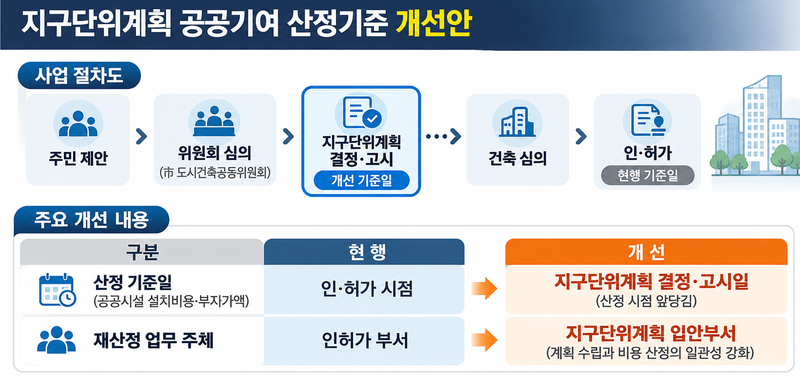
The key change is to move up the reference date for calculating the cost of installing public facilities and the value of land within district unit plan areas, from the existing permitting and approval stage to the date the district unit plan is decided and publicly announced. The Seoul Metropolitan Government plans to revise the Rules for the Enforcement of the Seoul Metropolitan Government Urban Planning Ordinance within this year.
Private developers can currently receive floor area ratio incentives commensurate with the value of public facilities they install or land they provide. However, even if a developer draws up a project plan taking into account the scale of its public contribution and the incentives, the actual costs and land value are not finalized until the building-permit stage.
A problem has been that, during the period from the decision on a district unit plan to the building permit—which can take months to years—changes in construction costs and land prices can create a gap between the originally anticipated scale of the public contribution and the floor area ratio incentives.
The Seoul Metropolitan Government plans to reduce uncertainty during project implementation by bringing forward the reference date for calculations. It will also transfer responsibility for recalculating public-facility installation costs and land values from the existing permitting department to the department responsible for drafting district unit plans, to improve consistency in planning and cost calculations.
Measures have also been prepared to make things easier for Seoul Bike users. Currently, if a bike is so damaged that it is difficult to ride, users must lower the locking lever on site and then call the call center for the return to be processed. Users who do not know this procedure have to take the broken bike to a rental station, and a delayed return may result in additional charges.
By 2027, the Seoul Metropolitan Government will upgrade the system so that when users upload a photo of the damaged part in the app and request an on-site return, the bike’s location is recorded using the Global Positioning System (GPS), the return is processed, and additional charges are stopped. By the end of this year, it plans to add on-site return instructions and a button to connect to the call center in the app.
The supervision system for building demolition work will also be revised. Currently, disputes between building owners and supervisors over supervision fees or the supervision period are delaying contracts and construction, while repeated cases of missing supervision completion reports are disrupting administrative procedures after construction ends.
The Seoul Metropolitan Government plans to revise the relevant ordinance within this year so that the Demolition Work Supervision Mediation Committee can mediate contract-related disputes, including those over the calculation and payment of supervision fees and the supervision period.
Last September, the criteria were revised to allow a supervisor to be reappointed if the building owner and supervisor agree before construction begins. However, reappointment by agreement is limited to two times. The roster of supervisors for projects subject to demolition notification will also be published separately for each autonomous district, and the permitting authority will be able to assist in selecting a supervisor at the owner’s request.
Jo Wan-seok, Director General for Regulatory Innovation Planning at the Seoul Metropolitan Government, said, “This regulatory improvement focuses on rationalizing the public contribution system under district unit plans to make project implementation more predictable and reduce conflicts on site and inconveniences in citizens’ daily lives.” He added, “We will continue to actively identify and improve unreasonable regulations from the perspective of citizens and businesses, bringing about tangible changes that people can feel in their daily lives and on the ground.”
[email protected] Seong Chorong Reporter