[Exclusive] “Cut RW and set the guarantee multiplier at 20x”... Bank chiefs urge government to expand “productive finance”
- Input
- 2026-11-03 14:30:08
- Updated
- 2026-11-03 14:30:08
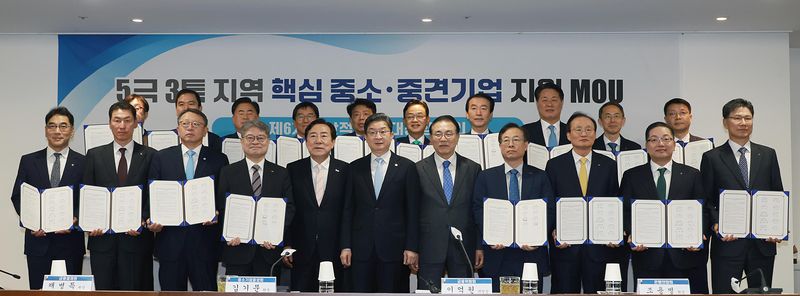
According to financial industry sources on the 3rd, bank chiefs proposed various policies to the Financial Services Commission and the Financial Supervisory Service to expand productive finance at the sixth Productive Finance Transformation Meeting, held on the 2nd at KBIZ headquarters in Yeouido, Seoul. First, Kang Tae-young, head of Nonghyup Bank, said that differentiated support for SMEs in regions outside the capital area was needed. “Following earlier measures by financial authorities, the loan-to-deposit ratio weighting for regional businesses was lowered from 85% to 80% starting in April,” Kang said. “A policy to differentiate the RW (risk weight) on loans to businesses based in regional areas, as with that measure, is also needed.” Lowering the RW applied when banks lend to regional businesses would create more headroom under capital adequacy regulations, making additional lending possible.
Kim Jin-hong, director-general of the Financial Industry Bureau at the FSC, told a reporter by phone, “We’ll consider the proposal to differentiate RWs, but since the loan-to-deposit ratio weighting was adjusted early this year, this is something we need to decide after looking at regional lending conditions and other factors.”
Lee Ho-sung, president of Hana Bank, put forward two proposals. “KODIT and KOTEC guarantee 15 times the amount of special contributions from the banking sector. If that were increased to around 20 times, productive finance would become much more active,” Lee said. That day, the banking sector agreed to contribute 300 billion won to KODIT and KOTEC over the next three years, and the two funds agreed to issue guarantee certificates worth 4.5 trillion won on that basis. Under Lee’s proposal, 6 trillion won could be supplied to regional SMEs.
Lee went on to say, “Please also consider increasing the guarantee coverage ratio for guaranteed loans to 100% and having banks cover the guarantee fees.” The current guarantee coverage ratio for guaranteed loans is around 85% to 90%. If it were raised to 100%, banks would not incur losses when defaults occur, thanks to payments made by guarantee institutions under their subrogation guarantees.
Park Chun-won, president of THE JEONBUK BANK LTD., proposed, “Taking Jeonbuk as an example, when policy financial institutions support regional strategic industries such as shipbuilding, local banks should participate as well and support partner (subcontractor) companies, helping to build a virtuous cycle.” Kang Jung-hoon, head of iM Bank, said, “SMEs in regional areas often ask KODIT and KOTEC to raise their guarantee limits. The limits are currently set at one-quarter or one-sixth of sales, so many companies cannot benefit even if policies like these (to expand productive finance) are introduced.”
There was also a proposal that the characteristics of each local government should be reflected as financial authorities provide 4.5 trillion won in guaranteed loans to key SMEs and mid-sized companies in areas covered by the Five Mega-Regions and Three Special Self-Governing Provinces Strategy. Jilseon Jung, president of Kwangju Bank, asked, “The FSC’s plan evaluates 13 metropolitan cities and provinces, with the amount of guaranteed-loan support varying by local government according to whether it is rated excellent, good, or average. If there are 13, it appears Gwangju and South Jeolla Province have been counted separately. What is the plan for the South Jeolla-Gwangju Integrated City?”
Kim Jin-hong said, “During the selection process, we will thoroughly assess applications, focusing on support measures for SMEs, including what level of interest subsidies is appropriate. The proposed funding allocation by tier—three top-rated, five good, and five average—is only a plan and has not been finalized, so we will take local governments’ capabilities and regional conditions into account.” That day, the FSC announced plans to provide 450 billion won to top-rated local governments, 350 billion won to those rated good, and 280 billion won to those rated average.
[email protected] Park Mun-su, Seo Ji-yoon, Lee Hyun-jung Reporter