[Editorial] 821 Trillion Won Superbudget: Thorough Scrutiny Must Come Before Speed
- Input
- 2026-11-02 18:46:06
- Updated
- 2026-11-02 18:46:06
There are aspects of the government’s expansionary fiscal policy that make strategic sense. Like the saying, “When the tide comes in, row hard,” the policy can be understood as aiming to strengthen growth momentum further when exports are rising and tax revenues are strong. The plan to allocate the additional revenue to addressing social inequality and polarization is also worth taking seriously. We also agree with investing in future growth engines and talent in fields such as semiconductors and artificial intelligence (AI).
Even so, there is considerable cause for concern about the rationale behind next year’s budget. Increased government spending can certainly serve as seed money to stimulate domestic demand and industry. It could also help lift next year’s economic growth rate. But the concern is that once spending is raised, it could lead to symptoms of addiction.
No one can deny that the current rise in tax revenue depends on the semiconductor boom. We must recognize that if the boom fades, tax revenue will naturally plunge, while spending that has once been increased is difficult to cut. If ongoing programs are expanded using temporary funds, spending will still have to continue after tax revenues slow, putting public finances at risk.
Moreover, increased government spending could act as kindling to revive sluggish domestic demand. It could also serve as a catalyst for strengthening industrial competitiveness. Nevertheless, excessive spending brings not only benefits but also adverse effects. Higher government spending stimulates aggregate demand. Given the realities of our economy, reviving domestic demand and stabilizing prices are urgent priorities. Both policy goals must be achieved at the same time. Spending should not be slashed, but excessive increases could bring a boomerang of high inflation.
The Future Fund, in particular, has become the focus of fierce debate between the ruling and opposition parties. Their differing views, which date back to the fund’s establishment, have yet to converge. At the heart of the debate is whether the Future Fund’s funding can be sustained. Indeed, the National Assembly Budget Office (NABO) has projected that additional tax revenues may not be sustainable. The assessment is that the additional revenue recently anticipated is closer to a temporary source concentrated in 2027–2028 than to a recurring source. It would be welcome if the Future Fund were an “ever-flowing spring,” but we must keep in mind that its impact may prove short-lived.
Rather than being buoyed by the largest budget proposal ever, now is the time to take a long-term view and consider strategic budget planning. This is why some argue that reducing the debt that has surged during a period of strong tax revenues is consistent with the intent of the National Finance Act. Paying down a reasonable amount of national debt when the public coffers are full may also be a rational choice.
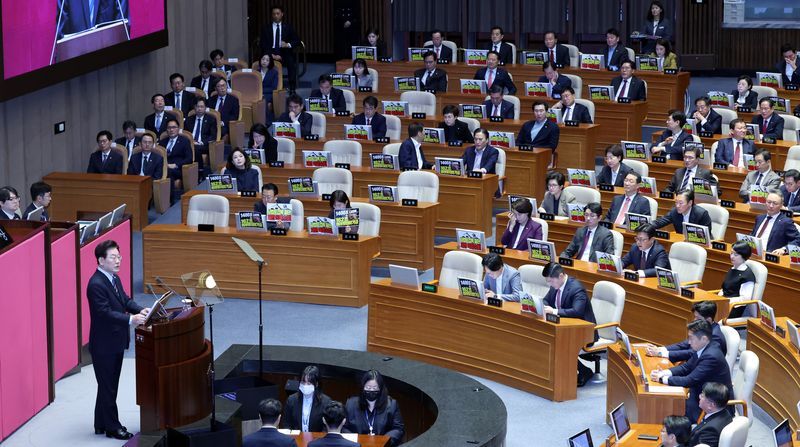
Following the president’s policy address that day, next year’s budget proposal is now in the hands of the National Assembly. The government believes that the budget’s actual impact depends on implementation and speed. But a flawed budget must be reconsidered and corrected. That is the National Assembly’s role. The ruling party must stop acting as a rubber stamp for the government’s original proposal. The opposition, too, should offer reasonable alternatives instead of simply obstructing the government’s budget.