Hoban eyes Korea Development Bank's stake in Hanjin KAL; next March's AGM will be a test
- Input
- 2026-11-02 18:35:05
- Updated
- 2026-11-02 18:35:05
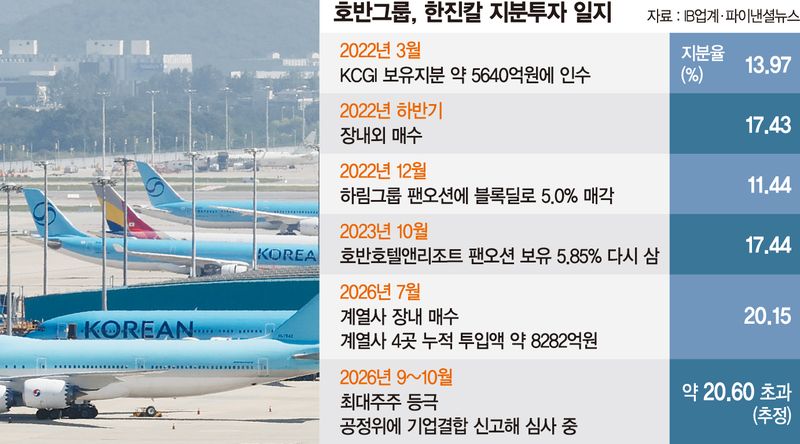
■ KDB's 10.58% stake: Exit clock ticking
According to IB industry sources on the 2nd, KDB is reportedly considering recovering its investment in Hanjin KAL once the aviation industry's restructuring is complete. The planned integration of Korean Air and Asiana Airlines in December is a turning point. If the integration proceeds as planned, KDB could begin considering a sale as early as this year, sources say.
KDB's guiding principle is to 'maximize the recovery of its investment.' Selling all or part of its stake are both options. Some in the industry also point to the possibility of a progressive deal, in which the stake is sold off in stages, as an alternative to an open competitive bidding process.
The key question is who will buy the stake. IB industry sources see Hoban as a leading potential buyer. An industry source said, "Because Hoban has steadily built up its stake in Hanjin KAL, an additional stake could have greater strategic value to it than to other investors." The source also noted, "For KDB, directly transferring the stake to Hoban is a concern because it could affect the balance of control."
Hoban continues to classify the purpose of its Hanjin KAL shareholding as 'simple investment.' If it directly acquires KDB's stake or formally announces its participation in management, the sale of shares by a state-run bank could be seen as supporting a particular company's bid to gain control. A deal structure involving an FI (financial investor) is also being discussed as a possible scenario. Under this approach, a separate investor would first acquire KDB's stake and then explore a share transaction or strategic cooperation with Hoban. However, if there is a prior agreement or a joint shareholding arrangement, the relevant disclosure requirements and business-combination regulations would need to be reviewed. Hoban Group has nevertheless maintained so far that "the purchase of Hanjin KAL shares remains for the same purpose of simple investment, as previously disclosed."
■ Next March's AGM will be the first test
Meanwhile, IB industry sources see time as the biggest variable in the shareholding contest. Hoban can remain a long-term investor and wait for an opportunity to increase its stake, while Cho's side faces the task of securing supportive shareholders in the future succession process as well. Analysts say that even without an immediate control dispute, the two sides' bargaining power could shift over time. Delta Air Lines and KDB are currently viewed as allies of Cho's side, but KDB's exit from its stake will inevitably change the existing balance. In the longer term, Cho's side may also consider cooperating with Hoban or adjusting their shareholding relationship.
The regular shareholders' meeting next March is widely seen as the first test, as the terms of directors recommended by KDB will expire around the same time as a possible reshuffle of the board. Whether there will be a request to convene an extraordinary shareholders' meeting or a shareholder proposal before then is another variable. The nature of the AGM is also expected to depend on whether Hoban maintains its simple-investment stance or shifts to participation in management.
Another IB industry source said, "KDB's stake is large enough to affect Hanjin KAL's long-term governance," adding, "What matters is not when it is sold, but who acquires it and through what structure. Hoban could take its time and broaden its options rather than rush to make a control dispute official." Ultimately, the future of control at Hanjin KAL depends on KDB's exit strategy and Hoban's next move. The two sides' calculations are expected to become clearer around next year's AGM, including how long the separation between the largest shareholder and actual control will last.
[email protected] Kim Gyeong-a, Kang Gu-gwi Reporter