Bridging the income gap with a “living-expense bucket”: How people in their 50s nearing retirement can allocate their assets [Financial Odyssey]
- Input
- 2026-11-02 18:32:50
- Updated
- 2026-11-02 18:32:50
According to financial industry sources on the 2nd, investors in their 50s nearing retirement should first review their own “retirement calendar,” rather than focus on the outlook for the stock market. They need to work out the period between retirement and when they begin receiving National Pension Service (NPS) benefits, then set aside enough living expenses in advance to cover that gap.
■ Start with a living-expense bucket to fill the “income gap”
Park Tae-hyeong, head of the PB branch at Woori Bank’s TCE Signature Center, advised Kim—who was worried about when stock prices would recover—to first consider the income gap after retirement. Kim will retire at 60 but plans to start receiving NPS benefits at 65, leaving a five-year income gap.
Kim will need 2.5 million won a month in living expenses during this period, to be covered by the retirement pension and other sources. That amounts to 30 million won for one year and 150 million won for five years. This is money that must be available every month, regardless of market conditions.
Park proposed a “living-expense bucket” strategy: secure in advance, in safe assets, the living expenses needed for a set period after retirement. The approach is to set aside funds for the first 3–5 years after retirement in principal-and-interest-guaranteed products or short-term bonds, while investing the rest for long-term returns. The size of the bucket can be calculated by considering current living expenses, life expectancy, inflation and medical costs.
This way, even if the stock market plunges, there is no need to sell equity products at fire-sale prices to cover immediate living expenses. Kim set a goal of first securing 90 million won—the equivalent of three years’ living expenses—in safe assets.
The closer retirement gets, the more important this kind of asset allocation becomes. When people are young, they have time to wait for a recovery even if the market plunges. But things are different just before retirement: there may not be enough time to make up losses, and they may have to sell assets at a loss to cover living expenses.
■ Change the ship’s center of gravity
Park stressed that “the asset allocation of a retirement pension should also change to match the timing of retirement.” In other words, people in their 30s and those in their 50s nearing retirement cannot maintain the same investment strategy. While younger people may focus on pursuing high returns, the closer retirement gets, the more they need to consider how to protect the assets they have accumulated while drawing them down over a long period.
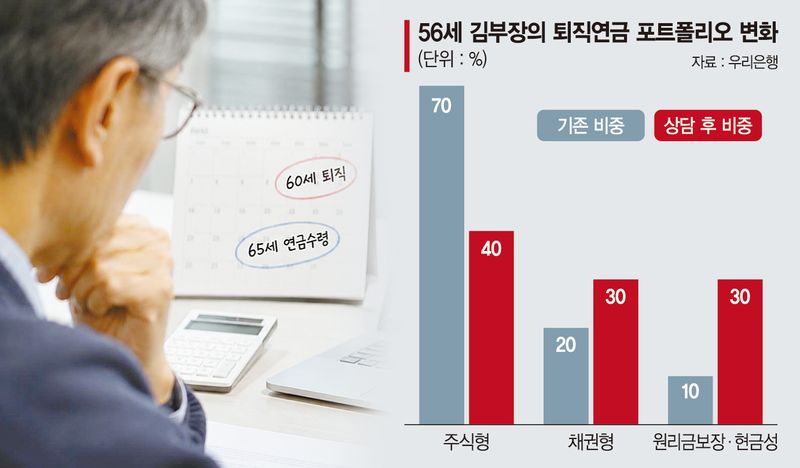
Kim also redesigned the retirement pension’s asset allocation in light of the time remaining until retirement. The allocation to equity products was reduced from 70% to 40%, while the allocation to bond products rose from 20% to 30%. The share of principal-protected and cash-like assets was also increased from 10% to 30%. Kim did not sell all the equity products at once. Selling all the assets when the stock market has plunged could make investment results hinge on that day’s market prices. Instead, Kim opted for “phased rebalancing,” adjusting the investment allocation over several transactions.
Of course, not everyone in their 50s needs to set their equity allocation at 40%. The appropriate allocation varies depending on factors such as how much they have in other pensions or real estate, whether their spouse has income, and whether they have finished supporting their children.
One principle, however, is clear: equity assets should be invested only with money that “will not be needed in the next five years.”
The possibility of losses on bond products due to interest-rate changes should also be considered. When market interest rates rise, the prices of existing bonds fall, which can result in unrealized losses on bond funds and similar investments. When choosing bond products, investors should check whether the maturity matches when they will need the money. Rather than long-term bonds whose maturities are far out of step with when the funds will be needed, it may be worth considering medium- to short-term bonds that mature around that time.
It is not advisable to put all assets into safe investments simply because retirement is approaching. Living expenses needed right away should be secured safely, while assets to be invested over the long term should be managed with a view to earning returns that can help keep pace with inflation. Taxes on pension payments should also be considered. Receiving retirement benefits as a pension rather than a lump sum can reduce the burden of retirement income tax.
Park compared preparing for retirement to a long voyage. People in their 50s nearing retirement need to weather immediate market fluctuations while also preparing for the decades of life that follow. Park stressed, “What we can determine is not the height of the waves, but the ship’s center of gravity,” adding, “We cannot control stock market volatility, but we can adjust our asset allocation and pension payment plans ourselves. It is important to design the share of equities, the portion in safe assets and the pension payment plan to match the timing of your retirement.”
Information provided by: Park Tae-hyeong, head of the PB branch at Woori Bank’s TCE Signature Center
[email protected] Lee Hyun-jung Reporter