Ruling and opposition parties enter ‘budget war’... clash over Future Fund
- Input
- 2026-11-02 18:29:24
- Updated
- 2026-11-02 18:29:24
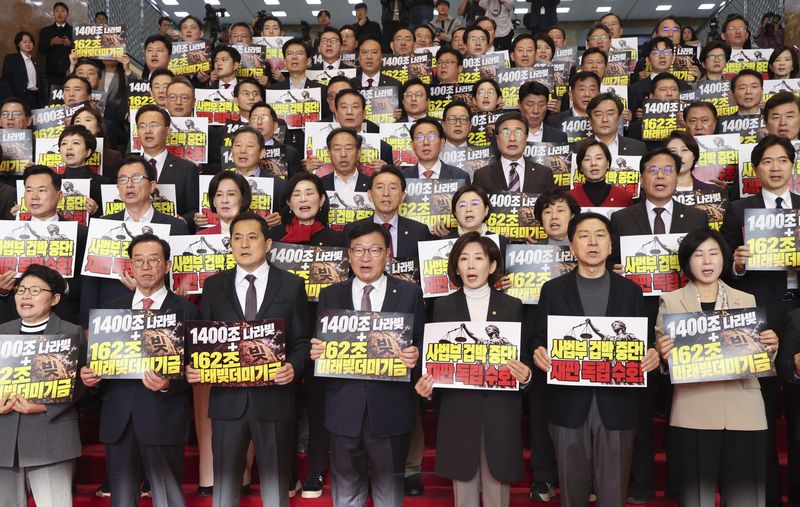
The Democratic Party of Korea argued that funds should be set aside to prepare for a slowdown in the semiconductor market, while the People Power Party countered that the national debt should be paid down first. It also warned of cuts totaling at least 30 trillion won.
At a budget bill forum at the National Assembly that afternoon, Democratic Party lawmaker Jung Tae-ho, the ruling party’s secretary on the Strategy and Finance Committee, said increased tax revenue from the semiconductor boom should be divided among investment in future growth engines, reserves for a slowdown in the economy and national debt management. Jung stressed the need to strike a balance among the three uses, saying, “It is extremely important to find the appropriate allocation ratio and a point of balance.”
The government’s 162.3 trillion won Future Fund is also intended to support investment in the future while securing a fiscal safety net. The government plans to invest 45.4 trillion won in four areas, including youth and growth engines, and use 12.5 trillion won to reduce new government bond issuance. The remaining 104.4 trillion won is to be set aside in preparation for a future decline in tax revenue.
At the forum that day, Lim Myeong-hyeon, head of the Budget Analysis Office at the National Assembly Budget Office (NABO), forecast that additional tax revenue above historical trends would reach 167.8 trillion won in 2027 and 71.7 trillion won in 2028, before disappearing from 2029 onward.
The People Power Party, meanwhile, objected that it was contradictory to issue large amounts of deficit bonds while setting aside around 104 trillion won in surplus funds. At the forum that day, People Power Party lawmaker Yoo Sang-bum criticized the plan, saying, “The government plans to issue 100.1 trillion won in deficit bonds while setting aside 104.4 trillion won,” and “The Future Fund is not a reservoir for future generations but a means of circumventing fiscal controls.”
At a press briefing that afternoon, floor leader Jeong Jeom-sik said, “It’s common sense to use the 104 trillion won to reduce the debt.” Policy Committee chair Im Lee-ja went further, identifying 158 problematic programs in the government’s budget proposal and warning that the party would seek cuts of at least 30 trillion won, focusing on 100 major programs. She took issue with items including 3.5 trillion won in Local Future Growth Support payments and 1.7 trillion won for Youth Future Savings, and named the 1.45 trillion won budget for local gift certificates as a target for cuts.
The National Assembly’s authority to oversee the fund’s operation has emerged as a new point of contention, alongside how the surplus funds should be used. Yoo argued that the rule allowing the government to change spending amounts for major fund categories by up to 30% without the National Assembly’s approval could weaken its budget review authority, and called for the limit to be sharply reduced. NABO also said the adjustment limit should be lowered to 20%.
The Democratic Party will hold a workshop for budget committee members on the 3rd to discuss its strategy for reviewing the budget bill, while the People Power Party will announce its livelihood budget plan the same day. The National Assembly’s Special Committee on Budget and Accounts (SCBA) will begin comprehensive policy questioning on the 4th.
[email protected] Jiwon Song, Lee Hae-ram Reporter