[Exclusive] Rental housing takes over redevelopment... rental share in a Yongsan District project nears 50% [‘All-out attack’ hamstrung by rentals]
- Input
- 2026-11-02 18:28:05
- Updated
- 2026-11-02 18:28:05
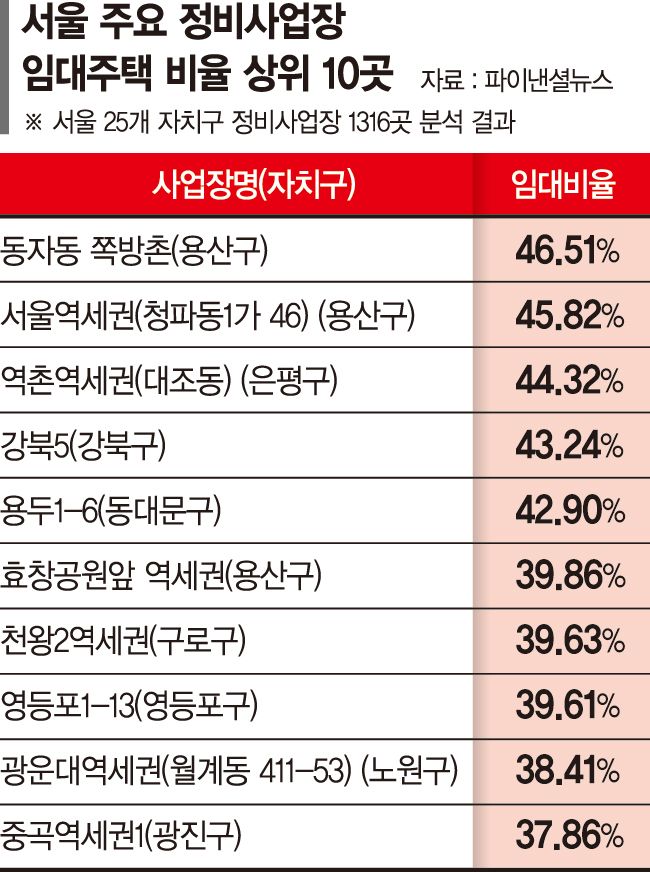
An analysis by Financial News on the 2nd of 1,316 redevelopment sites across Seoul’s 25 autonomous districts found that rental housing accounted for an average of 18.08% at the 369 sites for which plans for total supply and rental housing were confirmed. Of the 529,949 homes planned in total, 95,797 were rental units.
At five sites, the share of rental housing exceeded 40%. In other words, nearly one in every two homes being supplied was a rental unit.
The project with the highest share was the redevelopment of the single-room housing village in Dongja-dong, Yongsan District. Of the 2,150 homes planned in total, 1,000 were rental units, bringing the share to 46.51%. Nearby, the Seoul Station area in Yongsan District (46 Cheongpa-dong 1-ga) also had 334 rental units planned out of 729 homes, a share of 45.82%.
At the Yeokchon Station area in Daejo-dong, Eunpyeong District, 577 of the 1,302 homes planned were rental units, a share of 44.32%. In Gangbuk District’s Gangbuk 5 Zone, 294 of the 680 homes planned were rental units, for a share of 43.24%.
The rental housing share also topped 40% in Dongdaemun District’s Yongdu 1-6 Zone. Of the 958 homes planned in total, 411 were rental units, accounting for 42.90%.
Some sites were also found to have rental housing shares close to 40%. At the Hyochang Park Station area in Yongsan District, 1,193 of the 2,993 homes planned were rental units, a share of 39.86%. The figures were 39.63% for the Cheonwang 2 Station area in Guro District and 39.61% for Yeongdeungpo 1-13 Zone in Yeongdeungpo District.
Rental housing shares also varied by district. When total supply and rental housing plans at the surveyed sites were added up by district, Yongsan District had the highest share, at 23.12%. It was followed by Yeongdeungpo District at 22.33%, Eunpyeong District at 22.32%, Dongdaemun District at 21.18%, and Jungnang-gu at 20.98%. Yongsan District’s overall share was high because it included several sites with large rental housing shares, including the Dongja-dong single-room housing village, the Seoul Station area, and the Hyochang Park Station area. Yeongdeungpo and Eunpyeong districts also had rental housing shares above 22% at the surveyed sites, exceeding the Seoul-wide average of 18.08%.
Those in the redevelopment industry point out that a higher share of rental housing can make it harder to secure project revenue through sales to the general public. They argue that, particularly as rising construction costs increase the burden on redevelopment associations, the obligation to supply rental housing has emerged as a key factor affecting the financial viability of redevelopment projects.
[email protected] Choi A-young Reporter