“What’s the point of raising the floor-area ratio?” ... Mandatory rental quotas leave project viability unchanged [‘Supply at all costs’ hamstrung by rental obligations]
- Input
- 2026-11-02 18:27:52
- Updated
- 2026-11-02 18:27:52
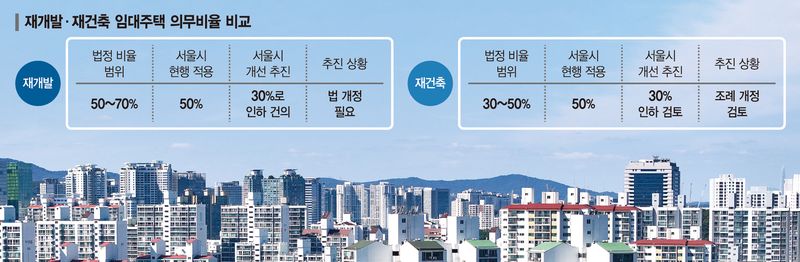
According to Seoul Metropolitan Government and industry sources on the 2nd, the mandatory rental-housing quota for redevelopment projects in Seoul is currently 50% of the increase in floor-area ratio. The quota for redevelopment projects can be set by ordinance at between 50% and 70% of the increase. Seoul Metropolitan Government has set it at 50%.
By a simple calculation, if the existing floor-area ratio rises from 250% to 300%, the increase is 50 percentage points. Half of that—25 percentage points’ worth of gross floor area—must be allocated to public housing.
Critics say that even if a higher floor-area ratio increases the number of homes supplied, the revenue that can be generated through sales to the general market remains limited. This is because a significant portion of the additional gross floor area must be supplied as public housing, while the association has to bear the construction costs of the additional building work. The failure of public-sector purchases of rental housing to adequately reflect actual construction costs is also cited as a factor undermining project viability.
In 2024, the government raised the purchase price for rental housing in redevelopment projects from the previous standard construction cost to around 80% of the basic construction cost. At the time, this was about 1.4 times the previous purchase price.
However, the construction industry says the gap between purchase prices and actual construction costs persists despite the increase. The standard construction cost used to calculate construction costs for public rental housing has been frozen for more than three years, since February 2023.
The urban-renewal sector sees limits to how much project viability can be improved by relaxing floor-area-ratio rules alone. The economic burden on associations from supplying rental housing is growing, it says.
An urban-renewal industry source said, “With housing prices and construction costs in Seoul rising sharply recently, the gap has widened between the revenue that could be earned by selling rental housing on the general market and the public purchase price.” The source added, “Taking opportunity costs and other factors into account, the association’s actual burden per rental unit is close to 300 million won.”
Questions have also been raised about whether the obligations to supply rental housing are equitable between redevelopment and reconstruction. Under the Act on the Improvement of Urban Areas and Residential Environments (the Urban Renewal Act), reconstruction projects must supply public housing equivalent to 30%–50% of the increase in floor-area ratio. Seoul Metropolitan Government is currently considering lowering the mandatory rental-housing quota for reconstruction to around 30%.
Unlike reconstruction, however, redevelopment projects are subject to a minimum quota of 50% set by the higher-level Urban Renewal Act, making it impossible to ease the rental-housing quota through an ordinance amendment alone.
If the mandatory rental-housing quota is lowered from 50% to 30%, the gross floor area available for the association to use increases accordingly. Assuming a project where the floor-area ratio rises from 250% to 300%, the share allocated to public housing would fall from 25 percentage points to 15 percentage points. In effect, this would secure an additional 10 percentage points’ worth of gross floor area.
The industry expects that using this additional area to increase the number of homes sold on the general market would help improve project returns and reduce members’ additional contributions.
In June, Seoul Metropolitan Government asked the government to amend the law to raise the statutory maximum floor-area ratio for private-sector urban-renewal projects to as much as 1.2 times its current level and lower the mandatory rental-housing quota for redevelopment to 30%, the level for reconstruction. However, the government’s housing supply measures announced in August did not include adjustments to mandatory rental-housing quotas or higher floor-area ratios for private-sector urban-renewal projects.
Experts say it is more important to expand the floor-area ratio that associations can actually use than simply to raise the statutory maximum. They say that easing mandatory rental-housing quotas must go hand in hand with bringing purchase prices in line with current costs.
Ko Jun-seok, a professor at Yonsei University’s Sangnam Institute of Management, said, “Redevelopment projects face a heavy burden from supplying rental housing and making public contributions.” He added, “With rising construction costs compounding the problem, they are struggling to move projects forward.”
[email protected] Choi A-young Reporter