Next year’s national subsidy budget to top 145 trillion won; surcharge for fraudulent claims to rise to eight times
- Input
- 2026-11-02 18:18:09
- Updated
- 2026-11-02 18:18:09
According to the Ministry of Planning and Budget on the 2nd, next year’s national subsidy budget has been set at 145.1 trillion won under the government’s proposal. This is an all-time high, up 18.7 trillion won from this year’s 126.4 trillion won. The national subsidy budget has grown every year, rising from 102.3 trillion won in 2023 to 109.1 trillion won in 2024 and 112.3 trillion won last year.
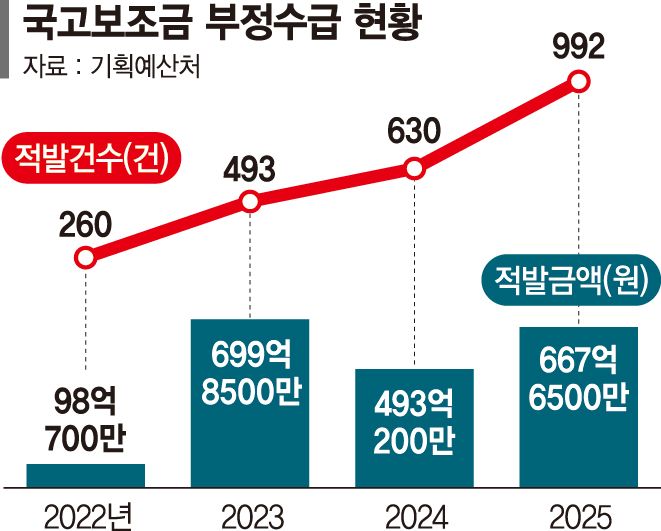
As the national subsidy budget has steadily grown, cases of fraudulent receipt have also continued to arise. The number of cases detected was 260 in 2022, 493 in 2023, 630 in 2024 and 992 in 2025. The amount detected has also continued to rise, reaching 66.765 billion won last year.
As cases of fraudulent receipt continued, the Ministry of Planning and Budget conducted large-scale, nationwide on-site inspections of projects suspected of involving fraudulent receipt. Beginning last April, the inspections covered a record-high total of 13,240 subsidy-funded projects and concluded at the end of last month.
Based on the inspections, the ministry plans to pursue thorough follow-up measures for projects found to involve fraudulent receipt, including determining whether fraud occurred and what sanctions to impose, through deliberations and resolutions by the Subcommittee on Fraudulent Receipt Reviews and the fraudulent receipt review committees at each ministry. The inspection results are expected early next year.
Legislation to strengthen the system for detecting fraudulent receipt is also under way in the National Assembly. In this connection, Kim Young-hwan, a lawmaker from the Democratic Party of Korea, has submitted a bill to amend the Act on the Management of Subsidies.
The bill to amend the Act on the Management of Subsidies would establish a definition of fraudulent receipt of subsidies and strengthen the system for detecting it.
The bill sets out provisions on monitoring, inspections, on-site investigations and follow-up measures related to fraudulent receipt, and establishes the authority to require operators of subsidy-funded projects and others to submit materials, file reports and provide statements of opinion during on-site investigations. It also adds the reporting and acceptance of reports of fraudulent receipt of subsidies or indirect subsidies to the online services available through the public portal.
Most notably, the bill puts the Ministry of Planning and Budget in the lead in determining whether fraudulent receipt occurred and the scope of sanctions. Currently, after fraudulent receipt of national subsidies is detected, each ministry’s review committee determines whether fraud occurred and the level of sanctions. In practice, however, strict sanctions are difficult to impose because officials may fear being reprimanded over management responsibility or because of lenient practices.
To enable objective and impartial consideration of effective follow-up measures for projects found to involve fraudulent receipt, the bill establishes a Specialized Committee on Fraudulent Receipt Reviews under the Ministry of Planning and Budget’s Subsidy Management Committee. It also sets out the specialized committee’s matters for review and its authority to require relevant parties to attend and to request materials.
Under the bill, the Ministry of Planning and Budget would directly review cases involving 10 million won or more in fraudulent receipt, then place them before the Subsidy Management Committee and request administrative action from the relevant ministry. Each ministry’s fraudulent receipt review committee would handle cases involving less than 10 million won, while the Ministry of Planning and Budget could periodically review whether the ministries’ actions were appropriate and, if necessary, request corrective measures.
The bill also enables the Subsidy Management Committee to serve as a control tower for managing fraudulent receipt. It adds the Specialized Committee on Fraudulent Receipt Reviews’ findings to the matters considered by the Subsidy Management Committee, and also covers notification of review results by the Minister of Planning and Budget, follow-up measures by the heads of central administrative agencies, and requests for disciplinary action against relevant public officials.
Provisions intended to curb the temptation to commit subsidy fraud are also noteworthy. The bill sharply raises the surcharge for fraudulent receipt to a level similar to penalties for stock price manipulation, increasing the current maximum surcharge from five times the total amount fraudulently received to eight times.
[email protected] Seo Young-jun, Lee Hae-ram Reporter